Make Anxiety Work FOR You | Arash Javanbakht on Fear
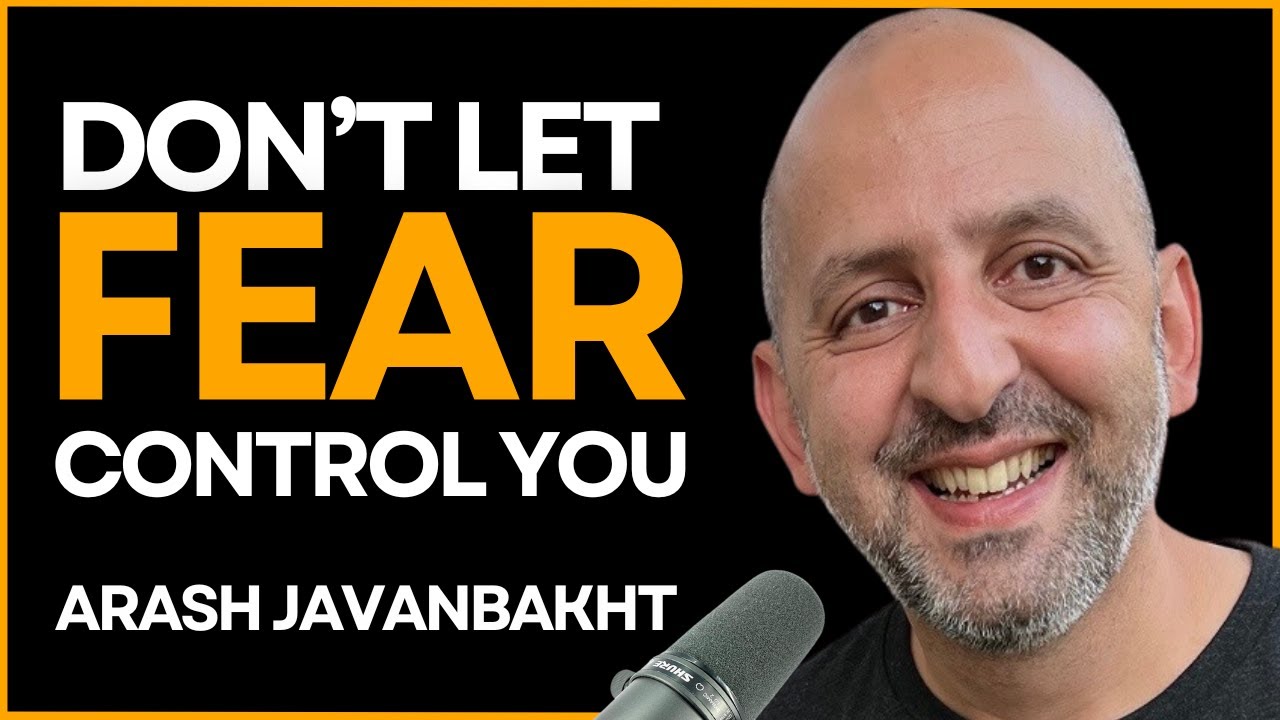
In this hour‑long podcast episode, neuroscientist and clinician Arash Javanbakht discusses the evolutionary purpose of fear and anxiety, how they can be harnessed as tools rather than merely obstacles, and practical ways to work with them. He shares personal exposure‑therapy anecdotes—from a forced mule ride down the Grand Canyon to flying a fighter jet despite a fear of heights—illustrating how confronting danger can diminish anxiety. The conversation expands to the science of fear circuitry, the role of knowledge, control, and meaning in modulating responses, and the distinction between genuine threat and learned or abstract fears. Javanbakht describes a novel augmented‑reality headset his lab built to deliver safe, graded exposure to phobias (e.g., virtual dogs for dog‑phobia) and its potential for public‑speaking training. The hosts explore how anxiety can serve as a motivational signal, the concept of bravery as action rather than a trait, and how meaning, cultural context, and personal values shape fear responses. They also discuss mortality, drawing on Javanbakht’s experience of his father’s death and how acceptance of death can refocus priorities. Practical advice is offered for entrepreneurs, creatives, and anyone facing fear of failure, including mindset framing, reminder systems, and leveraging anxiety for drive. The episode concludes with book recommendations (Rumi, Adult Children of Emotionally Mature Parents), a final piece of advice—“life is too short, don’t be afraid”—and information on where to find Javanbakht’s book Afraid: Understanding the Purpose of Fear and Harnessing the Power of Anxiety and his online presence.
Chapters
Fear and anxiety has been basically my career. To understand fear, we gotta understand its evolutionary purpose. What is the purpose of it? There are several ways anxiety can help us. Number one is that every time I avoid, I basically create the idea that it is dangerous because my brain for some reason has decided this is dangerous and says you should avoid. I avoid it, nothing bad happens. My brain is like, okay, you see, this is dangerous and if you avoid it, so you will be safe. As long as you're human, You have all the human emotions, including fear and anxiety. Never avoid. We always say in the clinic, fear is a bully. You gotta bully the bully. But my fear system is there as my one— its intention is to be my best friend. This will blow your mind.
Arash, welcome to the Book Thinkers Life-Changing Books Podcast. I'm so excited to have you here today. It's gonna be a fun chat. I'd love to kick off this episode with talking about the COVID of your book depicting your fear of heights and with going back to June 14th, 2022, where you ended up doing barrel rolls in an L-39 Albatross jet. Can you tell us about that experience and how you got yourself to do that even though you had the fear of heights and talk about why it was important for you to put that fear on the front of your book?
Thank you so much first for having me on, and I appreciate actually the start. It's very exciting. So I was, I was having a conversation with, with another neuroscientist yesterday. And we were talking about that, what excites us, we have some of it in us. And fear and anxiety has been basically my career and trauma. And of course, you have some acquaintance with it, and when you have it, you can understand it better than others. So, as you said, I start the intro of the book with an episode of my childhood when I climb up the ladder thinking that it's easy, which was easy. But then coming back down, I look down and I'm terrified. That was the first time I realized I'm afraid of heights. And actually, I talk about how we face fear and how we treat it in this book. And one of the ways we address fear is exposure, right? And my exposure therapy basically happened very randomly. I didn't plan it. So I just signed up for this mule ride down the Grand Canyon, not thinking and processing that I'm afraid of heights. And these walls are deep, and if you're on a mule in the winter where it's slippery and you you just see the bottom of the canyon. So, and when I realized that fact, it was too late. I was already on the mule and we were headed down. So a few hours of exposure, and that actually was my first basically real forced exposure therapy for my fear. And after that, the fear almost went away. And since childhood, I always had this. fascination with fighter jets. And when, as you mentioned, I got the chance to fly in this fighter jet, well, you have the fear come up. But basically, as I talk in the book about the overlap between the fear circuitry and excitement and thrill circuitry in the brain, right? Well, why we love to do things that scare us sometimes. So in that sense, the thrill aspect really overcame us. And it was a, it was a fun ride on the fighter jet. It was Crushing on the body, but it was fun.
That's so amazing. I went back and watched some of those videos of you doing like the actual rolls in the jet, and literally like just watching it gave me a little bit of shakes, and I was like, like the goosebumps, you know? I was like, whoa, so, so cool. But it's really amazing to see someone like you that had this fear of heights overcome that, and not only overcome that, but like go up and fly through the sky, you know, super fast and do these barrel rolls. So it's a— it was a super inspiring thing, and that's why I kind of wanted to To kick the episode off with that. I'd love to— you know, Nick actually has some, uh, some, uh, fear of heights that he overcame with also climbing up ladders. I don't know if you want to talk about that before we keep going, Nick, but I thought that—
Yeah, sure. That's a good point. I haven't told you those stories in a while, Luke, so Luke's pulling some good stuff out today. Yeah, when I was younger, I had a fear of heights, and I started to realize that when my parents would bring us into the city of Boston and we would park in a large parking garage, like a tall parking garage, and I'd peer over the edge and my legs would start shaking and I'd get sick to my stomach and I would kind of sit in that freeze mode for a minute and then I'd run away. So, as I started to get a little bit older, you know, I enjoyed climbing trees and things like that, but never too high. I was always very cautious of where I was. Well, fast forward to my college experience. I ran my own house painting business for 2 summers.
Wow.
And so, you just talked about it. You can address fear through exposure, and you can become desensitized over time. And that same fear that I would experience climbing a ladder and looking down eventually became a thrill, and it would bring excitement instead of anxiety, which is a very thin line, as I understand. So, we could talk about that a little bit throughout the podcast today, but I've had plenty of experiences in my life where I was able to address fear and anxiety through exposure, and I think that's a really cool lesson.
Yeah, and that's, uh, I mean, the title of the book is Afraid: Understanding the Purpose of Fear and Harnessing the Power of Anxiety. That's where you're doing the harnessing power of the power of anxiety part, right? And, and it's like it did— it speaks into so many variables that are involved in basically being defeated by or managing the fear, including here the motivation you had, right? If it's, uh, for me, it's a leisure thing to overcome a fear versus this is now my career, this is my work for some time, then it's a different story and I have to face it. And in parallel to your example, my own example, if I'm an anxiety and fear expert, I have to start preaching what I practice. So probably that was another motivator for me trying to face my own fears as well.
Yeah, well, I'll transition to a quote from the introduction that I'd like to read because most people today, they, they are experiencing fear and anxiety. And you say in the introduction that about a third of the world's population suffers from an anxiety disorder. And half of Americans have had at least one traumatic experience like rape, assault, shooting, or natural disaster. And I mean, you can't even go 2 minutes on TV on a news station without experiencing a little bit of fear and anxiety yourself based on everything that they're talking about. So fear is as old as life, we all experience it on a regular basis. Why do you say that it's as old as life?
So because, uh, so, and, and I always say, to understand fear, we got to understand this evolutionary purpose. What is the purpose of it? Because in the modern-day life, it usually is seen as just an annoyance, as a bother, as a false signal, as something that is wrong. But in reality, it is impossible for such a deeply rooted function in us to just be a mistake. It has an evolutionary purpose. It evolved throughout the history of life to protect the organisms because your most basic need as a life is to exist. If you don't exist, you're not alive. So, and this system is— it has evolved. Let's say this, the simplest form is you reach out. And actually, Eric Kandel, who got a Nobel Prize in neuroscience, was studying snails and how they shrink their basically antennas when you reach to them. And that's a very simple fear response. And this has evolved through other animals. Let's say for a rat or a mouse, they just run away, or they freeze, and gradually evolved and evolved more to us, which we also have the most simple basic animal fear responses and ways of learning fear and unlearning fear, to the point that my colleagues here are researching brains of rats and mice to understand fear circuitry in us. And then we have also existential anxieties of a human, worries about, I don't know, what happens after you die, to your reputation or to your company, to your business, or threats that humanity is facing now. So in that sense, I say fear has been— and in reality, if there has been any species that was unable, or mutations that were unable to experience fear, They do not exist now because they would go extinct.
That's, that's wild to think about. I was going to ask that, like, I was like, what about species that don't have any fear or are there any? Um, um, so that's really cool. You kind of just answered that. Why does our brain not seem to know the difference between I'm going to die and getting on stage and doing a speech?
Uh, because again, so, and there's a huge mismatch between the hardware and the software. So the hardware evolves over tens of thousands, hundreds of thousands of years. It takes that long for like one tiny mutation to change. But just look over, and the hardware was evolved to basically help us survive in the context of, let's say, 50,000, 100,000 years ago life of humans. In that context, the dangers to your existence or to your integrity were what? There were natural disasters, a rock falling on your head. a predator attacking you, or one of your tribemates, so another human wants to kill you or assault you or rape you or take away your food from you. So in all these conditions, you needed a fight and flight response. You needed to either run away or attack, and logical problem solving was less engaged. And I always say that caveman, cavewoman is inside of our heads. So the same way when I'm dreaming, I'm passively watching what's happening, what is— that is created by the unconscious brain. Imagine right now you and I are talking to each other, and that person, that part of us that creates the dreams, is now dreaming while we are awake but still reacts to what's going on around us. That caveman inside of me is confused in this modern life. So the hardware took so long, but the software over the past even 200 years, how much the real threats of our lives have changed. So now I'm giving you about, let's say that again, going 50,000 years ago, If I was talking to a group of my tribe mates, if they didn't like me, chances were high in a matter of minutes one of us could be seriously injured or dead. So I needed that response. Now I'm giving this public speech and I'm worried about people's judgment and my heart is pounding in my throat and my breathing is short. It's not helping me. I'm like, why is this system so stupid? But the reality is that it's reacting in accordance to the 50,000 years ago public situation. So it's confused. And that's why we have so much false alarms with the system these days.
Now, is the only way to start to overcome these fears, is the only way to do that is exposure? I know you, we talked a little bit about that just a minute ago, but is that the only way or are there any other ways that we can start to overcome our fears that we have?
And there are so many variables too, because, because first thing is fear is a signal, right? Anxiety is a signal. The signal could be appropriate, could be inappropriate. If it is appropriate, it could be exaggerated, because we also don't want to underestimate fear. Let's say I'm in a physically abusive relationship where my health is threatened, and if I'm not scared or worried or anxious about it, I will lose. If I'm in a job that is really not fit for me, and it's not a good situation, and I'm overstressed, But I don't experience the anxiety about it, then I will not make a change. So I usually say fear or anxiety is the pin in the chair that is wrong for us, and we have to get up or get off of that chair and go to the other chair sometimes. But sometimes, as you said, these are the fears which are the confusions or exaggerations or learned fears. Sometimes I learn from others. Let's say there is a— if a bear is attacking you and I, we both will have the same reaction. We both will probably run away, and we both will be relatively similarly scared. But how scary should be an interview with my superior? How scary is a low grade on an exam? For you and I, it's very different because this is an abstract form of threat that we learn from others and our own past experiences and environment how to gauge it, the level of danger. If my dad looked always terrified when I had an exam, I've registered that not doing great on an evaluation is a terrible thing, and that's an unconscious level. Then there are other aspects which are like how much sense of control you have over it, right? How you can gauge that sense of control and skills. If I'm dealing with a robbery versus a Navy SEAL dealing with that robbery, the robber is the same, but we are experiencing different levels of anxiety because that other person has more training and more skills and a better sense of control. So there are these other aspects, including knowledge. that can help us overcome fear. Let's say I have panic attacks and I'm worried that I'm, I'm about to die and this is something life-threatening. But then I meet and I learn about it and I learn they are very annoying, but they are not at all dangerous. That knowledge can help in control. So basically engaging different aspects of our mental and brain functioning. As you said, when, when we do exposure, it's more primitive parts of the brain which learn only through experience. Then there's the cognitive parts of brain that learn through knowledge. We actually even learn from each other how to be scared of things. Again, that has an evolutionary advantage to us. If 50,000 years ago our tribe mates— it would be stupid for us, all the tribe members, to go to that part of the woods and be bitten by the bear. So our tribe mates told us avoid that, and we avoid it. So we can learn also safety from others. That's how parts of the therapies work. We don't just throw a person with a dog in a room and close the door and say, okay, exposure therapy is going to happen, right? I am there as a clinician. And then there are, there, there are times that we can even use anxiety to our own advantage, basically because it has energy and it motivates.
So for some of these more abstract forms of fear, are there universal practices that people can go through to feel a better sense of control? Let's just say, public speaking or getting a bad grade on a test, like the outcome, what that means to us might be different, but are there certain things that everybody can do to kind of maybe improve the space between an input to their brain and their reaction and operate from a place of more logic instead of emotion?
Oh, very good points and questions. And you already mentioned there's an emotional and logical aspect to it, right? There's emotion, there's thoughts, and there's also the attention, and they all interact with each other. If I'm anxious, too anxious, all my attention is towards what could be perceived as negative or a sign of threat. And then I start acting accordingly, and my environment starts reacting accordingly, proving that I'm in a dangerous situation, right? I may get into, like, an awkward conversation with my boss because I'm perceiving everything as a threat, everything they say as something, a sign that they think I'm not doing great. Let's say I'm having that conversation or evaluation. So, the part— a part is never avoid. We always say in clinic, fear is a bully. You got to bully the bully. Of course, it's easier said than done, right? It's if you're terrified of heights, it's not easy to go do the Grand Canyon ride, which I would not do if I had thought this through before. So, you got to level it up gradually, step by step, go up the ladder, right? What matters is not to avoid, because every time I avoid, I basically create the idea that it is dangerous because my brain for some reason has decided this is dangerous and says you should avoid. I avoid it, nothing bad happens. My brain is like, okay, you see, this is dangerous, and if you avoid it, so you will be safe. So you got to prove that conception wrong. That applies to the dangers that I logically know are not dangerous, right? I'm afraid of a pet dog because I had a bad experience with dogs before. And now I'm avoiding them. And actually, the animal brain is so dumb in these senses that you can— we are using right now, actually, this is an invention in our lab. We are using these technologies. I wear these goggles and you see my eyes. So these are augmented realities, and I will place virtual dogs in your environment. And these dogs walk around and bark, and people's brains react exactly— those who are dog-phobic react exactly to these virtual dogs as if this is a real dog. And it treats them. After 1 hour, they go pet a real dog. So that's when it is like the animal brain, and you logically know. But there are parts, times that logically it's hard to assess that, right? How bad, or how horrifying, or how much should I be anxious about this evaluation that I have, or this exam I have, or the job situation I have? That part— One part is that if you're an anxious person, You have an estimate of how much you overshoot for danger usually, right? So you can go back and say, oh, past times, because anticipatory anxiety is usually worse than the real thing. And you're like, okay, in the past, I know logically I overshoot 30, 40%. So a lot of times you can use that to bring up the cognitive aspects of brain and reduce the emotional intensity of the thoughts, of the, of the emotions and fear, of fear and anxiety. Other ways are like to gauge it with others. Because we learn from each other. We learn also safety. It's the— besides the words, when I see my friend is this much more relaxed than I am about this, and I talked with my friend and the other one, then I gradually learned that, well, it may not be as terrifying as I think. Because let's say I learned from my mom or dad or this other person, or my own tough experiences, that this is tough. But now when I open up to others, I learn more and more. Of course, when I learn more, I also gain more skills and I feel more confident about being able to do it. And these are just some, just a few that's within our limited time I could mention.
Yeah, I'm sure Luke is also chomping at the bit to ask a few questions here. So after this one, I'll kind of pause and maybe Luke, you can take the next few because I've been hogging it. But I wanted to detail to you an experience that I had recently as far as public speaking is concerned. We hosted our very first event. We had about 50 of our author clients and podcast partners in the room. And traditionally, I've had a lot of social anxiety, a fear of public speaking. And when I got up on stage to do the opening keynote, I did feel a lot of that anxiety. I think the anticipatory anxiety was worse, but I felt a little bit of it on stage. As the day continued to progress, I felt less and less through that exposure. And by the end of the day, I was interviewing some of our authors on stage, hosting Q&As. And I was as cool as ice, right? My hands were as still as a surgeon's. And so all that anxiety went away. And I think that, yeah, that continued exposure is pretty cool. Now I'm wondering, with your device, can you have somebody on stage presenting in front of a fake audience and over time that anxiety would go away?
This will blow your mind because we are the only ones in the world who have done this. I just tested that. This headset is here because I just tested that. newest build. We are working with this group of programmers who have worked with Disney and Marvel. So I have a gradually scaling up gathering here. People of diverse sex, race, age, body type, body size, outfit, background standing here. They walk in and it's— you're in the real room. It's not VR that you're sitting here and you're in the virtual room. No, you're wearing— it's like wearing sunglasses. I can walk around and these characters walking through the door, and interact with each other and interact with myself. And then I can put any character I want in front of you and have a conversation with you through that character. And this— and we have been using it for the same purpose, like we're using it for PTSD, post-traumatic stress disorder, which is my expertise. And there are a lot of these people who, because of their trauma, brain is in constant threat detection mode. They don't want to be around people. So we are doing this and you First of all, these things are so realistic and they are 3D in there and emerge with the reality that after so many years, I'm the inventor of this technology. I still walk around these characters. I don't walk through them. They feel that real. But the patients, we have treated a few people. We just started use recently. And like, I have this person in the corner of the room like this, terrified of these characters. And gradually, gradually, gradually, it applies to real world. So yes, we have the answer there.
That is— yeah, I can imagine some people would pay big money to remove their anxiety of public speaking and interacting with other people in anticipation of an event. That is amazing. And that's so cool. All right, I'll— I'm excited about it. Luke, let's hand the baton over to you.
No, it's, it's all right, Nick. Um, you can keep asking your questions, man. I, I love this topic because as someone who has struggled with anxiety throughout my life in a big way, and it's kept me from doing a lot of things. Thankfully, I'm in a much better place now. Still have a lot of improvements to do. This conversation is just so interesting and fun for me. I'm thinking about my fear of what others think, my fear of spiders. I'm like, how can we, and, you know, use this augmented reality to help with those things? Because that is just such an amazing technology. And I've been wondering why someone out there hasn't been building something like that, but it seems like you have, which is Mind-blowing. So cool. So I want to just, maybe we can turn around a little bit. And you mentioned earlier that we can use the energy of anxiety to our advantage. So I'm wondering how we can do that.
So there are, there are several ways anxiety can help us. Number one is that, again, anxiety is a signal that something might be wrong. And a lot of times those signals come from the subconscious, or less like basically automatic brain, whatever language you want to use about it. Basically the mind that learns through experience and has basically piled up a ton of patterns. You just sometimes, we say, call it quote unquote gut feeling. And sometimes you have that gut feeling the first time you meet someone and you get engaged in a relationship with them, work or romantic. And after 6 months, you're like, wow. That was the gut feeling. So that can be a sign that helps us. Of course, that gut feeling a lot of times could be wrong, right? So we gradually learn about ourselves, how much I can trust my intuitions and fears and anxiety. So we assess the fear and see how relatable and how reasonable it is. And so it's basically my fear. We see it as an enemy, but my fear system is there as my one— its intention is to be my best friend. But it just a lot of times goes wrong because of, number one, the confusions I talked about, but also past experiences, what we have taught to be, what we have learned from the others, which has been based on their own mistakes and their own adverse experiences. Then the other part is that we need some level of anxiety and fear to be motivated. If I was not a little bit nervous about this conversation, I would probably miss out on some different— some little details about how I dress up or how I talk, or I wouldn't probably be as motivated for the conversation. Same for exams. If in anticipation of your exam you are very, very chill, you sleep more than study. But if you're also terrified, then the fear brain, the amygdala, will bypass the frontal cortex, the logical brain, and you will not be able to even learn because memory is impaired, attention is impaired. So we need that optimal level of arousal. to be able to basically perform at our best. And we can actually utilize that fear by basically stirring that fear to motivate ourselves. We can stir it up, remind ourselves the same way we remind ourselves of the positive consequences, and in areas that we need the motivation, remind ourselves of what we may lose, and that will give us the motivation to use it. And of course, There's a whole industry of using fear for fun, right? Fear and anxiety. We, we use it to enjoy, and we can talk about that later. And then there is a fear that tells us about others, because we are very social animals, and we interact with others, and there are a lot of bullies out there. So those kind of experiences, those kind of when interacting with others triggers anxiety and fear. It can tell us about how other people are dealing with us and interacting with us and using even a lot of, uh, less conscious, uh, skills of interacting with others. And if a person is using fear against us, how we can utilize it to basically reverse the, reverse the force.
So fascinating. And are there any key differences between— brave might be the wrong word, but Is there any key differences between the brains of people that seem to be really brave and, you know, face fears constantly versus someone who is more fearful?
So, so, so there's a chapter in the book about bravery, right? And that was one of the most time-consuming chapters for me to write because like the parts about evolution, brain, body diseases, how we treat them, politics, media, I'd written and worked a lot on those and it was easier. But this one, Because, I mean, the first question is, what is bravery? What is a brave action? Because we don't have necessarily brave people. We have brave actions that determine someone is called brave, and those are what we see from outside, right? We'd never know. We are not inside the mind of a person who's considered brave. Of course, biologically, you can say some brains are less, and we know that. We know genetically, biologically, some people are less or more prone to feeling fear or being more or less anxious in the same situations. We even look at brain imaging studies, and we can, we can notice that in the brain reactions. You and I could be put in a scanner, they show us a face of an angry person, we will have different brain amygdala responses. But then besides that, there are other, many other factors. Examples I use, one is skills, right? A sense of control. If I'm a police officer dealing with a robber, and if I am not a police officer dealing with a robber, I will have a different fear reaction, right? Based on the amount of training I've had and sense of control I have.
have.
If I— and then there's the knowledge that I have. There's a snake in front of me, I freak out. And but you know more about snakes, if they're poisonous and/or non-venomous, and you know this one is not poisonous and you go ahead and touch it. You just had some different knowledge. Sometimes, sometimes it's stupidity. Sometimes it's like I have underestimated the danger and I just jump in it and everybody else thinks I'm a very brave person. But the challenge was that I didn't Get it right, but I was lucky and I survived it. And then there are a lot of other aspects like the meaning of that experience. I've had— the example I often use is that I had a police officer whose partner was shot in front of her. Partner was shot in the neck, and she was sitting there with her hand under her partner's neck to stop the bleeding. And the person who was shooting at them was coming with the rifle and kept shooting. And I asked her— Weren't you worried about your own life at that moment? The answer was, I was not thinking about my life. So when you are in it, a lot of times your attention is elsewhere. At that moment, the only thing she was thinking was how to save her partner. There's also changes in our biology based on the meaning of life, like a mother whose children are in danger could be very different than a person, someone else who sees other children in danger, right? And And it's not just humans, animals, like with rats and mice, their usual response to danger is run away or freeze. But when rats have pups, because if you run away, the cat will eat the pups, they become more aggressive. And then sometimes you have to choose between— there's the cultural meaning. We have a whole chapter in the book about fear and meaning, right? And how the meaning you have created for it. If you are, let's say, Ukrainian soldier trying to protect your country, your perception of the danger in front of you is different than the Russian soldier who may think that I'm the oppressor here and I'm the aggressor, I'm the occupying force doing this for the wrong reason. Sometimes there's 2 fears that you put aside next to each other and choose one of them over the other. Example, if you don't do this thing that you're afraid of, your society will judge you for the rest of your life. So now you have 2 abstract fears in front of you and you choose the lesser one. So there are so many variables that determine a brave action that I got more confused myself when I was studying it than to have a clear, definite answer.
Yeah, there's that example of, you know, would you walk a plank between 2 buildings for $20? No. But would you walk a plank between 2 buildings if your child was on the other side and that building was burning? Yes. So, you know, it's situational awareness, I think, sometimes. And I've got a different type of question for you. I was thinking a little bit about our audience as you were discussing this. Our audience, a lot of young professionals, solopreneurs, maybe people with a side hustle looking to grow a business, maybe even looking to start a business. And so for those aspiring entrepreneurs, there's a lot of fear. In starting a business. Sometimes I think it's fear of judgment from friends and family. Sometimes it's fear of failure. What advice do you have for people so they can get over that fear, manage that anxiety, and take a little bit more action?
That gets me to the chapter on fear and creativity, because those— these people you're talking about are the people who want to blaze a trail, create something new, get out of the average norm of what they are familiar with or the environment is familiar with, right? Example, with this augmented reality technology, we are the only ones who are doing in the world. So we had to figure out a lot of things, right? So these kind of people have to find out a lot of things and do things that have— may, might have a higher chance of failure. So if you know that, if you set your mind, because then it's different. Another parallel I can make here is that dating world, right? Most people are terrified of going on a date and failing and it not working, right? But the reality is that majority of people out there are not a good match for you. So logically, every time you go out on a date, your chances of failure logically are much higher than chance of success. So if you succeed, it's an exception. And if you have that mindset, when you go to a date and you go on a date, you will be much less disappointed if there's failure. So knowing the fact that I'm in a path that is different, it's not the normal regular day-to-day path of other people. But then there's a ton of excitement possibly attached. And then before I get to the exciting part, there's also how environment judges you, right? Because the tribe usually wants to keep you within the norms of the tribe, because for the tribe, the major— the top priority is coherence and integrity of the tribe. So if you're an outlier, the tribe will not like it. Same has happened to a lot of artists and scientists and creative people who even at their time were not appreciated. I'm not saying that any terrible job should be appreciated as something different, but knowing why the resistances happen inside of us and outside of us is some factor that can help right now. I know what is happening at the knowledge of what's happening in me and is triggered inside me by the outside world helps. But then there's the motivation part, right? You were talking earlier about like the passing from this building to the other one for $20, for saving your kid. I have a third option. There's $1 million money on the other side. Chances are higher you will take the challenge than when there's $20. So, reminding ourselves of what is there and what I'm fighting for. So I even sometimes write that I have sticky notes on my computer because I'm in a very tough career also with the research, with the grants that are accepted 5%, especially with highly— 5% chance, especially with this highly innovative work we are doing. So I keep reminding myself, and sometimes those reminders could be things you have from the past. You have the successes that you have had from the past. You have even a recommendation letter a mentor wrote for you that tells you who you are. And when you are shaky a little bit, you can go back to that letter and it reminds you who you really are. Because we— and because we get inside of our own head a lot of times, right? And we get terrified and we get— or I'm in the midst of the storm, in the midst of the, uh, what's the word, the clouds and the dust, and I cannot see well sometimes. stepping outside or looking at someone or getting feedback from someone outside who sees us and the dust can help.
I'm loving all this information. Thank you so much. I, uh, I think we should maybe like we can pivot a little bit and talk about some— a lot of people's biggest fear, which is death. And I'd like to talk about that for a couple reasons. One, um, I grew up in a very conservative Christian home who believed in heaven and hell and The picture of death that I have is extremely, like, terrifying. So that's something that I've realized that I've struggled with throughout my life, and it's a fear that has held me back from doing specific things. Um, your dad passed away in 2018, I think November, and, um, you had mentioned that he— in some posts that I saw, you had mentioned that he didn't fear death. And I would just love to maybe tell a little bit about your dad and the impact he had on your life and your relationship to death and what your experience and thoughts are on it in general.
2 hours time. So, so my dad was an extremely active person at the age of 65 when he retired a couple of years later, he was invited to found the university in his hometown, and he took on the task and he did it. I think one reason he was not afraid of death was that he lived his life. There's a quote from Mr. Nobody, the movie that I so much love, which says, I'm not afraid of dying. I'm afraid I haven't been alive enough. So, I think if you go to the amusement park and really enjoy every single ride, when the time comes to leave the park, you will be more comfortable. But if you're sitting in a corner of the park terrified that you have not ridden all of them, it will be harder to leave the park. But there's realities. We are— we want to remain, we want to continue on, and we have created a lot of stories to help us feel safe. We have created a lot of myths. I mean, and for the length of humanity, right? Egyptians had the mummy themselves, mummified themselves, and had the pyramids and everything with the hope that after death they will continue on. We want to. And I don't say I'm religious or not really. I'm more on the spiritual side. So for religious people, for some of them, is actually easier because you have a clear story. And because if you're religious, you're a good person, you will go to heaven and you will continue on. But for some people, it's more difficult, and you have to define it for each person within their own worldview and ideology. Like when I talk to a religious person about their anxieties, we have to define it within their worldview, not my worldview, because who am I to tell you or the other person if they are right or wrong? Because each of us could be right or wrong. So I'm very— a lot more humble than most scientists about this aspect of life. But my personal life was when my dad passed away, and that was the first time I really got in touch with death because before that, death was just some abstract concept. This man, this distant person died. But that's when death became real to me and I faced my own mortality because now I'm next in line. And in that sense, I think what the way it impacted me was that, okay, now I know my minutes are limited. What am I going to do with these minutes? So first step is to accept the fact that I'm going to die because just don't run away from it. Exposure therapy, accept it. When you accept it, then okay, now what am I going to do with these limited hours I have? What changed in my life was that I decided what matters to me is the impact, impact of what I do. Now the number of my papers and the number of, I don't know, grants and these other things that are academically important, became a 3rd and 4th and 5th priority. Now, every time I want to take on a new task, including writing this book, was what is the impact? How is it gonna change? How's it gonna make other people happier or myself happier? Because my, for me, this has become the goal of life to make others happy and myself as happy and productive as possible. But then there are other ways that you can Fight your mortality or delay your mortality. One is, of course, I mean, in the most concrete way, you work out and exercise and eat well and try to not be too much terrified of death because too much anxiety has a negative impact on the brain and body. We have talked about it in the book. But then there's other ways we can continue on. I mean, one, when I train my mentees, I— part of me continues on in their minds and in their skills, and they transfer to others. Every time I treat a patient, the change I've helped in their life will continue on in themselves and in their children and those around them. The pieces I write, the pieces that we create, the things we do, this podcast we are doing may have a tiny impact in someone else's brain and mind, and that will continue on and trickle down. And that gives us a sense of continuation and continuity. A lot of people have it through their children, right? So at the end of the day, When you accept it and accept— one of the good things we talked a lot about sense of control, but it's also very helpful to get in touch with the fact that we have little control. If you accept you have little control, life is going to be much easier because now you have a more realistic and objective understanding of the world. And then the more realistic you understand it, the more it is attuned with your real self. which is the true— because you are part of this whole system, it will be easier. Of course, I'm just— I mean, it's so easy for me to talk about it. I have my own fears and anxieties, and we all have hesitations, but there are ways that I can suggest to basically become more comfortable with death.
Here, check out this form of exposure. I have Memento Mori, remember you're going to die, tattooed on my chest as a reminder not to fear death. So it's a constant thought of mine. And just like you're talking about, it helps me prioritize living my life and taking advantage of every breath, riding everything that I can in the amusement park and being in the present moment. We are getting towards the end of the podcast. Before Luke asks his final favorite question, I was curious, you just mentioned this, you still experience fear and anxiety even though You're the master. You understand it. You've written a book on the subject. So it is okay to experience fear and anxiety. We don't have to remove it from every area of our life. I'm curious, when was the last time you kind of had your heart thumping and you really felt fear?
Oh, that's a good question. I mean, so we all are humans. As long as you're human, you have all the human emotions, including fear and anxiety. And what matters is how we handle them, how we manage them, and how we act and react in their face. I mean, the book starts— my dedication of the book is to those who were afraid, but their actions were fearless. So when was the last time? The last time my heart was pounding with fear, it's hard to remember, like that kind of level of fear. It was probably Probably I should have been somewhere very high on a tall edge of a building, maybe the mule ride in the Grand Canyon. But the last time I was nervous, I'm sure it has been a couple of days ago. I'm nervous about a lot of things, nervous about this other meeting, nervous about this other interview, nervous about this other person who now might leave our team or this other person who might want to join or the bill that we are receiving. They're always facing it. It's always, it's a It's a friend that's always there, which a lot of times annoys us.
Yeah, no, it's a good point. I think a better question probably would have been, when was the last time you felt nervous anyway? But I appreciate your answer, and you're right, we're all human and we're going to have human emotions. So Luke, I'll kick it to you for the final and favorite question.
Yes.
Actually, no. Yeah, you know what? I have one more question that I want to start asking people. What is the book that you've gifted the most to other people over the last 5 years? And we have to exclude your new copy because I'm sure you've gifted out a bunch of books. But outside of your own writing, what is the book that you've gifted the most and why?
I can tell you the book that I've— I can think of a few. That's hard because I'm thinking a few books. Well, I can say I have recommended than gifted. Can I? Is it— does it count?
Yeah, that counts.
So there are 2 that I have recommended a lot. Uh, one is Rumi's, uh, book. Uh, uh, but the second one is, uh, Adult Children of Emotionally Mature Parents. Uh, basically this book talks about someone who was raised in tough, chaotic, challenging environments and how as an adult you feel it in yourself and how you can deal with those situations. Emotions and handle them and understand yourself better. And I love this book because unfortunately, as I've been researching and studying in this field, there are so many books which are not evidence-based, not science-based. They're just so random. So like, not the person who wrote it didn't even have any experience, any training in, in any of these areas, subject matters. But it's written by an expert and it, it makes a lot of sense to me. So that's the book I've, uh, Recommend, I've been recommending recently a lot.
I love that. Thanks, Nick, for remembering that question. I know we talked about it before, so I'm glad you remembered that. We'll have to start remembering that for, for the precursor to my question or vice versa or whatever. All right. So this is the final question, Arash. Thank you so much for your time. This has been amazing. I've really enjoyed this. But the final question is this, you pass away and all the information that you put out disappears. You can't, nothing, none of the courses, books, everything disappears, but you're allowed to leave the world With a single piece of advice, what would it be?
Before I say the advice, I would want to ask the audience if they read the book and liked it, leave a review on Amazon because that helps a lot for it to see, find others. But the piece is actually, I mean, just the first thing that just comes to my mind is that, which is I'm writing now when I give the book, assign the book for others. Which says, uh, life is too short. Uh, don't be afraid.
Life is too short. Don't be afraid. That's beautiful. It's a great way to end this podcast. And one more question. This is the final, final, final question is where can people go to find you? What can they do and how can they find your book and everything else?
So the book can be found on Amazon and Barnes& Noble and Roman and Littlefield, which is the publisher and other, uh, the major distributors of books. And of course, there's an electronic version, and seems like I will be narrating the audio version too. There's— I have competitors for narration, but I have a chance, it seems like. But—
Here, you can clip this. You can send this to your audiobook producer. As somebody who's read and listened to hundreds of books, it's always better when the author does it every single time.
I agree. I totally agree. What some authors are less and some are more charismatic with their voices. So, and where to find me? You can just Google my name. We have a website for my research lab. It's called starklab.org, and you can also find me on Instagram. I do. I have been posting some basically once in a while I post some educational, motivational, practical tips about anxiety and depression and how to deal with them. Arash Jamonbakh. hard to write my name. But if you find the book Afraid: Understanding the Purpose of Fear and Harnessing the Power of Anxiety, you can find my name also there.
We'll throw everything in the, in the show notes below so people can click over to it too.
More from Nick

Napoleon Hill’s “Think and Grow Rich” is a timeless classic #selfhelp #personaldevelopment

4 Books to Help You Get Better at Decision Making #selfhelpbooks #bookrecs #nonfictionbooks


Have you read this book yet? 📖: The 5AM Club by Robin Sharma #selfhelpbooks #robinsharma

Dan Sullivan on Listening to Your Customers Instead of Watching Your Competitors

5 Books That Will Boost Your Financial Intelligence #financialfreedom #nonfictionbooks

The People That Preach the Loudest About Virtue are Usually the Most Power Hungry



Books are the greatest mentors you can find #selfhelpbooks #businessbooks #successmindset

Let’s fight this toxic instant gratification culture together 📖 #selfhelpbooks #jimkwik