Manifest the Life of Your DREAMS with Tzachi Ozeri
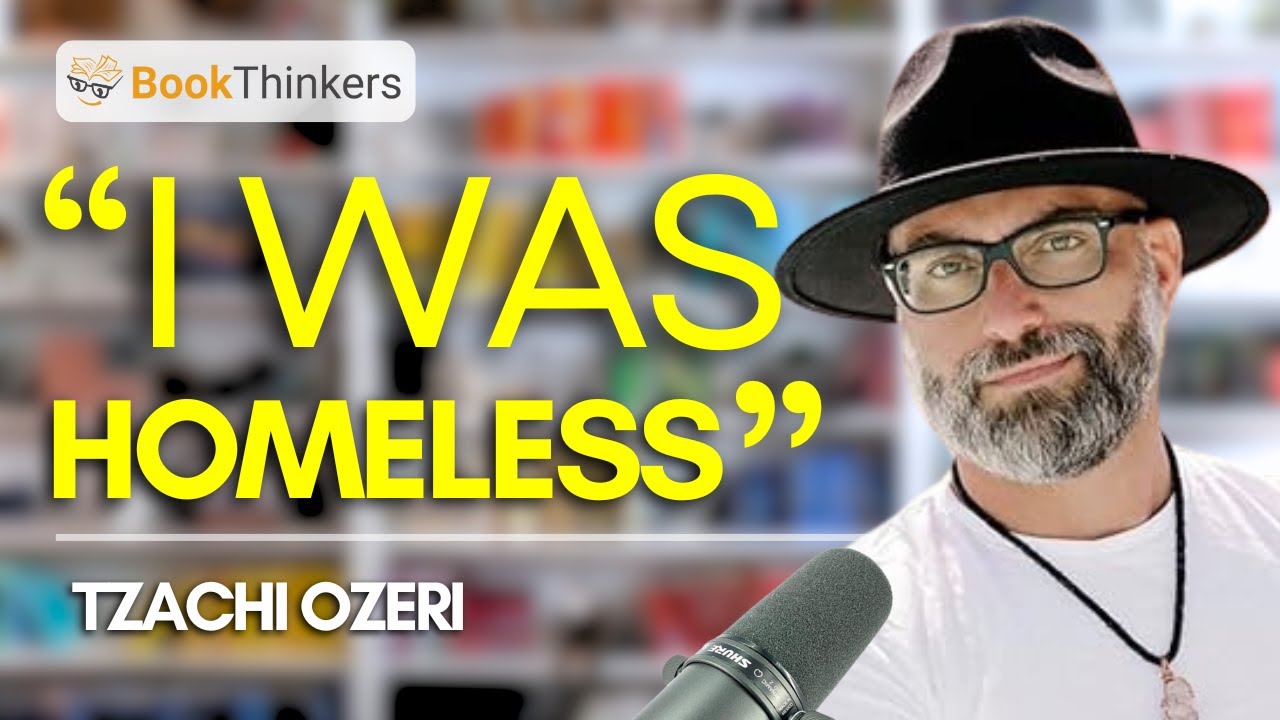
In this episode of the Book Thinkers Life‑Changing Books podcast, host Nick Hutchison interviews author and personal‑development speaker Tzachi Ozeri. The conversation weaves through Ozeri’s turbulent upbringing—growing up in Israel, moving to New York at twelve, enduring family dysfunction, addiction, abuse, and periods of homelessness—into the moment he chose personal responsibility as a turning point. Ozeri explains how taking ownership of his choices, rather than blaming others, allowed him to rebuild his life, learn English through movies and music, and eventually write two pocket‑sized self‑help books, Monk vs. Monkey Mind and FYP. He discusses the design of his books for readers with short attention spans, the “monk vs. monkey mind” metaphor, and a practical grounding technique he calls the 333 method (name three things you see, hear, and move). He cites influential reads such as Gabrielle Bernstein’s The Universe Has Your Back, Robert Kiyosaki’s Rich Dad Poor Dad, and John Maxwell’s The 3 Things for Success. The interview also touches on the sponsor, Ken Rusk, and ends with Ozeri’s core mantra: “Freedom is a choice.” The dialogue blends personal anecdotes, practical tools, and philosophical reflections aimed at listeners seeking agency, resilience, and a clearer sense of purpose.
Chapters
Because in the end of the day, you're dealing with yourself. You're not dealing with your friends, you're not dealing with your family. Your life is your life, nobody else. And one of the things about success, which I think is interesting, because I think people, when you ask them about success, they're going to tell you different goals. But I think success is all about making the right choices. So if you're successfully making the right choices, you're going to be successful. But there are some of us who successfully making the wrong choices over and over again. So success is all about learning. It's all about, okay, I did a mistake. Okay, how can I refine it? How can I change it? How can I make it better? Uh, and if you keep doing the same thing over and over again, you're successfully making the same mistake over and over again.
Z, welcome to the Book Thinkers Life-Changing Books Podcast, man. How are you feeling today?
I'm feeling great. Thank you for having me. And especially thank you for, you know, helping me be on podcasts because you, you know, you allowed me to experience podcasts and, you know, learn and enjoy it as I am today.
Yeah, well, listen, it's such a fun format because our audience is here to learn a little bit more about you as an author, get to know you, and if they like you, they'll check out your books. And I had the pleasure of reading this book this morning at a coffee shop over a couple of oat milk lattes this morning. And I was fascinated to get into your brain and see the lens through which you view the world. So before we dive into any of my questions, uh, we started talking a little bit about personal responsibility, taking responsibility when given certain circumstances in life. And let's kick off there. What are your thoughts on responsibility?
Well, it's a big thing because, um, I think if I go back to my childhood and I saw how my parents were, um, reacting to the reality or acknowledge reality. The things that matter to me in the end is my dad, who wasn't there for 20 years, decided to meet with me and take responsibility to his actions and the reason why, and share the story with me. And that is a big thing that, you know, changed my life in a way, because taking responsibility is something that we don't realize that we need to do, especially, for example, if we are in a relationship. And the relationship going south, the girl is cheating or the guy is cheating, whatever it is, if you don't take responsibility for the fact that you're staying in a relationship and not, um, you know, stepping out of it, then it's your fault. No matter what, you know, the other person was, uh, was doing, you are still there. You feel comfortable with the situation. You never left. So that's why responsibility is something that we don't do often and we should do. Because it's, it helps, it helps to move on from a lot of situations in life.
Why do you think it is in today's society that we're trending in the other direction? I'll, I'll say from my perspective, I see a lot of victim mentality out there. People who say it's not my fault, it's your fault. Whoever it is, it's your fault, right? Whether it's political or a social issue, whether it's employee versus employer, it's always somebody else's fault. Why do you think we have such a tough time taking responsibility?
It's because, um, it depends on the scenarios. Uh, and if I give you an example, if you hire somebody and he does— doing a mistake, then you blame him. What? Why? You're the person who hired him. You were supposed to do your research about this person and know what is good and what is bad. And if he does the same mistake, understand that this is his weakness. And if you don't do it, then it's your responsibility and not the other person. So I think, um, I think it's just the mindset. I think because we are not acknowledging that, uh, it's, it's a big step in order to move forward, or understanding, or creating solution, or avoiding problems, or I don't know, you name it. I think that is the big, the big reason why people don't see this as a possibility, or Acknowledging.
Yeah, me too. You know, it reminds me of the Stoic idea, the aphorism amor fati, which stands for the love of one's fate. If you view things outside of your control as neutral or positive instead of negative, then they don't have control over you, right? You view everything as positive, you take the input, and then it's your decision on how to react. You were also reminding me a little bit of Jocko Willink's idea of extreme ownership, the idea that It is your responsibility no matter what. Yeah, whether you're leading up the chain or leading down the chain, it's always your responsibility. And I love that, man. Why don't you give everybody in the audience a little bit of your background? I mean, you just touched on an example of your background, right? A relationship with your father that didn't have anything for 20 years, and then boom, he takes responsibility. But where did you come from? What's your background? What's your story?
So I originally from Israel. I moved here when I was 12. I felt like I guess Israel is too small for me in a way, and not because it's really small of the country; it's just because I felt that I can find my potential or look understand my potential. So I decided to move out of Israel and move to New York, which was a very good decision. But at the same time, I was still stuck in the same habits that my parents. um, had or still have, because my mom is still stuck in the past. My dad, although he passed away, I, I can say that he was able to see it more clear, um, and able to understand more and move on compared to my mom. But my mom is still stuck in the past till this day. Um, so I myself had— I don't think I don't know what to say, privilege, but I had, you know, the same kind of habits that they had and, you know, adapted more, which is addiction. And another, you know, addiction was sexual abuse, physical abuse, emotional abuse. I was homeless a few times, so I had a lot and I had to go through a lot until I was 38 and I decided that's it. I lost my partnership, I lost my Uh, my friends, I lost my girlfriend, and most importantly, I lost myself. So I had to make a choice. And by blaming other people, like I said, and taking responsibility was a big step in order to the right direction.
Yeah, when you blame other people, you're giving away control, and then it's hard to get out of that circumstance. So this period of time that you were homeless a couple of times, was that in New York City?
Yeah, uh, it was— well, I was homeless because my parents, because of the reality they, they built. Me and my mom and my brothers and sister, um, either staying with my grandma or some of them staying with my aunts, uh, family-wise. Um, but I also created it by myself, uh, twice, to be honest. And the second time, I actually was living in a van for a few weeks, not even for a lot. For a longer time, it has been between a van Between apartment sofas of people or apartment that people does not live at the moment, and I can stay there for a while. Or if my brother came from London to U.S. for a visit, I will stay with him with the apartment or hotel that he was renting. So I had the moment when I was homeless and needed to figure it out. And the reason why I lost my friends is because I had um. I had a skill, but I knew if I go with that skill, I might lose my friend because my friend taught me that skill, which is construction. And I had to make a decision. Do I keep, um, going back to the same company who doesn't value me, who doesn't give me a partnership, or doesn't want me to be more? Or I finally take responsibility and understand that if I take the other route, I might lose them. So I decided to lose them. Because I decided to think about me, myself. Look at, look at me. I'm homeless. I have nothing. What else can I gain by being their friends? And that's where my decision, the first decision that I made in order to calm my struggles. But it just, it was, it was just one step before things went back to a bad situation and I had to make another decision.
I have a couple of questions that are popping up for me. One is, one is, and I'll give some context here, a lot of people listen to this podcast because they are in a negative spiral. The momentum is working against them, and they're looking for a book to help them reverse that momentum and start taking control and, and have agency, responsibility, like we're talking about. Um, so how does somebody go from homeless To writing books. Um, when did you start studying personal development information? Like, when did you start to really take control?
So one of the reasons I never wanted to learn or go to university, because I did high school in the Army, um, it's because of the way my mom basically handled her emotion towards me. And it was usually at a time when I always need to study for something. Um, so it made me not want to learn, uh, books-wise. I didn't want to read anything. I didn't want to touch— as soon as I finished high school, I just wanted to live my life, especially after the Army. I wanted to find myself like everybody else. And I was for a long time in a lost and found kind of category. I knew that I can build something, but I preferred to— I usually prefer to build somebody else's dream instead of mine. But along this way, if my mom wasn't you know, cut off with her life in her situation with my dad and tried to just put food on the table, she will probably recognize that I was a writer from the beginning. Because I remember years ago when I was in school and I had some issues because I had some anger issues. I was usually very upset towards kids and teachers. So they sent me to test to do what's wrong with me. And one of the things that I remember at the test that I did, they asked me to write something and I didn't have anything to write of. So the thing that I wrote was a simple story, kid story, in less than 10 minutes. Now, if my mom saw this as something like, you know, I should, you know, learn more how to do, she would put the time and effort to push me. But she didn't see it because she was so consumed with her life that it was hard for her to push me to the right direction. Um, so I always had it, but I think the books that helps me to, um, open up and see possibility was, um, Gabrielle Bernstein, um, The Universe Has Your Back. That's the first one. And then the book that you like as well, Poor Dad Rich Dad, which I love not because of the concept of the finance, it's actually because of the fact that he has 2 different dads to learn from and decide which route he wants to go. Uh, he decided to go with the rich route, right? That, that rich dad. So what happened with him as well, he also came to the place where he was also homeless with his wife till he got his, you know, first opportunity to overcome, uh, to, um, be where he is right now. But Robert Kiyosaki had the same story like me, so I felt very compelled. I said, wait, I can do this. He's not a writer. I can do it myself. And I was starting to overthink, thinking my life and going back and see what I can— and just put a journal. And the journal became, well, I think I have something. And I start continuing, continuing, continue. And then I gave it to somebody, said, yeah, you have something, maybe you should do something about it. And that's how things, you know, landed to where I am today.
And, um, I think that this format for your books, it's so cool. They're like, uh, pocket-sized almost. What's the reasoning behind that? You know, they're a little—
It actually had the reason, uh, for that because When I was reading, I have issues reading, focusing when I'm reading. And for me, if a book, even if it can be a very good book, doesn't have the point quickly, I get very anxious. It's very annoying from the book. I'm not going to read it. So I thought, why? There's a lot of people like me who doesn't like to read. Maybe if I can simplify things by sharing my own story and creating this, um, you know, I don't want to say blueprint, but, you know, straight to the point. That'll be more, you know, authentic and real and people want to, you know, read it. And that's why the reason I'm doing it small and do it short and easy to read.
Yeah, I think I had a lot of fun because I felt like I was progressing through the book so fast. And when you have the momentum and you have the speed because there's not a lot of text on every page, yeah, it makes you want to keep reading. So I think you did a really nice job.
So, um, and you just mentioned something that just— again, um, the fun part is very important for me because otherwise I lose interest in a book. And if it's— it can be a very good book, I'm not saying it's not a good book, but for me to read it, I probably would need to listen to it in order for me to understand the book or have some sort of, um, interest. Um, but yeah, um, there was another Key point to this. Um, I think the reason why I did it small is also because, um, I felt it easier to carry as well. Look, it's a lot of things that I thought about that is, is that I felt it's annoying to carry a book while I, you know, if I cannot carry it in the pocket, where I'm going to put it? I need to buy a bag. I don't want to be having a bag on when I was walking. I don't know, it's all kind of the things that came out of my head why I— but yeah.
Yeah.
Well, hey, listen, I think it's fun and it's a differentiator. Okay. So back to your story a little bit. You know, you're homeless. You have this situation where you, where you've learned a skill, which is construction. You decide to take a little bit of responsibility. What happens after that? You know, where does the writing start? You know, what resources are you studying? You mentioned Rich Dad Poor Dad. Close that gap a little bit.
It's myself.
I'm sitting here today with Ken Rusk, who has done hundreds of millions of dollars in business. He's also sold tens of thousands of books and changed countless lives. We're sitting here today because he is sponsoring today's episode. So Ken, tell everybody about your course.
Well, thank you. I built a course called The Path to a Successful Life. It's designed around trying to get somebody unstuck. You know, sometimes you're feeling like you're kind of stuck in where you are. You're not really sure what you want your life to look like or how to go about getting it. Well, for the cost of about dinner and a movie and maybe the time you spend on a weekend, you can exactly what you want your future to look like and how to go about getting it.
You know the power of vision. That's why you watch podcasts like this. So click the link below, get signed up, and let me know what your experience is.
Because in the end of the day, uh, you're dealing with yourself. You're not dealing with your friends. You're not dealing with your family. Your life is your life, nobody else. Um, and one other thing about success, which I think is interesting, because I think people, when you ask them about success, they're going to tell you different goals. But I think success is all about making the right choices. So if you're successfully making the right choices, you're going to be successful. But there are some of us who successfully making the wrong choices over and over again. So success is all about learning. It's all about, okay, I did a mistake. Okay, how can I refine it? How can I change it? How can I make it better? Uh, and if you keep doing the same thing over and over again, you're successfully making the same mistake over and over again. And I feel like understanding that helped me to figure out what was my mistakes. How did I look— how am I looking at my past wrongly? What things that I did in the past that I can do now better? What's stopping me from being better? If it's me speaking fast, okay, should I go to public speaking? Should I go to acting class? Should I pronunciation. What exactly is stopping me from being the person that can actually present himself, actually can inspire people, actually be like Lewis Howes, Robert, uh, um, Tony Robbins, uh, Jay Shetty? Why they are different than me? They're not. It's just they have their own unique style of sharing story, and I have my own, and I need to figure this out. So in order to do so, um, you need to go back, you need to dig in. And that's what my third book is all about. It's about digging into the past, see the, the pattern that I have with my parents and how can I break the cycles for me to be here in front of you, talk to you and present myself properly.
Yeah, well, Luis has been on this podcast before, so you're sharing the digital stage with him and, you know, you're in front of the same audience that he's presenting to, which is really cool. Um, English is not your first language, but clearly you can speak and think and articulate in English very well. What was that process like for you? Did you grow up speaking English as a second language, or was it a big lap at 28?
I hated learning in school. So, um, and I used to— yeah, I, I— so, and my teacher used to be very mad, upset, because they didn't understand how I learned English. But I actually learned English from, uh, movies, um, music. And I can, I can thank my brother, big brother that introduced me to the movies and theaters and music. And I was repeating sentences. I was repeating, quoting movies and memorizing ways of how to talk and starting pronunciation differently. And when I came here to New York, people thought, yeah, you have an accent, but it's not an Israeli accent. What is it? And I was like, I don't know. I just, I was repeating other people on TV and— trying to copy their, their style of talking. That's how I learned English and able to speak. And then along the way, I was also, um, working in the airport, Israeli airport, so you dealing with a lot of, um, Europe flights and, um, you know, United States flights. So you speak in English, you don't speak Spanish or other languages, so you're going to speak English with the, um, flight attendants or the pilots and, you know, communicate with them in English. So the process. And the— yeah, that's it. That's what I can say about how I learned English, to be honest.
Yeah, well, your, your brain is more efficient than my brain. You're smarter than I am because I've tried so hard for so long to learn Spanish and I can barely speak the language. But your English is great. And I bet some people in the audience are wondering what— if you remember any of the movies or TV shows or, or maybe like bands or you know, the types of music that you were listening to and repeating?
Oh, uh, there's a lot. Um, any favorites? Um, any favorites that I used to— The Mask. Um, The Mask. Um, there was one of them. It was— what was that when I was a kid? The Mask, Indiana Jones, uh, probably going to be Rocky. Um, it would be All Schwarzenegger movies. If it's, um, yeah, I have a lot. I'm a geek. I used to work in Blockbuster as well, so, um, I used to be a geek when it comes to movie. Um, there's so much of them. Um, Walt Disney, a lot of them. Uh, Dumbo, uh, Lion King. Um, yeah, all the good stuff.
I love it. I love how you mentioned Schwarzenegger. You were probably speaking with an Austrian accent when you moved to New York.
Not really, but, um, What else? Wait, it's a lot of— also a lot of shows. WWE, uh, The A-Team, uh, there was a lot of the Golden Age, uh, MacGyver when I was a kid as well. Used to love MacGyver. Wow, there's a lot of— a lot of them. I can keep going. It's just a lot.
I love it, man. Well, I'm happy I brought it up. And, and movies like Rocky, you know, and all of Schwarzenegger stuff like that, that was my favorite kind of genre for a little while too. So I love that. Let's talk a little bit about monk versus monkey mind, because, you know, I've read so many books where people are trying to articulate the difference between the higher and lower self. And I think you did a really nice job articulating sort of that same thing with this metaphor of a monk versus a monkey. So why don't you explain it to everybody?
So, um, we, we can actually do something very to see where, where your mind is right now. So I'm gonna tell you to do something, uh, and you're gonna ask yourself in your mind and see what's gonna appear. So, okay, in a few seconds, you're gonna ask yourself, um, I wonder what my brain, my thoughts gonna be the next thought. I wonder why, what's my next thought will be. That's even what you're gonna say in 1, 2, 3. Okay. So there's 2 scenarios before you answer the question, what was in your mind? One scenario was nothing. Second scenario, you're going to repeat the question over and over again. Third scenario, you're probably going to create a story in your mind that wasn't supposed to be there, but for some reason it was there because you didn't have nothing else to think about. So what was it?
Well, for me it was actually scenario number 1, but I'm a little guilty here because I used to practice a form of meditation where you would try to think about your next thought. And so I get to a place where there's just nothing there. Yeah.
And that's where, where, where the difference between monkey mind and— there's a— so if you are thinking about something which wasn't supposed to be there, then you are still in the monkey mind. If you're in the process of moving out of it. So you basically going to be in a, in a place where you asking the question over and over again just to try to get out of this idea that something's going to come to your mind. And if you are in a, you know, state of mind like a monk mind, you're going to be nothing. It was quiet silence. And that's where you want to be in your life. And the thing that happened when I was writing this book, a lot of things that I had in childhood that keep coming to my mind and it Couldn't know. I didn't exactly know what to do with it. For example, there is a sentence in Hebrew that says "אבות אכלו בוסר שיני בנים תיכנה," which means "Our dad sins, our child suffering." So it was always in my mind, but I didn't know why. It's the reason it's still stuck in my mind till this day because I have no use. But I did have use. I put on the in the book, and the reason why is because. It doesn't have— it doesn't have to be that your, your dad is, is a criminal, but it can also be the reality that he built for your— for the family that created issues and trauma to your child, to the child. So that's basically what the sending is all about. And I had to explain this in my book in order to understand why I have it for 38 years in my mind and it's still stuck. So those thoughts, it's keep coming towards you. What exactly? Understanding what it is, why it's there. Maybe there is a reason why. Maybe you need to figure it out in order to, uh, move out of it. And there is another way of moving things out, which is the 333 method, which you basically— you, uh, the first one is name 3, uh, things that you can see right now, and then name 3 sounds that you can hear, and then, uh, move 3 parts of your body. And that's how you try to just, um, you know, disturb your mind from continuing to think. Because if you can't find solution, reason why you're thinking it, you want to try to get out of this thought in order to move forward with your day.
I love that suggestion of the 333 method. And, uh, I love the explanation of the monk versus monkey mind with the 3 different you know, things that you could have been thinking of. I remember somewhere in the book you said, listen, it took me a long time to get to this level of fulfillment, this level of peace. And I can resonate with that. You know, when I look back 10 years ago, I had a lot of anxiety issues, a lot of ego-related issues. I was also very emotionally reactive, and I would get angry. And Through deliberate practice, things like meditation and journaling and mindfulness exercises, I'm able to get to the place where when I'm walking my dog— and I— you said you walk your dog too— when I'm walking my dog, I can have complete silence. Or when I'm meditating, I can have moments where there's nothing there. It's complete silence. I fall, you know, to the floor. And it's great to have those moments of bliss and quiet and fulfillment. But you're right, it takes a ton of work, doesn't it?
Yeah, it's again, that just because we say we're happy doesn't mean we don't have this diversity in life. Things can still going to happen to us. Um, the good part of it is because we are happy, we have— we might get over it very quickly, we might be able to solve it instantly, or we might to put it aside and then come back to it in order to find a resolution. In either way, we're going to find a solution. Other people that get stuck or struggle, which just get stuck in it. And this is the big difference between a happy and a disturbing mind or an unpeaceful mind. And that's the thing that people try to get out. And it's not simple. It's just, it's not just, it's one step to start doing everything, but it's a lot of ways to do it. It's the same like diet. It's not just one diet that can be good for you. Even if you're doing the 16 hours, 8 hours diet, there's, there's You need to know exactly when you should stop eating and know exactly when you can start eating and know exactly what type of food you should put in your body that you can get the benefit that you are looking for. Otherwise, you can still do the 16:8 hours, but it's nothing— it's not, it's not going to be effective, and you're not going to get the benefit of, you know, the diet, and you're going to get upset for no reason. The idea is to figure it out yourself. You're facing yourself in the mirror, not facing your girlfriend, not your friends, not your family. They are there just to support if they're supporting. If not, move them away. Take a step back. Create your own peace. Create your own comfort zone. And then grow. Make your own foundation. Because without the foundation, you're not going to be able to solve any problem. Every building that I'm building has an issue. Just because they're building it correctly doesn't mean that you're not going to have an issue. There's a way to, you know, solve this. You open the wall. Change a pipe, put it back on, plaster, paint, and move on.
Yeah, it makes me think of, you know, I focus a lot on health and fitness, and just because you're eating healthy and supplementing the right way doesn't mean you won't get sick. But if you do, you will recover a lot faster if you're maintaining that healthy, you know, habits and routines and things like that. Same thing when you reach a place of ultimate peace and, and tranquility in your mind. It doesn't mean that you won't get disrupted. Something is going to happen and knock you off course, but it's your ability to get back on track quickly and efficiently. That's why we practice. That's why we focus on, you know, maintaining the monk, right, versus the monkey mind, right?
Yeah, and the best practice is those struggles. those struggles meant to shape you, not to make to harm you. If you understand that— if you don't understand that, they're going to keep you— going to keep being stuck with the same struggle over and over again. Understanding that struggles are here to, um, help us, um, push us to the limit. Um, yes, you—
if you—
let me— to be honest, if your back is against the wall, what else to do? Either face it Or just stay against the wall. But if you want to move forward, face it, find a solution, find a way, ask, learn, be around people that already been in the situation can help you out. Listen to this, to this podcast or any podcast can talk that talks about this. It helps because it helps me. Um, not every book that I read was 90% efficient for me. Maybe I took 10%, but this 10% helps me a lot. Because it helped me to create a new habit or helped me to change a habit that I already have. Because habit is good to have, but you need to know that sometimes your body will reflect, sometimes body will get used to it. So you need to change it, tweak it, in order to see a different, um, change and a different progress in your body. And this, I think, common sense in the end of the day. And if people doesn't want to understand common sense, that would be difficult for them to move forward.
Yeah, I think you— I think I remember you saying something in the beginning of the book. You're like, I don't have a, you know, a doctorate or something like that, but I do have a degree, you know, in just like common sense or like hard knocks or like from life, you know. It's just like, you know, sometimes people get a little too fancy with it. But when you attend events like the Lewis Howes Summit of Greatness and you surround yourself with great people and you listen to great podcasts and you read great books and you constantly have discussions like this, Of course you're going to make progress. You're going to be more willing to fight, you know, and get off of the wall.
I think the end of the day, yeah, I think the end of the day it's all about if you want to exist or if you want to live. And it's 2 different things because life, it's all about mission and all about finding your gift, all about, um, helping, um, compared to, um, existing, which is all about need. I need to nurture a body. I need to feed. I need to rent. need to rent an apartment, I need to buy an apartment, I need to have a car, I need clothes. It's all about— it's a needy place. And if you're in a needy place, you would never get out or never be able to focus or find your gift. And that is a big difference. I was— if I wasn't able to understand that my writing is my gift and, uh, me getting jobs in my industry is my gift, in order— and then finding the right people to do this job, that is my gift— then I wouldn't be able to be here standing here and explaining all of this. But it took me time. And it's one of the things that I, I had to learn is to self-value, value myself, value time more than value money. Because if you don't value time, you can't value your money. You can't value how much you're worth. You can't value anything because time is value. You don't have a lot of time. You don't know if you're going to live tomorrow. I don't know if you're going to wake tomorrow. Maybe that will be my last podcast. I hope not, but I'm just saying maybe it will. Um, but yeah, uh, it's, it's again, it's a learning process and it's, it's not just one step. It's, it's, it's, it's— sorry, it's not just one way. It's one step, but it's not just one way. It's kind of developing, kind of thinking, kind of— it's, you want it. It's the same like Kobe Bryant. If you want to be a basketball player, you just want it. You want it more than anybody else, and that's why you spend much time on court more than anybody else. If you don't spend that much time on court, you're not going to be better than Kobe Bryant. You're not going to be better than Stephen Curry. You're not going to be better than Michael Jordan. Stephen Curry is, is, is the best shooter just because he's shooting 500 shots a day in each corner, not in just one corner, in just each position, each spot. He put his effort and time in order to be who he is right now. And that's what everybody needs to I don't know if embracing or, you know, trying to do or trying to motivate themselves because nobody else will motivate you. I cannot motivate you to wake up tomorrow, smile, which happiness it is. Happiness is a choice because, you know, whatever happened yesterday, if you're still stuck on it, it's a choice. Nobody tells you to be stuck on whatever happened yesterday. It's a new day. Focus on what can be happening today. Focus on what can you do today. You can choose.
Very true. And you'll have to make your way up over here to Boston because this is our year up here.
Oh yeah, in basketball.
Yeah, yeah, yeah.
Well, we'll just see about that after the last fall. But yeah, um, okay, I guess Cleveland last time, right?
What'd you say?
They lost to Cleveland like 2 days ago now.
Yeah, no, I know. You know what's so funny is I turned the game on with like 2 minutes left And Celtics were up, and then I went to the bathroom and I was cleaning up. It was late, and then I came back and they lost the game. So I shouldn't have turned it on. It was— I take responsibility for that.
Yeah, well, I, to be honest, I can't wait for the Knicks to be healthy and see how that's going to turn out because I feel the Knicks have a very good team this year, and I wish all of them will be healthy to see if that's true. But they have really good squad, and You know, I'm excited for the Knicks for sure.
Yeah, well, you're in a good city because you have 2 football teams, you have 2 basketball teams, you have 2 baseball teams. I don't watch hockey, but I'm sure you have at least 1 hockey team.
Rangers. Um, but yeah, Knicks, uh, if you make it here, you make it anywhere. I'm just kidding.
Yeah, no, I love it, man. Listen, this was a great first conversation. We'll have you back on the podcast another time. Before I let you go, I have a couple more questions. Before I ask you those final questions, why don't you tell everybody in the audience where they can go to get a copy of your book or learn more about you?
Well, I only have Instagram, so you can look at my Instagram. That would be great. And regarding my books, online, Amazon, Barnes& Noble, Apple, anywhere you can online, you can get it. All of my books, which is 2 of them, is FYP. And then you have The Monk Versus Monkey Mind. And yeah, if you have any question, please don't DM me. Don't, you know, don't— I forgot a word. Don't hesitate. Yeah, that's what I was looking for. Yeah.
Perfect. Yeah, we will have, uh, all of those linked in the show notes below. So here are my 2 final questions. Number one, what was the best book that you read in 2023, last year?
The best book I read 2023, actually, I'm actually reading right now, is John Maxwell. It's The 3 Things for Success. I think it's for— yeah, that is a very good book. It's also easy to read. And that's what I love about those kinds of books. Yeah.
All right. Amazing. And then here's my last question. And I'm stealing this one from Luke, because typically he asks it. But Let's pretend that your 2 books, they disappear. They're no longer available. This next book you're about to release, the manuscript gets lost, but you're allowed to leave the world with one piece of information before you get hit by a car tomorrow. And this is your last podcast. So you're allowed to leave the world with one piece of advice. What is that piece of advice?
Freedom is a choice.
Freedom is a choice. I like that.
It's nothing to do with what you hear in the news. There's no freedom of— there's no freedom of speech. There's no freedom, uh, financial freedom. The only freedom we have, the freedom of choice. And that's what I— yeah, that's what I want to leave with the audience right now.
I love it, man. Well, hey, thank you so much for coming on the Book Thinkers Life-Changing Books podcast. I had a chance to read Monk vs. Monkey Mind, so by the time this goes out, everybody can head over to Instagram and Scroll back a little bit. You can see my post that went live on IG, and until next time, Zee, it was nice to interview you today.
Thank you very much for having me. Pleasure.
More from Nick

Napoleon Hill’s “Think and Grow Rich” is a timeless classic #selfhelp #personaldevelopment

4 Books to Help You Get Better at Decision Making #selfhelpbooks #bookrecs #nonfictionbooks


Have you read this book yet? 📖: The 5AM Club by Robin Sharma #selfhelpbooks #robinsharma

Dan Sullivan on Listening to Your Customers Instead of Watching Your Competitors

5 Books That Will Boost Your Financial Intelligence #financialfreedom #nonfictionbooks

The People That Preach the Loudest About Virtue are Usually the Most Power Hungry



Books are the greatest mentors you can find #selfhelpbooks #businessbooks #successmindset

Let’s fight this toxic instant gratification culture together 📖 #selfhelpbooks #jimkwik