Mindfulness without the Bells and Beads by Clif Smith
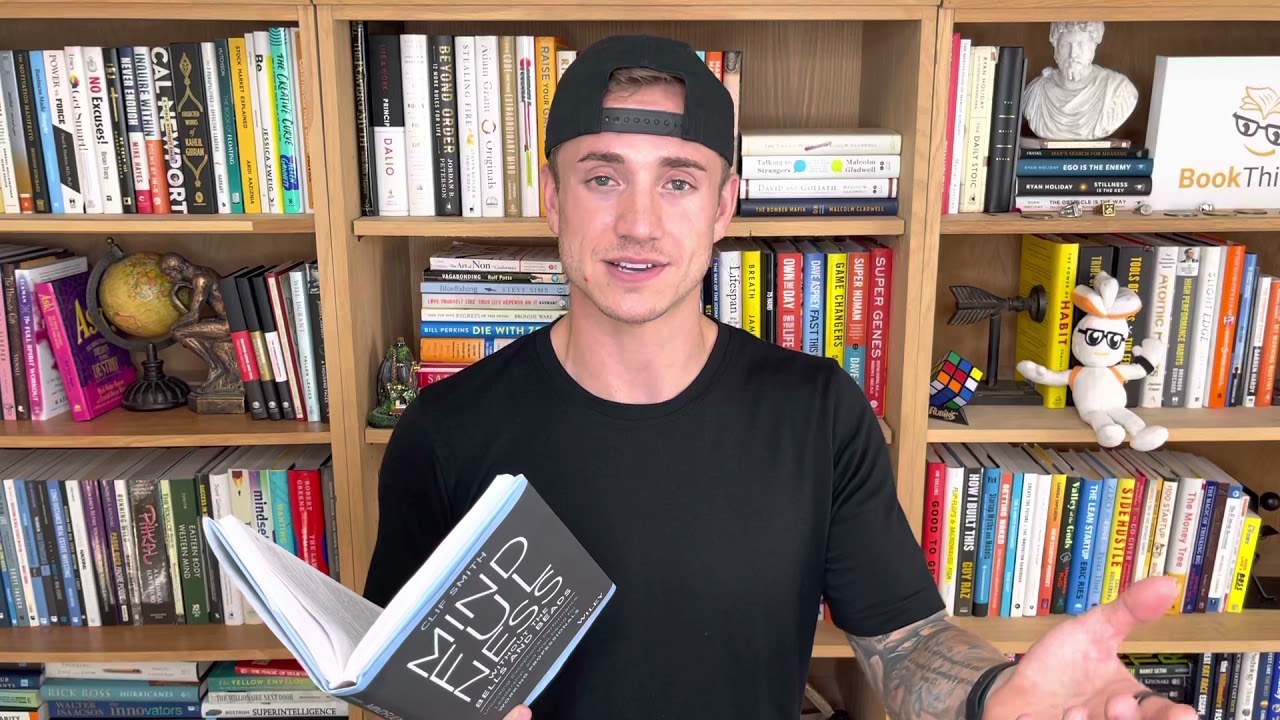
Nick Hutchison reviews Cliff Smith's mindfulness guide for working professionals. Smith, a former military officer and Harvard graduate turned corporate trainer, argues that mind-wandering causes unhappiness and that sustained attention builds happiness. The book's 8-week program uses twice-daily breath meditation and autopilot-breaking exercises to rewire the brain's attention centers.
Chapters
Raise your hand if you've heard the term mindfulness tossed around the personal development industry, but you're still confused as to what it really is and how it can apply to your life. I know that I would have raised my hand a couple of weeks ago, but Book Thinkers family, after reading this book, I cleared up all of my confusion. So today I'm going to review Mindfulness Without the Bells and Beads by author Cliff Smith. I love this book, and the subtitle was Unlocking exceptional performance, leadership, and well-being for working professionals. So who is Cliff Smith? Well, he's an expert on this subject matter. Life started off kind of rough for him. He had a tough time in school. His family was on welfare, but he ended up getting into the military, surpassing all expectations, and even putting himself through Harvard before becoming a full-time mindfulness expert, going around and speaking about this subject and working with large businesses to implement the 8-week course that he teaches in this book. So if you're confused about mindfulness like I was, I would like to start today's review by defining mindfulness for you. So on page 50, Cliff says that mindfulness is an ability to keep attention on one's present moment experience without getting too caught up in automatic thoughts and judgments. So that's it— living in the present moment. But what are the benefits of living in the present moment? Earlier in the book, Cliff talks about this research study that was done, and I thought this was fascinating. It shows that there was a positive correlation between mind wandering and unhappiness, which means that the more your mind wanders, the less likely you are to be happy. Can you believe that? If you are focused, you are happier. If your mind wanders, you are unhappier. across a large group of people. And the kicker is that it doesn't matter what the activity is. Regardless of the activity, if you're focused on the present moment, you are happier. If you're not focused on the present moment, you are less likely to be happy. You're unhappy. And that, I mean, it really kind of hits home for me with work. You hear about people that just hate their jobs, and so they zone out and they just kind of scroll through social media or they do mindless emails. No wonder you're unhappy. Your work doesn't demand your attention, and so therefore your mind wanders and you're unhappy. And he goes on to talk about how this applies to different areas of business and life and stuff like that. So the science is there. But if you're wondering what is the science around mindfulness, Cliff actually has an entire section of the book about this. And I thought this part was really cool because, hey, listen, I'm in the personal development book space. I meditate, I do all these crazy things, I practice mindfulness. And so people often ask me, is it scientifically validated? Do you have science to back up what you're teaching? And sometimes authors don't. Well, Cliff does. Remember, he's an expert on the space. So this is just some of the science, but mindfulness changes your brain in a really positive way. It reduces the size and activity of the amygdala. It increases the activity in the anterior cingulate cortex, the ACC. It increases the size of your hippocampus. It increases the size of your insula. And by the way, in every single one of these parts, he talks about what the benefits of that actually mean. So if somebody says it increases the size of your hippocampus, what does that mean? I'm trying to create a little curiosity for you here so that you buy a copy of the book. I won't spoil it for you, But you're going to want to understand this science because then you can kind of tell friends and family that question you exactly what this can do for you. Now, 2 more things that I'd like to cover in the review before you'll be able to determine if this is going to be a good fit for you. Number one, chapter 6. There's a metaphor here that I absolutely love because I got really confused about the difference between mindfulness and meditation until I read this. So check it out. It says the relationship between mindfulness and meditation is similar to the relationship between fitness and exercise. When you go to the gym and exercise, you're not working out so that you will be more fit at the gym, but instead so that you will have a higher level of fitness outside of the gym, right? You're not working out in the gym just so that you're good at being in the gym. You're working out in the gym so that you can walk up the stairs when you're 80, or so that you can go help coach your kid's T-ball team or something in the future. It's the same with meditation. You do formal meditation practices not so that you are more mindful during the exercises, but so that you are more mindful in your everyday life. Meditation is a mental exercise that affects your baseline level of mindfulness, and it's just like physical exercise and how physical exercise affects your baseline of fitness. They're not all created equal though. And then he goes on to talk about the different types of meditation and mindfulness practices that you're going to learn about in this book. Fascinating stuff. I'm so happy that I understand the difference now. So in the second half of this book, you are going to be put through an 8-week exercise. Well, it's really 8 chapters. Each can be 1 to 2 weeks depending on what you'd like to do. Not shorter, remember that. And so chapter 9 is really week 1. No Trivial Moments is the title, and it's all about moving from autopilot to aware in your life. And there are a bunch of different formal and informal exercises that you'll go through, through the first week, so that you could start to go from autopilot to aware in different areas of your life. And what I'd like to do now is just kind of talk through this first week, my experiences with it, and this will tell you whether or not you're going to want to go through the 8 weeks and buy a copy of this book, which I think you will, because this stuff is really fascinating for people in the Book Thinkers community. So he talks a little bit about how humans are creatures of habit, and once something becomes routinized, then it often fades into the background. And so this can happen in a positive or negative way. As an example, you could be sitting in front of the TV and the bag of chips is there and your hand is just automatically doing this. You're not conscious of it, and now boom, you know, all of a sudden you've eaten an entire bag of chips and you're unhappy with yourself. That's automatic behavior, and we're going to learn how we can unwind some of that and become more aware of the present moment through this first week, right? That's part of the goals. It can also happen in positive ways. I mean, when you get behind the wheel of a car, you don't want to have to focus all the time on every single little thing that you're doing. So there are benefits to, uh, you know, basically automating the relationship between where you live and work or something like that so that you can really get there. And you know, when you get pushed outside of your comfort zone and outside of that automatic behavior when there's a detour and now your entire world unravels or something like that. Really interesting stuff. And then he goes on to talk about waking up your life in this chapter and the breath meditation that he introduced earlier in chapter 6 and about how he wants you to do that on a daily basis or 2 times a day throughout week 1. And it has this catch and release mechanism to it. It's a really fascinating thing. The video reviews sometimes go for a while, so I know that I can't go into all of the details, but this shows you how practical it is. He wants you to sit down, make time in the morning, make time in the evening, go through these routines. There are different types of meditations. This breathing meditation that he introduces is really practical. And then there's kind of like some informal stuff. He talks about taking a mindful shower, which I did, and I really loved this experience. Seeing the shower, really take a moment to observe it before you get in and once you get in. Turning on the water, pay attention to that. Don't do it automatically. Stop, think about it, watch the mechanism as it happens. Heating the water or hearing the water, listening to it. When was the last time that you were in the shower and you just stopped for a second and you heard the water hitting your body and hitting the tub or the wall or whatever the case is? Entering the shower, noticing the feel of the water as it touches your skin, fully engaging in that sensory experience. When was the last time you realized the water is actually hitting your skin and you spent time thinking about it? Smelling the soap— grab your soap and hold it to your nose. Inhale. What's the scent? Notice it. It's powerful. You have this mechanism. Use it in every area of your life. Washing rinsing, drying off, noticing and reflecting after you get out of the shower. He recommends that you do this every day during the first week, which I did, and it was a lot of fun. Um, somebody in the past had told me while I was sitting down, like, do you even realize you're sitting down? Feel your gravity as it sits in the chair. It's a very similar type of experience. Um, then you're gonna go through body scan meditations throughout the first week, which were really cool. I've done some of these in the past. But you're really spotlighting different parts of your body. It's a really long process. There's a ton of detail that Cliff gives you, but in summary, you learn how to spotlight and feel the different sensations that are happening in different parts of your body. You know, maybe after a tough day at the gym, after you do legs, you can really focus in on the feeling of your legs, and it brings just a sense of awareness to you. And there's a lot of other kind of like formal and informal stuff that he teaches you throughout this, but the key points of week 1 are that you are not on— or so that you shouldn't always be on autopilot, living much of, uh, our lives just in a trance, basically, like as a sheep, you know, just in a herd. You're just going and doing things without even realizing them. Coming off autopilot enables you to be more fully engaged in all of your experiences, like I just talked about with the shower and the body scan meditation. Helps you to notice subtle physiological sensations, and that's a really cool thing that you could start to train. So that's just week 1 out of the 8 weeks. I would really recommend this book. I hope that you enjoyed today's review. Please DM me, ask me questions, comment down below, ask me questions. Thank you for watching this review. Go read something, and I hope you enjoy this book.
More from Nick

Napoleon Hill’s “Think and Grow Rich” is a timeless classic #selfhelp #personaldevelopment

4 Books to Help You Get Better at Decision Making #selfhelpbooks #bookrecs #nonfictionbooks


Have you read this book yet? 📖: The 5AM Club by Robin Sharma #selfhelpbooks #robinsharma

Dan Sullivan on Listening to Your Customers Instead of Watching Your Competitors

5 Books That Will Boost Your Financial Intelligence #financialfreedom #nonfictionbooks

The People That Preach the Loudest About Virtue are Usually the Most Power Hungry



Books are the greatest mentors you can find #selfhelpbooks #businessbooks #successmindset

Let’s fight this toxic instant gratification culture together 📖 #selfhelpbooks #jimkwik