Strategies for Mastering Your Reading Habits | Ep 242 Interview Sessions with Nick Hutchison
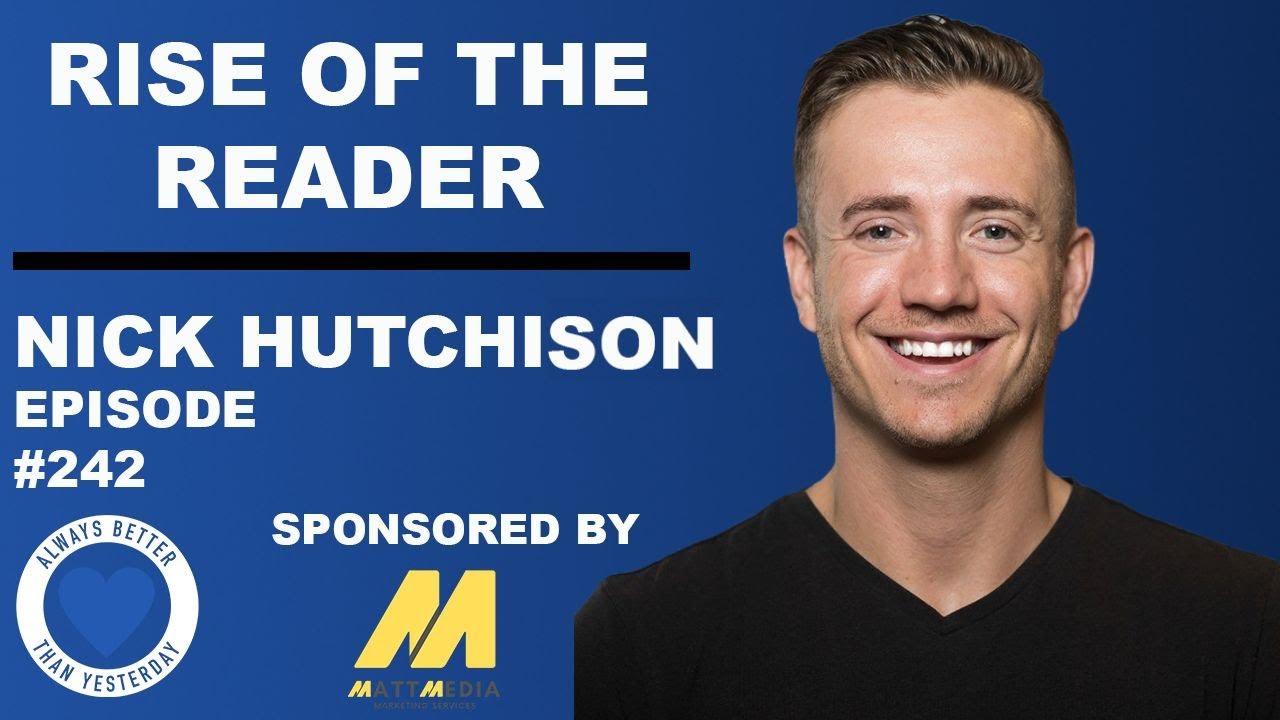
Nick Hutchison went from non-reader to prolific reader after Rich Dad Poor Dad changed his life. He built a system around SMART intentions, detailed notes, weekly accountability groups, and idea mash-ups he calls "book-sex" to turn reading into action. His community BookThinkers now has 140k+ nonfiction readers.
Chapters
Welcome to the Always Better Than Yesterday podcast. I'm your host, Ryan Hartley. This podcast exists to equip and inspire your heart-centered leadership. Every week we bring interviews with some of the greatest heartsets and mindsets on the planet. I hope the heartprint of our time spent together is that it creates new possibilities for you and all those you come into contact with. If you'd like to explore what we could make possible for you, then head to abty.co.uk and book in a free 30-minute call to begin our journey together. I just want to express a huge amount of gratitude to our sponsors, Matt Media Online, an independent agency who specialize in content marketing, helping businesses get their message seen by the right audience. Matt has produced all the digital media assets for this podcast since episode 106 back in December 2020. To have Matt in your corner, head to mattmedia.online. Online. I'd also like to thank Exhale Coffee. I have been a big fan of Exhale Coffee since meeting Alex and the team back in 2022. Exhale is the first coffee to be sourced, roasted, and lab tested specifically to maximize its antioxidant and anti-inflammatory potency. An independent lab test has shown that 1 cup of Exhale Coffee has the same antioxidant power as 1.8 kilos of blueberries Or 55 oranges. I'm a huge fan, and Mrs. H loves the decaf, especially because she knows that Exhale use the mountain water decaffeination process, which uses only pure glacial water from the highest mountain in Mexico and no nasty chemicals. Simply head to exhalecoffee.com/ABTY for your special offer. And lastly, before I introduce this week's guest, guest, please do subscribe to the channel if you haven't already. It would really help us leave a greater heartprint on this world. On episode 242, I welcome Nick Hutchinson, founder of Book Thinkers and author of the new book Rise of the Reader: Strategies for Mastering Your Reading Habits and Applying What You Learn. Rise of the Reader is out today, the 1st of November. Head to all bookstores, you can get your copy of Rise of the Reader. And Nick has this belief the right book at the right time can change your life. Maybe this book will be that for you. Here we go. It's episode 242 with Nick Hutchison.
Nick, welcome to the Always Better Than Yesterday podcast. How are you, brother?
Ryan, I am excited for today's conversation. There's no place I'd rather be.
I love it. You and I have a heart and a passion for books, and I've been a fortunate receiver of an advanced copy of your book, and it says in one line, it made me laugh. It says, I didn't come out of the womb reading? You know, there's this idea that actually not everyone is born a reader. And I guess, where did your love affair with books start to come in?
Well, I was not a reader growing up at all. I mean, I dabbled in a little bit of fiction from time to time, but I didn't start reading until late in my college experience or university experience. And so I was 20 years old, And I went most of my life without reading books before that.
Yeah. And you and I were just talking off air around the impact of Bob Burg. And I remember just getting into the early days of the personal development industry and books and The Go-Giver by Bob Burg and John David Mann was incredibly important for me. And I love the phrase that you use with your business is underlying belief that the right book can change your life. And I guess, is there something there for you? Is there a book that came into your life at the right time that really supercharged your journey?
So when I was going into my senior year of college, I took an internship at a local software company. It was a sales internship and my boss at the time would take me on a few local trips to go meet some existing customers and we would listen to some business podcasts. I wasn't really into educational material prior to that. Like I mentioned, I wasn't the best student. I didn't really read a lot growing up, but I became interested in these podcasts because he was very successful and he was telling me that a lot of his success came from the ideas that he was getting in these podcasts, just like this one right here. And so, I had about an hour commute each way to this internship. And so, I would put on business podcasts and the same books would be mentioned over and over and over again. The guest would say, I owe all of my success to, and then insert book. And as I listened to these shows, the idea became reinforced that I'm missing out on something. If I'm choosing deliberately not to read these personal development books, I'm choosing to live under my potential. And that sort of hit home. So one day, I had a lunch break because I had to clock in and out of this place, and I went over to a local bookstore with my list in hand, and I grabbed maybe about 8 to 10 books, a bunch of the ones that I had heard about and a few extras. And the first one that I decided to read was Rich Dad Poor Dad by Robert Kiyosaki. And that book changed everything for me. It was more of a mindset and a belief style book at first. I know for some people it's real estate investment, whatever, but Robert taught me that if you want to become successful, you have to study successful people because successful subjects like financial literacy are not typically taught in school. They're taught in the home. And so, somebody like Robert can condense decades of lived experience into days.
Yeah.
of reading. And that was the original book. And I've got a funny story about The Go-Giver, if you don't mind. I'll tell you about that one too.
Yeah, go ahead, please. Yeah, yeah, yeah.
So, as I progressed through my senior year of college or university, I was interviewing with a lot of big companies in Boston. And I went to this interview one day, took the elevator way up in a skyscraper, went to a corner office. This guy had a beautiful bookshelf behind him. So, we're going through the interview and I asked him about his biggest influence. I said, I see you have a lot of books behind you. I'm recently into personal development books. What's your favorite book? And so, he grabbed a copy of The Go-Giver and he slid it across the desk to me and he said, when you come back and accept this job, then I'll take my copy back, but I want you to read it between now and then. So, I read the book. It had an amazing impact on me. Which we could talk about later. I love Bob Burg. I love John David Mann. I did not accept that position. I offered through LinkedIn to ship the book back to him, but he's like, no, I have 1,000 copies of it. Don't worry about it. Keep the book. But that's how I stumbled across The Go-Giver my first time.
It's so powerful, isn't it? And it just, it's just testament to that belief that the right book at the right time can change your life. And at what point did you go from Because I had a period of time in the place where I was in my career where I was just loving learning about personal development. I have a particular passion for leadership and then I started to share some of my learnings, some of my insights that I was gaining on Instagram, which brought me a lot of judgment and attention, negative attention, shall I say, in my day job. It made things quite uncomfortable. It's like comments like, The fuck does Ryan Hartley know about leadership type comments? You know, it made me quite vulnerable to start sharing some of these insights. When did you bridge that gap and go from being a learner to a sharer of your learning?
So it happened pretty fast because I had a great system around me. I had a great group of friends. I mean, this sales mentor of mine, I ended up working full-time. out of school at that same company. And so, my boss was really into personal development books, really into personal development podcasts, and I had a few friends who were also very interested in this type of material. So, I started sharing the books that I was reading mostly through word of mouth. I would tell friends and family about them, and they were the ones that encouraged me to start sharing on social media.
Nice.
Now, the long story short, I wanted to start a business while I was working my full-time job. And my friend Alec and I came up with this idea of BookThinkers. And at the first iteration, our dream was that we would build a mobile application, which never happened, but build a mobile application that could help readers retain and implement more from the books they were reading. And in anticipation of that, we developed this BookThinkers social media presence so that when the app went live, we could sell the app to our audience. The app never really went live. But the audience started to take off and I definitely received a little bit of criticism from friends and family, you know, hey, personal development books, they're all snake oil salesmen. They're, you know, these books are just speaking into an echo chamber, things like that. But for the most part, most people were relatively supportive and curious more than anything. Why did I go from a non-reader to a reader? And why am I now posting my book reviews on social media every single day? And so, that process might have taken a couple of years, but after all is said and done, now I'm known as the book guy. So.
Hey, my friends.
Thank you for being with us so far. I hope you're enjoying the interview. I just wanted to take a quick moment to let you know about our signature Heartprint Coaching. Our Heartprint Coaching is for you if you're ready to go all in on becoming a heart-centered leader. Ready to go all in on doing more of what you love? Ready to see what you are capable of with support, guidance, and accountability? You're ready to go on a rapid transformational journey that will change your life and others in as little as 3 months. Are you ready to show up with courage and share your gift with the world? Ready to start making an income and more impact by doing what you love? Ready to start leaving your legacy where those around you are left better than yesterday. In our Heartprint Signature Coaching, in our time together, I'll help you lead from your heartset. I'll help you develop other people and your team. I'll help you bring your heartwork to the world. I'll help you start leaving a legacy and capturing examples of your impact. I will help you be someone you love, to do more of what you love, and to serve people that you love. It's an amazing opportunity for someone who's ready to go all in and be a heart-centered leader. I'll throw in loads of other bonuses including your Life Languages profile, access to our Master Heart and Mind membership, and even some Always Better Than Yesterday merchandise. Head to abty.co.uk/coaching to find out more, and I look forward to connecting with you very soon. That's abty.co.uk/coaching. Here we go, back to the interview.
Yeah.
And do you know what? I think the greatest example is that it creates new possibilities. You know, it is, you and I were talking, you know, we've entered this industry as curious learners and people that want to gain all this knowledge and insight from these $20 mentors, as you call them. And it's just like, well, it's opened up, I'm sure it's opened up many doors for you and as it has me, you know, having conversations with the likes of the people we do. I see that, you know, your podcast, I'll share all the links to your podcast as well in the show notes. The people you're having conversations with, brushing shoulders, we can't not be better for spending time in the presence of those people.
Yeah, you're totally right. $20, a few hours of your time and you can learn from the world's most successful people. Who have overcome the problems that you're currently facing and they could show you how to do it. And that's wisdom right there. I think personal experience is a great teacher when you go through something and you fail and you learn and you iterate and you change and you grow and you adapt and then you overcome that challenge. But if you could bypass the entire process by reading about how somebody else overcame the problem that you're facing or doubled down on the skill that you're looking to improve, Why not take the shortcut? Because you'll be faced with another roadblock anyway. And so, yeah, I mean, I, looking back, if you would've told me that I would've read over 100,000 pages when I was 20, I would've, I would've bet a million dollars in the other direction. Yeah. But I'm so happy. I owe literally everything that I have in my life to these books.
Yeah. $20. And one of the things that I know that you're passionate about, and I've said this many times before, is I have to be careful that my book collection and my wife know every time the Amazon thing arrives, she knows I've bought another book, right? And I have to be really conscious to not allow it to become shelf development, to not just be, I know you talk about this in your book as well, like shelf help. I need to make sure that I sit down and read the books I buy. And I think one of the things that you articulate really nicely is to know your intentions, to know your why for reading the book. Is that something you're conscious of every time you pick up a new book?
Most of the time, and it took me a long time to develop this. So Ryan, for everybody in your audience today, I'll ask them this question. Why are you reading The book that you're currently reading. Far too often I'll bump into somebody at a networking event or out on the street or run into an old friend and the subject of book thinkers will come up and I'll say, hey, what are you reading? They'll tell me and I'll say, why? What do you mean why? Why are you reading the book that you're reading?
Yeah.
Well, I don't know. I saw it on Instagram or you recommended it, or I don't know, I, whatever. It's a bestseller. Well, if you don't define an intention for the book that you're reading, it will probably underserve you. I like to follow the SMART goal framework when building an intention. So, I want the intention for each book to be specific, measurable, attainable, relevant, or written down somewhere, and time-bound. So, if I'm— I actually don't have a book within arm's reach, but let's say I was reading The Go-Giver. By Bob Burg and John David Mann. When I look at the book, I read the front cover, I read the back cover, maybe I read the first couple of pages and I'll say, what am I looking to get out of this book? And it needs to meet that criteria that I just mentioned to you. So I'm looking to find and implement at least 2 giving-related habits by the end of next week. That's specific. It's measurable. I'll know whether or not I hit it. It's attainable. I'm not saying I want to use the book to make $1 million by next week. I'm just saying I want to find and implement 2 things to improve my ability to give. It's relevant to my life if I want to become more of a giver, and it's written down in my activity tracker, which we could talk about later, and it's time-bound. I want to do it by the end of next week. And if you can spice it up and add because, because I was focused mostly on my ego as a young person, I didn't really focus on serving others, and I'm looking to become more of a giver. To help balance out all of the bad that I did, you know, prior to becoming somebody more focused on impact. And if I reread that intention every single time I pick up the book and read a few more chapters, I'm more likely to take action on that intention and actually implement something. So yeah, I think that, you know, reading intention-free is a problem. I think most people read these personal development books with somebody else's intention in mind. you know, hey, I think you should read this because instead of I think I should read this because. And so that's kind of step one. And I love to write that intention on the inside cover of the book like I just mentioned. I love to sign and date the book. And it's fun when other people, when I gift other people the book or when I lend it out to somebody and they're like, what's on the inside cover here? And then I could tell them a little bit about why I wrote that intention. It's also fun to look back on those books sometimes months later or years later and see why was I reading this book. Oh, I remember because I was having an issue with my sleep or I was having an issue with leadership. And it's fun to see how much you've grown.
Yeah.
And I, from my own experience, I know that these habits that we create, they compound, you know, they will flow into other areas of your life like setting intention of the book. is one thing, but when you set intention for every interaction that you have with another human being or wherever you go, like that, that's such an unseen byproduct, shall we say, of how it can just flow off into the other areas of your life.
Yeah, I've only been invited to speak a few times at some smaller conferences, entrepreneurship-style conferences. But one time I was up on stage and I said to the audience, like, raise your hand Yeah. If you've set an intention for your time at this conference, nobody raises their hand. Well, why are you attending this conference? You're spending money, you're spending time. Most of you have traveled here and you're not even really sure why you're here. What if you bump into somebody in the hallway and they say, hey, why are you attending the conference? What can I help with? You've got to have that answer ready to go so that other people can connect with you on a deeper level. It's a more meaningful relationship when you can share an emotional intention with somebody else. Like, I'm at this conference because I'm tired of working a 9-to-5 job that I don't like, and I'm really interested in entrepreneurship. And hopefully, I can find somebody here that can hold me accountable to doing that by the end of this year, whatever the intention is. And so, yeah, I think you're totally right. When you can approach each and every area of your life, every relationship, every podcast, every interaction with an intention, It's more powerful.
Yeah, I love that. One of the other things that you said at one of those talks is, what is the use of reading if you can't recall what you know? What is the use of reading if you can't recall what you know? And it's just, you know, there's 200-300 pages of a book and if we're not recalling anything, then we're not implementing anything. Even that, I think you quote Mark Twain, which is the man who does not read good books is no better than the man who can't, which is effectively even if you're reading and you're not implementing, the transformation remains to be seen. How do you then bridge the gap between reading and I know you talk about having some form of systems. Maybe we can start talking about that now is how do you go from being a reader to actually allowing the insights of the book to transform us?
My process started because that full-time sales job that I had, each time I would sell a software package to a customer, they would go through an implementation phase and that implementation phase would last anywhere between a few weeks and a few months. And so you couldn't just take the software that I was selling and start using it the next day. You had to implement with intention. You had to practice, follow a systematic roadmap. And so, when I started reading these books, I think what happened is because nobody taught me to do this at first, I think I just naturally started to follow that process. Each time I would read a book, I would spend anywhere between a few weeks to a few months implementing and practicing the material that I had just read. And I remember, I don't think this is in the book anywhere, but I remember I was on a business trip as a recent college graduate. I was in Chicago. at a bar with my boss, Kyle. And I remember talking with him and he said, hey, so you've been crushing these books and I see that you're implementing them. And then I just start spitting all this information at him about how excited I was. And he said, you know, most people don't read books after college. Those that do don't really take notes, and those that take notes don't really implement any information from them. So he is like, you're not, He's like, I don't think you realize that you're going way above and beyond compared to what most other people are doing. And that was the first time that he sort of, I don't know, put language to this because I wasn't having a lot of conversations about it. I was just doing it. And from there, I think what happened is a few years later, I was asked to write this book and I had to go back and actually document what I was doing.
Yeah. Yeah.
I had to go back and say, oh, here are the steps that I go through, which have changed a lot over time, you know, but from a very high level, Ryan, what I like to do is set an— basically identify a problem or a skill that I want to improve. So set this intention, find a good book that will help solve that problem. Then I like to read the book. I like to go through those notes over and over and over again. I like to plug those notes into an activity tracker. I like to meet with my accountability group on a weekly basis, talk about why I put these actions into my activity tracker. Then I like to follow up with them and I like to measure the results and see if these results are having the intended impact that I want them to have. And that's the process. And there are a bunch of little systems that are built into that process. But from a high level, that's what I like to do. And it sounds like a lot, but I'll remind everybody of that famous Jocko Willink line that Discipline equals freedom. And a very good example of that is if you're unstructured throughout your workday and you're scrolling on social media, you might only get 4 or 5 hours of work done in an 8-hour day. But if you just did that work upfront, you'd have all that time free. So it's like the extra discipline actually creates a little bit more freedom for you. And that's what my reading process does for me as well.
Yeah, I love that because when you break down the maths, you talk about how 15 minutes a day of reading over the course of a year equates to, I think it's something about over 20 books. And it's just that, this is, it's just the having the discipline to do something simple every single day that then leads to that possibility. You don't think you can? Well, can you do 15 minutes? Yeah, I could do that. Okay, we'll do that. Start there.
Yeah, I always hear from people, Ryan, hey, I don't think I'll be able to find the time to read. Well, I don't think you're going to find any extra time either because most of us use all 24 hours every day. But what you can do is replace low-impact activities with high-impact activities. So what I like to tell people is let's replace 15 minutes of your morning Instagram scrolling with something more productive like reading. Or listening to this podcast. And let's replace the first 15 minutes of your evening Netflix or whatever the case is with reading, not the whole activity. You know, I still like to have fun. I still watch TV, but let's replace the first 15 minutes with reading. So the math is that if you read 15 minutes in the morning, 15 minutes in the evening, for beginning style readers, you'll read about 20 pages. 5 days a week, not on the weekends. I don't want to overdo it, but just 5 days a week, you'll read 100 pages a week, which is about a book every 2 and a half weeks. So it's about 20 books a year. And imagine 15 minutes in the morning, 15 minutes in the evening, you can drastically improve 20 areas of your life over the next 12 months, which you'll be able to take advantage of for the rest of your life. These books have a very long tail. Like you said, they Compound on each other. And so when you put it like that, people go, okay, you know, I think I could do 15 minutes.
Yeah.
Or maybe even cut that in half, 10 books a year, just 15 minutes in the morning.
Yeah.
Magical things.
When you, when you talk about having that systems to enable your recall, I, it makes me think of my wife who often looks at me and goes, how do you remember that stuff? How do you remember that one line from that one book that, and I, so I then start thinking about what is it I do? And I guess I'm fortunate enough that I've got this podcast where every Monday, Tuesday, Thursday, Friday, I'll share like a 5-minute insight. And quite often I'll take my insight, I'll write it down in a notes page, and then I'll speak it. I'll try and understand it, its context, and I'll try and reapply it in another context. I almost like try and get to the nuts and the bolts of what I think I've learned and then try and put it back together in a different situation. So almost like I learn through almost teaching, if that makes sense. And then, oh yeah. So I've realized I've given myself the gift of reinforcing my own learning without even knowing it.
Yeah, absolutely. I think when you read to teach other people, which is what I essentially do, you can retain a lot more because you're totally right. You're trying to restructure and reform the information in your head in a way that you can present it easily. And so you're simplifying something, you're reworking it. And all of that processing, I think, is a form of repetition. And so one of the core messages that Kevin Horsley taught me is that repetition leads to retention. And so if you can review the information first, you're reading it, then you're rewriting it a first time, then you're rewriting it a second time, and then you're reviewing that information systematically. All of that's repetition. You're strengthening your neural pathway connection to the information. And then if you go and teach it to other people, I mean, you're just developing a much stronger relationship to it. So, yeah, I love that you do that, Ryan. That's a really cool process. And it reminds me of something that I talk about in the book as well, which is this idea. I call it book sex.
Okay.
It's actually something that I originally took from James Altucher. He calls it idea sex, where you take 2 totally unrelated things, you mash them together, and you just see what you can make from it. And so you take a book note from Rich Dad Poor Dad, you take a book note from The Go-Giver, mash them together and journal about it for a few minutes. Think about it. It's a fun exercise and sometimes you get pretty useful information.
Yeah, I've been doing that well with slight trepidation with the Bible and other books. It's not like cross-referencing, but I'm like, ah, there seems to be like shared wisdom between the Bible and the stuff that Joe Dispenza might say, for example. And it's like, oh, how funny that is.
Yeah, I, you'll catch me saying sometimes that the Bible is my favorite personal development book. Yeah.
And, and that's it. And, and I think I, I, I was having conversation, you mentioned it earlier with John Gordon, and I think him and I were talking about how it's a playbook. The, the Bible is a playbook. Is the Bible is a playbook for creating heaven on earth in this lifetime. So it's like a lot of wisdom in there to take.
That's a fun way to put it. Yeah, I didn't get that far into the conversation. I was listening to your John Gordon interview, as I mentioned before we started recording. I didn't get to hear that piece, but I'll go back and listen to it because that's a fun way to put it.
Yeah. Yeah.
And see, let's not start talking about the specific book. Let's package it in a way that people can go, what's the title of the book? What is the title of the book? What's it called? And why specifically A guy that loves books, why are you writing on this topic and why that title?
Sure. Rise of the Reader: Strategies for Mastering Your Reading Habits and Applying What You Learn. And here's why I decided to write the book. I've built a community online of over 140,000 nonfiction readers at the time of this recording. And over the year, it was a slow organic grow. So, over the years, I have received hundreds of messages that sounded something like this. Hey, Nick, thank you so much for putting out cool content. I've read a bunch of the books that you've recommended. I get really excited about implementing them. I know they can solve my problems, but I have a tough time translating that information into action. So, I'm in the same place, but I'm reading these books. Can you help me? And every single time I received one of those hundreds of messages, I did my best to answer them, but I felt that each time I delivered an answer, it would come up short, right? Because I was limited by the platform and I didn't have all of these systems really documented in a way that they could be digested by other people. So I might type out a few paragraphs or I might send a few voice notes through Instagram DMs, I might even offer to get on a call with somebody and spend half an hour telling them about what I do. But each and every time I got off of one of those calls or sent one of those messages, I thought I'm underserving my community because I know I do a lot more than what I'm able to communicate. And so, I was presented with an opportunity a few years ago from one of our referral partners that helps people write books. And they said, hey, Nick, if you ever want to write a book, We'll comp some of our services in exchange for an ad in the back of your book. You can go through our process and let me know if anything ever comes to mind. And I let it sit for a very short period of time. I basically jumped on the opportunity immediately because I said, I need to write a book. What does my community want? Yes, they enjoy podcasts. I'm sure a lot of them digest courses, online articles, blogs, but I know they all read books, so I have to write a book about what I'm doing. And Ryan, I'll add one more thing, which is that a lot of people in the audience might be thinking, okay, you know, Nick's in his 20s, why should he write a book? And I had a little bit of that, what do you call it? Imposter syndrome.
Mm-hmm.
You know, most of the people that I read about, they're in their 40s, 50s, 60s, maybe even older. They've built and sold big businesses. They have super intricate degrees and specialized stuff and they run their own studies. But I realized that I wanted to serve my younger self, Nick, when he was 20 years old and started reading these books. And I realized that the version of Nick today in his late 20s has a lot to offer that guy.
Yeah.
And so, I just needed to serve You know, a young motivated professional who wanted to get more from books. I didn't need to be Grant Cardone or Patrick Bet-David or John Gordon or Bob Burg. I just needed to be somebody who could help that guy. And that's why I decided to go forward with it and write the book now.
Yeah, I love that heart set. I love that heart set because I've had similar feelings of like, you know, I said earlier, oh no, not yet, not now. And every time I've come back to the reality of it, I've always thought about either the person that I was and what I needed, or I think about my children and what is the legacy message I want to impart with them? What do I want them to know about this thing of life that I've discovered?
Yeah.
And when I start thinking about it like that, like the bigger purpose to it, I think all the little opinions just strip they become less relevant because I'm not writing for the people like that. And so to hear you talk about serving your younger self, I also believe in something and then you talk about it in the book is about the proximity, about how close. And in my early days, I was a Simon Sinek fanboy, right? But I've come to realize that sometimes the people like Tony Robbins of this world, they're so big and out there that actually, you know, they're not in your close proximity to influence your behavior change. But if there's a guy that you've known and you've followed and you built a relationship with through his platform, then maybe you become the authority to speak into their life to truly influence that behavior change. What's your thought on that?
Yeah, that's a great way to think about it. I, I do believe that old Jim Rohn idea that we are the average of the 5 people that we spend the most time with. And when I first started reading these books, a few of my friends, we talked about this concept of, it's so funny, I actually didn't even realize this until after I decided on the title of the book, Rise of the Reader. But we used to talk about this idea of rise together and it was because we all wanted to be successful in our own way. And so let's support each other. Let's build over the next 20, 30, 40, 50 years together. And support each other. So that was sort of the vibe of my early accountability group, but also for the people that— for the people in your circle that maybe aren't the most motivated, like maybe you're the most motivated person in your friend group if you're listening today and you go, nobody in my friend group really wants to listen to this kind of stuff. I think there are communities like Ryan's community where you can network and meet with and support other people in his community. Build together, rise together, form accountability groups in the comment section, go meet some people that are also a fan of the podcast. But for the people in your friend group that aren't as motivated, you know, I always ask permission. Hey, I noticed you're struggling with this. Are you open to a suggestion? Because I used to be like that too, you know, and I'm always trying to gift books and make small recommendations because I believe All of us, even me today, we're all living way under our potential and we sometimes we need a little kick in the butt. We need somebody to say, hey, I don't know if anybody's told you recently, but you're capable of doing more. And that's exciting. That's not depressing. That's super cool. And I'm happy to support you on that. Let me know if you want to talk about it.
Yeah, I had these random thoughts every now and again, and I had this thought one time that was that we're the only, we're the only species that has the potential to go to the grave having not found our potential. You know, the animal kingdom just operates from its being, right? Whereas we have this gap between who we're being and who we could be.
Yeah, that's the thing.
Think about it.
Choice. This thing called intention, which is both a gift and a curse, right? This, this consciousness. Because there's a gap between what we're doing and what we know we could be doing. And I think many people don't take the responsibility that that brings because it's just easier. There's a reason why ignorance is bliss, right? So this, our, our human consciousness is, it reveals to us, well, if we could do more than, than maybe we, we ought to be seeing what potential lies on the other side of that.
Yeah. Ryan, have you read The Top 5 Regrets of the Dying by Bronnie Ware?
No, not in full, but I know that you were talking about, yeah.
Yeah. It's, uh, for everybody listening, I recommend the book. almost more than any other book because Bronnie Ware was an end-of-life palliative care nurse. She would spend the last few months of somebody's life with them taking care of them and she would sit there and talk and eventually she realized that everybody had the same regrets. And the number one is that most people tend to live lives based on everybody else's expectations of them instead of their own. And so that fear of rejection from each of our own individual communities, sometimes it forces us to live under our potential. And I don't— me personally, I don't want to wake up on my deathbed and realize that I was capable of doing more for the sake of my younger self, but also my future children, everybody around me, the people in my community. I just want to be the biggest, baddest, boldest version of myself. So that I don't end up having any regret. And, uh, yeah, that book was a big eye-opener for me.
Yeah. Thank you for sharing that. And I know that one of the things you do, we've got in common is, um, the use of tattoos, almost like these play bigger triggers, right? I know you talk about them. And so I'm the type of guy that if there's a screenshot of like your background, I'm zooming in to try and figure out what books you've got on your shelf, right? I'm that guy. I'm not, I've got no shame in saying I zoom in to see what books you reading. Um, but I also do that with tattoos. And, and before I even saw any of your book, I was like, oh, this guy's got some cool tattoos. I wonder what they're named, and I wonder what it says. I wonder what the meanings are. And there's a few that you outline in the book, but there's one that you don't, and I'm going to try and pronounce it. And I want to know the meaning behind this one. For, for the listeners, you've got to go check out the book to find out the meanings of Nick's other tattoos. But this one is—
is it ataraxia?
It's right by the—
Ataraxia.
Ataraxia.
It's right by the, uh, on your, on your forearm here by the 1, 2, and the 3.
There we go.
Ataraxia. Tell me about that. What does that mean?
Sure. So it's written in ancient Greek. I'm a big fan of Stoic philosophy, uh, which was written in ancient Greek, ancient Latin. And when I was—
That's why you have Amor Fati on that right arm. Is that— what can I say?
Yes.
Yeah, I'll tell you exactly.
And I have the Memento Mori, which I talked—
Yeah, yeah, yeah.
about in the book. And so this term ataraxia, it, it translates to stillness, stillness. And I got it tattooed. This is actually a really fun story. So last year, I did a little trip through Europe. I'm from the United States, if you can't tell by my voice. And I visited Athens. Athens is sort of The birthplace of Stoicism, almost. And we were walking around, and I was telling my fiancée at the time, now my wife, I was telling her, "Hey, I'd like to get a tattoo here, and I'm not really sure what it's going to be." So we're traveling around the Greek islands, and I'm listening to a podcast before getting to Athens, and Ryan Holiday is being interviewed on a podcast, and he's talking about this term ataraxia. And ataraxia, like I said, translates to stillness. It's the space between an input to your brain and your reaction. And one of the biggest benefits of studying Stoicism, but also all of the meditation that I've done over the last few years, is increasing the time between an input to my brain and my reaction to it. And so I thought, that's a really interesting tattoo idea. And I love tattoos that reinforce behaviors, reinforce positive thinking. And so I thought, okay, maybe anytime I could get that tattooed on my wrist, and maybe anytime I'm feeling stressed about something or emotionally reactive, I can look down and remember to center myself, to be still. And so, okay, fast forward, we're walking around Athens, and I just said, hey, I'm feeling like right now I want to get the tattoo. And Rachel is like, okay, like, let's find a shop. I'm like, I'll just whatever the closest one is to right where we're standing. So I look it up and there's one. It was like a 5-minute walk. So we walk in and there's just one guy in the tattoo shop. He's an older guy and he says, hey, I'm just finishing up a tattoo. Give me a few minutes. So give him a few minutes in English. Give him a few minutes. And we started talking about the tattoo and he said, hey, I'm not really familiar with this term. He said, I've grown up here, I speak Greek, I'm familiar with a little bit of ancient Greek, but I don't know this term. Let's look it up. I want to make sure that what you're getting tattooed actually means what you think you're getting tattooed, which was really nice because sometimes people, it's more transactional and so they'll just tattoo whatever you want. But this guy said, no, I I want to make sure you get what you're looking for. And so we spent about an hour going through all of these Greek, like, articles and stuff about this idea of stillness. And eventually we found the right translation, which did translate to stillness. And it was a really fun process. I learned all about how his father had started the tattoo shop for, like, a naval group. A US-based naval group that was in Athens a long, long, long time ago. And that's why he learned English. And now he carries on the tradition of running the tattoo shop, and now his son is getting into it. And we just had this wonderful conversation, and he gave me the tattoo. And so, yeah, it's related to Stoicism. It's a great reminder. It's one of the biggest benefits I've had from meditation. It was a really cool experience. And I view this as a souvenir, but also a really cool reminder of that experience. So thank you for giving me a few minutes to tell you about it.
When you were talking about it, it reminds me of the famous quote by Viktor Frankl, which is, between stimulus and response lies a choice, and in that choice lies your freedom, I think is the quote.
That's an amazing quote. And Is that in Man's Search for Meaning?
I think so.
I'll have to reread that again. That's an amazing quote and it sums up what I was trying to say perfectly.
Yeah. Oh, this is a great conversation, man. I'm gonna enjoy myself. What is it that you want specifically people to hear specifically about your book? Why might people— okay, let's reverse engineer this conversation. People are gonna have an intention. When they want to read your book, when they pick up your book, they're gonna set themselves an intention. What is it that you hope that they receive from reading your book?
I think there are a few different directions that we could take this answer. I think the most common intention that people will set is I'm looking to implement 2 or 3 ways or 2 or 3 strategies that can help me translate information into action more efficiently or more consistently. And that's kind of the main purpose of the book. But I think there's this other intention that probably exists, which is, you know, I want to start living up to my potential. And so what actions can I take within Nick's book that can help me do that? You know, so many people think that Their problems are unique to them. And what I hope people realize as they're going through my book is that literally billions of people have lived before us, tens of billions. I think by some estimates, 100 billion people have lived before us, and so many of them have gone through the same problems we're currently facing today. Millions of them have written about their experience navigating that problem. And you could pick it up for $20, read it for a few hours, and solve something that you've been dealing with for a very long time. And I don't think that, like we talked about that Mark Twain quote, so many of us have the ability to read and choose not to. And that's sad. I think that reading personal development books and implementing them to solve our biggest problems is one of the most underutilized skills that we all possess. And yeah, yeah, they say your purpose comes from your pain, Ryan. That's an Evan Carmichael quote. Your purpose comes from your pain. And I just want to help people realize their potential. I really do. So I kind of took your question and ran with it in a different direction a little bit. But that's sort of the underlying meaning for my book. I'm 29 years old now. I feel completely at peace, fulfilled. happy, joyful. And unfortunately, so many people go their entire lives without experiencing what I feel like I experience every single day. And this feeling is on the other side of books, just books. That's it. Just books and a little bit of work, but books.
I love your heart for it, my friend. I love your heart for it. And my audience have heard me say this multiple times, so they're probably rolling their eyes when I say this, but Brother to brother, the, the, the pain to purpose stuff. There's a bit in scripture that I read, and everybody knows the thorns in the flesh scripture, right? We got Paul pleading to God, remove these thorns from my flesh. He pleads 3 times. In the normal translation that everybody knows is, in your weakness you're made strong. And then I read the Passion Translation, and God's response was a little bit different. In the Passion Translation, it said, in your weakness you will find my fullest expression. I was like, oh, like, that just hits different. Like, in my pain, uh, it brings forth the fullest expression of God within me so that I may be of service to other people. That's what really sets my heart on fire.
Yeah, mine too. It really does. And I don't know if I would have believed that until I went through it, and now I believe it. You know, we didn't touch on it too much, but when I was in my late teens and early 20s, I was operating from a place of ego on one side of the spectrum that would represent itself at the expense of everybody that I was around. All eyes on me, putting other people down, but also a lot of insecurity on the other side of the spectrum. So I had a fear of communicating in front of other people. I had a lot of social anxiety and I would, you know, I'd limit myself, limit my potential as a result of that. And books helped me completely undo The ego issue and the insecurity issue. And I now feel like I just sit right in the middle where I'm confident each and every day. I don't experience insecurity communicating in front of other people. And the ego thing, I mean, that's a battle everybody will have forever, but I'm way more focused on impact than I ever have been in my life. And I'll continue to trend in that direction as much as possible, sort of using the go-giver mentality. And so, Yeah, books, they just helped me undo all of that pain, all of that confusion. And it was in that pain though that I found the purpose, just like you're talking about.
It's a very personal thing, isn't it? When you're reading a book, the very experience of it, whether it be the intellectual stimulation, whether it be the physical, you know, people are sensory, you know, the smell of a bookshop, the smell of a new book, It is an experience in itself. And I guess what we do is we open ourselves. I think I'm just speaking as I think here, and I think even the act of opening a book almost opens up the mind. If I didn't think I could learn something, I wouldn't open the book. So it's like a metaphor for opening myself to the possibilities within the pages.
Yes. I wish that I used that metaphor on my book somewhere. But it's the title. That's a beautiful way of looking for it. You know, I, one of the authors that I've studied a lot, her name is Vanessa Van Edwards. She's written a couple of books on human behavior, Captivate and Cues. And one of the things that I read in her book, which I'm sure all of us have seen some version of this on social media, is that your posture relates to your learning as well. And so if you're closed off and slouched forward, then you're sort of closed off for learning. But when you open yourself up, You're also opening yourself up for learning from a cognitive perspective. And I, it's almost like a book naturally puts you in that position, which is really interesting. And so I'll have to incorporate that, Ryan. Thank you for putting that metaphor in my brain.
Love that. It's, um, what, what Vanessa said is a far more articulate version than, than what my previous guest said, which is our posture is either, uh, our programming that has either got us sex or safety.
Yeah.
An embodiment of you on the podcast. He said how your posture is, has either got you sex or safety. Made me laugh.
Yeah, that's funny. Yeah. But I mean, it's a good reminder. I talk in my book a little bit about reading hygiene, setting up the right environment for your reading so that you can get the most out of your books. And yeah, having good posture, being open to learning, I think some of those things are really important.
And lock up your phone.
Lock up your phone.
Yes.
In one of these little kitchen safe timer things. You literally don't— So I can set the timer on here. Yeah, I literally do. I could set the timer on here. I push it down, it locks, and I can't take my phone out of it when it's going. So I should do that during podcasts as well.
There's something that's said about you can turn an adult into a child quite quickly by asking them what they're doing on their phone. to get off their phone. Like, and as I imagine, like, as you put that in there, obviously you've done that now and you've crafted your Stoic kind of philosophy. But I imagine in the early days it's like, oh no, it's locked, how do I get it out? Literally attachment to these things.
Yes, yes. And I've, uh, I was asked recently to look at the amount of time that I spend on my phone, and I was shocked. You know, all of these iPhones and Android devices have the ability to look at screen time and I was shocked. So in the last, just in the last 6 weeks, I've cut that time in half and I'm looking to further decrease it. And every once in a while I'll have to use the Maps app on my phone for a long drive or something and I'm like, I need to find an alternative because it spikes my screen time because the maps are open on my phone.
That's so funny. I want to draw this conversation to a close. by really being super respectful of your time. At the end of the book, you give over 100 habits. Like when we talked earlier about playbook, like this is it. There's 100 habits that each have the possibility of leaving you better than yesterday. You talk about habits for your health, your wealth, and your happiness. What an incredible gift. What an incredible resource. Is there anything that you're instinctively, intuitively called to share, like one or two of those habits in this moment?
One of my favorites is gratitude, and I'll give an example. I'm grateful for you, Ryan, for the conversation today. I feel like we are cut from the same cloth. I feel like we could sit down and have a conversation about these subjects from morning until dusk.
Yes.
And still have a lot to cover. So hopefully, we have the chance to meet up in person someday. If you're ever in the Boston, Massachusetts area, I'll definitely treat you to a cup of coffee. And gratitude has changed everything in my life. I have a couple of gratitude-related tattoos to stay on that subject for a second, but I really am grateful for you. I'm grateful for the positive impact that you are having on each and every listener of this podcast and on the guests that you invite on like me. You know, I feel better now having had this conversation than I did before. And that's an amazing gift. So, thank you for that.
Thank you, man.
Thank you.
Any others?
I have so, so, so, so, so many others. Something that I talk about in the book is that if you put healthy people in your social media newsfeed, so if you follow healthy people, if you follow wealthy people, If you follow happy people, you'll get some of that energy as well. It's contagious. And so, I encourage everybody to do a social media audit. Go through who you follow, remove anybody that drains your energy, or even remove anybody that's neutral. You only want positivity. And so, far too often, we get sucked into social media. It can be divisive. It can be negative. It can drain your energy.
Yeah.
And every time that happens, get in the practice of unfollowing that person. You know, it doesn't matter if there's somebody that you see in your day-to-day life, just say, hey, listen, I'm kind of trimming my social media. I'm re-engineering it so that it drives positivity. And I'm only following people that talk about health, wealth, and happiness or personal development or podcasters. So that's another one of those habits that Has really served me over the last few years.
Yeah, it's, um, try it, try it, you know, that's it. I think the transformation is in the experience. So start implementing some of the things that Nick is saying. So absolutely. Now, if you're not following Book Thinkers and Nick, um, head to the show notes, go follow if you're not already. I have been for a very long time. I love, um, I'm a book lover. So the fact that you share your love for the books, man, it's just contagious. I love it. So stoked to see your book in physical version when it comes out. We look forward to sharing that. All the links in the show notes to preorder a copy. The release date is November 1st, 2023. Oh man, I'm so excited for the impact this book's gonna have on people. It's gonna be such a gift and a blessing to people. One of the habits that I picked up on which kind of made me smile is you talk about a virtual time capsule. And before I ask you about that, I, I've started to see my podcast as almost an audio time capsule. I've started to realize that my great-great-great-grandchildren, who may never meet me in this lifetime, get the opportunity to understand the heart and the man and the character that they come from.
Mm-hmm.
And, and, and for me, that kind of like just sets a whole different tone to how I show up, how I use the platform, yes, to help people in the immediate now. But thinking generationally does something different to my spirit. It really does quieten down the voice of judgment. It makes me realize that actually the possibility and the power that I can have in any of these conversations, not only do they benefit by hearing the character and the heart of me, but I get to bring incredible people like you on to help them learn and grow too. And it's just like, I've started to see that that's the power of this technology. That is the possibility of this technology. Why do you talk about having a virtual time capsule?
Sure. So the practice that I follow, and by the way, Ryan, that's a beautiful way of putting things. I hadn't thought about my podcast like that either, and now I will. That's amazing. So here's my practice. At the end of every week on Sunday, I like to pull out my phone and I like to record a 1-minute video. Here we go. Now we got it in camera. So, I like to record a 1-minute video and I like to look back through my week and just speak to the camera and tell my future self some of the things that I'm the most grateful for. And usually, that video is about 1 minute in length.
Yeah.
And I upload that video to a Google Drive. It's private.
Yeah.
Categorize it by year, and then I rename the video based on the date that I recorded it. And the idea is that in the future, I'll be able to go back and condense an entire year's worth of gratitude into a 1-hour video, right? 52 weeks, about a minute apiece, a 1-hour video. And so, I'll be able to go back and see an entire year's worth of gratitude in just 1 hour. And I think that'll be really cool. It'll be accessible to me in the future. It'll be accessible to my children. It'll be accessible to anybody that wants to see it, probably over time. And sometimes I'll just go click through random videos from the last few years and see, wow, I can't believe I forgot about that, or wow, I can't believe I was so happy about this. And it always brings a smile to my face. So, that's my gratitude time capsule process. And I have no clue. where I got that from. It's just something that I started to do and just another form of gratitude and repetition leads to retention. The more that I can focus on gratitude, the more it's top of mind.
One of the things I say to my people quite a lot is, yes, we can focus on becoming better than we were yesterday, but never at the expense of how far we've come. Look at where you're going, look at where, you know, your possibility and your potential lies, but never at the expense of how far you've come. I always have to carve out, I think the analogy is like an eagle, right? And an eagle, as graceful and as majestic as the bird is, sometimes has to perch. He has to look back at how far it's come before it starts to look forward about how, how well it's off going again. And I think, you know, drawing us into that kind of contemplative looking back, reflecting, looking at those videos, oh, what a gift that's gonna be for your kids to see in 20, 30, 40 years' time.
Yeah, that's amazing. And what you just said reminds me of something, maybe we can finish off here, which is that you'll often hear comparison is the thief of joy. But I believe that comparison can create joy when you compare where you are today to where you used to be. And so oftentimes when I think back to where I was, I wouldn't trade anything to go back and redo it because I'm very happy with where I am now. Took a lot of hard work. I'm on the right path. I really love the process. I'm totally at peace. And so, yeah, comparison, when I compare myself to where I used to be, I'm filled with nothing but joy.
Oh, I love that. My final question for you, my brother, is I have a word here at Always Betting Yesterday. It's called heartprint. And the word heartprint represents like the ripple effect, the legacy, the impact of our presence on other people. It comes from my time in policing where we used to talk about the Lockhart's Exchange Principle. The idea that every contact leaves a trace and that contact can either be positive, negative. We can leave people better or worse. Either way, one thing's for sure is that we're leaving an impact on people. And I just love for you just to think about 30, 40 years' time and just, you have this moment of looking back at all these decades worth of videos. Nick, what do you hope your heartprint will be?
I hope that I've connected thousands or millions of people to books that can improve their lives and that people improve their lives and that compounds and sort of ripples out the butterfly effect to other people in their lives. I think when you improve your own life, you improve the lives of the people around you because you're driving that average of the 5 people up. And so every time somebody DMs me and says, hey Nick, I read this book, I implemented it and it did change my life, which happens. I'm just left very fulfilled and I know somebody's going to go on and do bigger and better things as a result of that. And it makes me really happy. So I hope that people view me as somebody that connected them to a good book and that good book positively impacted them and the people around them.
I love that. I love that. Many of my audience are parents and I think one of the things that's really important is that we can't just want our kids to want to read. They— it's like, it's not monkey say monkey do, it's monkey see monkey do. So it's a call to action to all parents that are listening. If you want your kids to receive the benefit of everything Nick's talked about, then become a reader because it is through that role modeling and that modeling of reading that your kids will be like, oh, maybe I'll pick up a book. What do you think about that?
Oh yeah, I love it. I, I watched a talk by Ed Mylett last year where he said that things are caught, not taught by children. So it's not what you teach them, it's what they see you doing. And yeah, so I, yeah, I definitely believe that.
Love that. Nick, thank you for your time, my friend. Thank you for all the greatness that you're putting out into the world and just be honored if you'd leave us a final thought from your good self.
The right book at the right time. Can change your life.
Let's go. Appreciate it, man.
Appreciate you.
Thank you for making it to the end of the interview here on YouTube. I hope that our time spent together has left you a little bit better than before you pushed play. Before you go anywhere, please leave a comment down below, some of your key reflections, your key takeaways. I love hearing from you and what this conversation has inspired in you. Let me know what you're going to do as a result of this conversation. I will be back next Wednesday where I will share another inspiring guest. To make sure that you don't miss that, please do subscribe, hit the bell, and you will be notified as soon as it goes live. If you're curious to know how I, through Always Better Than Yesterday, can serve you, your team, your organisation, please do visit alwaysbetterthanyesterday.com, and it would be my honour and privilege to help you in any way I can. Can. Keep leading, my friends. I've been Ryan Hartley, host of the Always Better Than Yesterday podcast here on YouTube. Always love.
More from Nick

Napoleon Hill’s “Think and Grow Rich” is a timeless classic #selfhelp #personaldevelopment

4 Books to Help You Get Better at Decision Making #selfhelpbooks #bookrecs #nonfictionbooks


Have you read this book yet? 📖: The 5AM Club by Robin Sharma #selfhelpbooks #robinsharma

Dan Sullivan on Listening to Your Customers Instead of Watching Your Competitors

5 Books That Will Boost Your Financial Intelligence #financialfreedom #nonfictionbooks

The People That Preach the Loudest About Virtue are Usually the Most Power Hungry



Books are the greatest mentors you can find #selfhelpbooks #businessbooks #successmindset

Let’s fight this toxic instant gratification culture together 📖 #selfhelpbooks #jimkwik