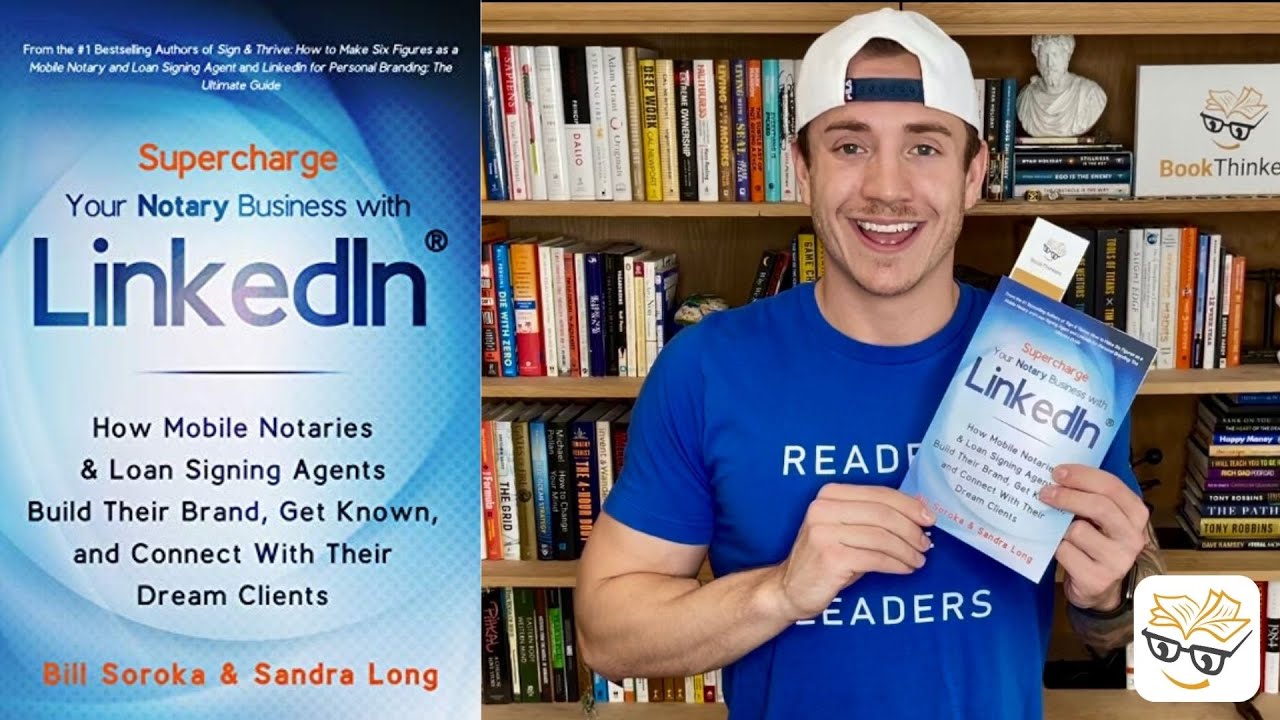
In this solo video, Nick Hutchison reviews the book Supercharge Your Notary Business with LinkedIn by Bill Soroka and Sandra Long and extracts four actionable takeaways for any professional looking to leverage LinkedIn. He first stresses the importance of a fully completed, SEO‑optimized personal profile, both for external search engines and LinkedIn’s internal search, noting that a complete profile dramatically increases visibility and leads. The second takeaway focuses on the About Me section, introducing Sandra Long’s 5H framework—Hook, Help, Human, Hot words, Hello/contact—and offering concrete prompts (e.g., story, client benefits, personality, industry keywords, contact info) to turn the bio into a sales‑oriented narrative. The third point urges creators to build a dedicated business page, keep it polished, and regularly post content, using the page as a brand‑level SEO asset. Finally, Hutchison explains the 80/20 rule: spend 80 % of LinkedIn activity on genuine engagement (commenting, connecting, asking questions) and only 20 % on direct selling, and he recommends daily micro‑actions such as adding 3–5 new connections and leaving thoughtful comments on 90 posts (the “$1.80” strategy). Throughout, he ties each tip back to measurable outcomes—profile views, compound network growth, and increased referral potential—while encouraging viewers to apply the concepts to any profession beyond mobile notaries.
Chapters
Hello, Book Thinkers family! I'm going to make you a bet, and that bet is that by the end of this video, you're going to learn something about LinkedIn that you probably didn't know. See, I thought I was a LinkedIn all-star until I read this book right here, Supercharge Your Notary Business with LinkedIn by Bill Soroka and Sandra Long. I've been using LinkedIn forever. I thought I was a LinkedIn all-star, and then I read this book and I realized that LinkedIn holds a lot more business potential than I thought it did. It's a fantastic tool for a lot of different reasons. And so I'm going to give you 4 reasons right now, and hopefully one of these is useful for you and you can implement it immediately. Number 1 is just the importance of your LinkedIn profile and filling it out in its entirety. LinkedIn is an amazing SEO tool, both externally, meaning outside of LinkedIn. It's great on Google and Bing and all of these other search engines. It ranks very highly if you fill out your profile completely. And then number 2, internally, There are so many things that you can do to pop up in that little search box on LinkedIn when people are searching for certain things. It's a great sales tool. It's kind of like a top end of a funnel. If you make yourself more visible, if you take the time to build out your LinkedIn profile and read this book, you will get more leads for your business or your personal brand, and you'll have more of an opportunity to connect with cool people. Number 2, your About Me section. I've never really paid attention to the About Me section, and mine's pretty weak. And so one of my homework items after this video is to go in there and rewrite my About Me section. Bill and Sandra go pretty far into detail in the book and give you some ideas of what you could put in here. So there's 2 things I want to read to you, 2 supercharged tips. The first is from Sandra, and she has this framework called the 5H format. And so you could put these 5 items in your About Me section. A hook— start with a compelling opening. Do you have a story about how you got into the business or what you do for work? Number 2, help. Describe how you help your clients. This is great from a sales perspective because if you describe how you help your clients, then that potential client can put themselves in that profile and sort of envision it, and you're creating a relationship with that person before you even start talking to them. Human. Add some personality, passion, or personal interest. People hire people. People buy from people. That's one of the biggest sales lessons out of the 50 sales books I've read too. Be a person. So number 4 is hot words. Incorporate keywords and notary language naturally. Notary meaning because this book is for mobile notaries and loan signing agents, but you can swap that out for whatever profession you're in. And then hello, add your contact information at the end. That's probably the only thing that I did the right way, adding my contact information into my about me bio. It's an opportunity to connect with people and show that you're a real human. And so there's some more supercharged tips over here that I want to give. Consider answering some of these questions in your About Me section: why you became XYZ, how you solve your clients' problems, why people should hire you or why people do hire you, who your clients are. You could put testimonials in there. How you got interested in your industry, how you manage your industry, and what other complementary offerings you have. And that's great if you have a portfolio of different things that you're involved in and why you love doing it. And then there's even more tips down below, but I don't want to spoil all of them. So that was my second biggest takeaway, which is I really, really, really need to spend more time on that About Me section, especially because I checked my profile views on LinkedIn and they're way higher than I thought. And so more people are paying attention, and there's an opportunity cost to not spending the time to develop that. I think, and this is off the top of my head, but I think that there were something like 2,600 characters that you can use, and I bet I'm only using 100 or something like that. My third biggest takeaway is that once you build out your personal page on LinkedIn, your personal profile, again, great for SEO, really good top of the sales opportunity, you need to build out a successful business page. You have the opportunity to create a dedicated business page that that highlights exactly what you do professionally. Book Thinkers has one, but we don't post on it ever because we're just lazy or we're not organized enough or we're not taking enough steps in the right direction on LinkedIn. Now I see the value in it. Now we're going to really start pumping content through that business page. Again, it ranks really high when people Google Book Thinkers. The Book Thinkers LinkedIn pops up, but it's a really poor-looking profile. So don't have a profile unless you're gonna beef it up. And if you do have a profile, you should beef it up. So that's my third biggest lesson. And my fourth is the 80/20 rule that I learned in this book. And I thought this was brilliant. 80% of your activity on LinkedIn should be engagement related, commenting on other people's posts, connection, connecting with new people, asking genuine questions, learning in a genuine way. That's what you should spend 80% of your time doing. And only 20% of your time selling through direct messages and comments and stuff like that on LinkedIn. A lot of people have it flipped. They're selling first, and I know that I'm doing a lot of that. So you're just selling right through DMs or you're selling right through connections and adding a little note. You don't want to be doing that. It needs to be more about a genuine opportunity to connect and build relationships, and only 20% of the time should you be selling. Now, right in that section is where I learned some good little daily dos and don'ts. I realized that the compound effect, which is my favorite thing in the entire world, and I've used it very heavily in Instagram, works in LinkedIn too. Every single day, as an example, you should be adding 3 to 5 people. You should be connecting with more people in your industry or prospective clients for whatever business you're in. And over time, that adds up. I mean, think a couple years from now, you're going to have thousands of new connections and thousands thousands of new people who have the opportunity to share your work or absorb it and might want to work with you or connect with you or make referrals or whatever the case is. And it only takes a couple minutes per day. So leverage the compound effect and spend 80% of your time engaging. The biggest thing that helped me grow Book Thinkers on Instagram at first was Gary Vaynerchuk's $1.80 strategy, where he basically says go out there into the community and and leave your 2 cents on 90 different posts every single day. And to get a little bit more granular, if you search a hashtag on Instagram, you could see the top 9 posts that are trending. Leave your 2 cents on all top 9 and do that 10 times. Now you hit your $1.80, and that gives other people in the community the opportunity to engage with you. It's not spammy. It's not, hey, come follow Book Thinkers. It's, hey, I really like that book. What'd you think about it? And engaging in real conversation. The other benefit from doing that and from leveraging this on LinkedIn is that you learn what other successful people are doing with their profiles and with their businesses. And so you can kind of consume a lot of information. That's what happened on Book Thinkers on Instagram too. I got to learn a lot about the business. So in wraps, I hope you learned something new. I hope my bet was correct because there's always an opportunity to learn. And this book specifically is for mobile notaries and loan signing agents. But like I said, you can swap that out, insert your job, and this book is a fantastic resource for you. As always, drop a comment down below. Let me know if you've read it. Let me know if you have any questions. If you want to connect with me on LinkedIn, I would be happy to do so and support whatever business you guys have going on. I love, you know, now that I learned this 80/20 principle on LinkedIn, I'm going to be engaging with a lot more content in my feed, which I was probably only doing once or twice per week maximum, only one or two posts. So big opportunity cost right there. And this is the end of the video. Go read something. Bye.