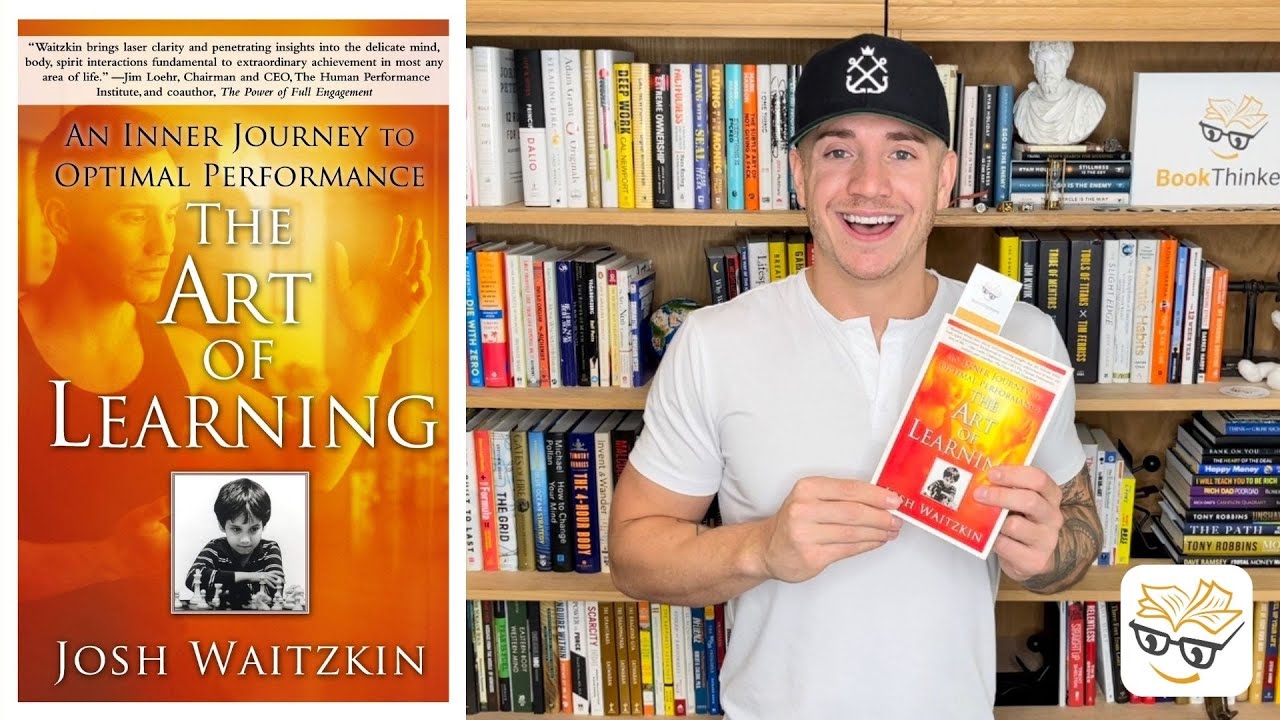
In this YouTube book review, Nick Hutchison introduces Josh Waitzkin’s The Art of Learning by first highlighting Waitzkin’s extraordinary achievements as an eight‑time national chess champion and a twenty‑plus‑time national martial‑arts champion. Hutchinson explains Waitzkin’s central learning framework—“form to leave form” (or “numbers to leave numbers”)—which describes how intense, repeated practice can embed skills so deeply that the subconscious executes them without conscious deliberation. He illustrates the concept with concrete examples from chess and martial arts, showing how mastery allows automatic, instinctive decision‑making in the moment. Hutchinson then critiques superficial learning tools such as Blinkist and MentorBox, arguing that brief summaries only provide a surface introduction and cannot produce the deep, subconscious competence the framework demands. He ties the discussion to neuroplasticity, noting that repeated, focused practice rewires neural pathways, enabling automatic behavior change over time. The video concludes with a call to action: readers should engage in deep, repeated study—reading multiple books on a subject—to achieve “national champion‑level” mastery in reading and personal development.
Chapters
Book Thinkers Family, imagine being a national chess champion in your youth, not once, not twice, but 8 times, and then going on to become a 20-something-time national martial arts champion and several-time world champion, right? Those 2 disciplines don't really match, do they? Well, for this author right here, they do. Book Thinkers Family, this is The Art of Learning by author Josh Waitzkin. I found Josh for the first time on the Tim Ferriss podcast, one of my favorite shows. And Josh's story fascinated me. I mean, he's the subject of the movie and the book Finding Bobby Fischer. That's how successful he was with chess in his youth. And I thought, man, I need to learn something from this guy. And so I read The Art of Learning, and I'm so happy that I did. See, this book teaches a framework of learning called form to leave form or numbers to leave numbers. And I thought it was so fascinating that now I talk about it all the time with my friends and family and And I try to teach this because this form to leave form or numbers to leave numbers thing means you need to ingrain something in your subconscious so intensely. You need to study something so deeply that your subconscious acts on your behalf. So we'll use 2 examples. We'll use one from chess and one from martial arts. Imagine that you study chess so intensely that while you're playing, you don't need to consciously think about what moves and playing different scenarios. Your subconscious just tells you where to play. It sounds kind of like fantasy, right? It doesn't sound like that could really happen, but that's what Josh did. You get in the game, you get in the zone, you don't think consciously, you don't apply logic, you just act with your subconscious. And all of a sudden you're an 8-time national chess champion and you're the subject of a movie about chess. Well, what about martial arts? The form to leave form part. You study martial arts so intensely, you know every single position you could possibly be in inside and out. You've gone through the repetitions a bazillion times, and all of a sudden you find yourself on the mat, you're facing an opponent, you're in a situation, and you just act immediately. You don't have time to think about all the different options you've learned and what the mechanics might be. That's how you become a 20-something-time national martial arts champion. Your form helps you to leave your form and your subconscious takes over. So why am I talking about this so much, and why am I so passionate? Because we need to do the same thing with books. It's very important. You need to study subjects so deeply, so intensely, that your subconscious looks for opportunities to implement it. That's how you become the national champion of reading. That's how you become the national champion of behavior change. You need to apply this, this framework for learning. So people ask me all the time about companies like Blinkist, which provide book summaries, or MentorBox. I love those platforms for certain things, but not as a final learning tool. Those subjects merely introduce you to a subject, and if you want to achieve national champion-level status at reading and behavior change, you need to study a little bit more intensely than that. You need to go a little bit deeper. Instead of reading a book, a book summary, or listening to a 15-minute book summary, you need to read 10 books on a subject. And that's what I try to talk about with behavior change, like Yes, you can read a book and it can change your life. I mean, neuroplasticity happens in one of two ways, and that big euphoric change can totally rewire your brain. But for most of us, it's slow steps in the right direction. It's hacking away at that path in your brain, and eventually, over time, through repetition, you can rewire your brain. Those neural pathways can change, and your subconscious can now Operate independently and automatically. But that takes work, man. It takes a lot of work. A book like this can help reinforce why you can't become a national chess champion overnight or a 20-something-time martial arts champion. You need to work. Repetition will help your form to leave form and your numbers to leave numbers. Such a cool concept. I hope you give this book a shot. Go read something. Bye.