The One AI Skill You Must Learn Now with Rajeev Kapur
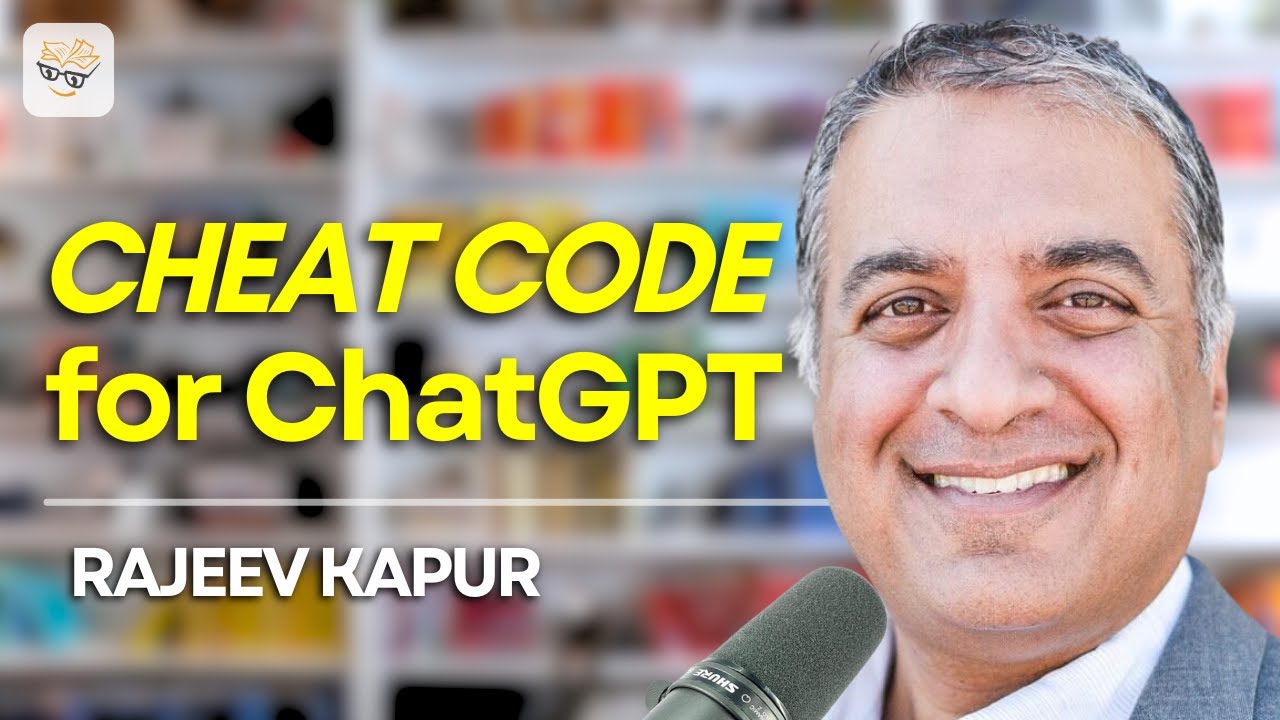
Rajeev Kapur breaks down prompting large language models, the core AI skill to learn now. He explains the RTCA framework (role, text, context, ask), shares how an 18-year-old built a $2M business with one AI employee, and warns about hallucinations and privacy risks.
Chapters
Don't worry that you don't get the prompt right the first time. It's okay. You know, chain prompt. Just have a conversation with ChatGPT. Pretend you're talking to me. Pretend they're talking to you. Just start with ChatGPT. Just start with ChatGPT and just start having a conversation. It's no different than maybe talking to a family member who's living overseas or maybe a client or an employee or a partner working overseas. Just have that conversation. Maybe you're stuck. Just start with, hey, ChatGPT, I'm stuck. So, just have the conversation. You don't have to go into this by knowing your full problem.
Rajiv, welcome back to The Book Thinkers Life-Changing Books Podcast. This is either your second or third interview, and I'm excited to dive into your newest book. But first, I have a fun question for you. Will you ever let AI or or an AI-infused robot walk your dog Chewy? Is there a day that that's going to happen?
Oh boy, you know, um, how do I answer that question? So here's the thing, you know Chewy's like my love of my life, right? And just like I know your dog is love of your life, uh, even though you have a brand new baby. Um, here's the thing, I think the day of robots walking our dogs is probably 10 years out from now. And Chewy may not be around then, which is kind of sad to think about, but let's just go with the premise that he is. I think the answer is probably in a pinch, sure, but most likely not, just because it's the way I get some exercise.
Yeah, it's the way I get exercise too. And, uh, how old is Chewy now? 8 years old?
He's 9. 9 and a half. He'll be 10 in February.
Yeah, beautiful dog. And you, you made a joke about robots walking dogs in the book at some point, and so I figured I would bring that out to start the conversation. But, uh, again, welcome back to the, to the podcast. Talk about Prompting Made Simple. So the first obvious question is, why prompting? Why'd you decide to write a book about prompting? And I guess, what is prompting for the audience?
Yeah, so First of all, what is prompting? So prompting is what you— when you open up ChatGPT or even Gemini or Grok, whatever one you prefer, it's what you write in the box. So just like when you do a Google search, it's what you write in the box. So in Google, when you search something, you don't call it prompting. But in AI, when you absolutely write in the window, it's not like a search. It's not like, hey, tell me about this book or typing in the title of the book. Pulls up Amazon, right? It's, it's more about telling a story within the prompt to try to give it to have you have it tell you a story or have it give you the proper response that you're looking for. And that's called you have to prompt it. So you have to prompt the AI in order to work with the AI in order to give you the answer you're looking for. So that's why it's called prompting. And there's 6 key takeaways for AI success. I'm not gonna get into all of them, but I'll tell you one of the 6 is absolutely all about— sorry, just wanted to turn my phone off. So one of the 6 is absolutely all about the ability to be a storyteller. So all of you liberal arts majors, all you English majors, and all you like theater majors, and all you people who are journalists, your time to shine is now. Like it's— so that's what's key. Like the more you know how to be eloquent and write and type within the box, of your ChatGPT window, the more, the more of a, the more, the more the response will be valuable to you. And so that's why I decided to write the book because storytelling is gonna become an art form. It's gonna be the most important thing people are gonna have to learn. Look, 99% of the population is not AI engineers. Right? So, you know, only 1% of the population is gonna be, like, super AI savvy and technologically crazy and all that stuff. Right? But the 99% of us who are not technically savvy like that, you know, are gonna have to learn how to use it, how to talk to it, how to really use it to enhance your life. And that's where prompting comes in. That's the number one skill I think every single person right now needs to learn. And it's an easy skill to learn. And I hope the book helps.
Yeah, well, the book is very easy to read and implement. You give a bunch of great examples and different types of prompting, which we'll get into in just a couple of minutes. There's a quote that I highlighted on page 44 of your book that I think cements this point really well. You say to master prompting, you need to become a storyteller. And I'll tell you, Rajiv, that my, my creativity has skyrocketed as a result of using AI. And what I, what I tend to do inside of that little box is usually I'm not typing. I have a hotkey on my keyboard that allows me to dictate. And so I'll talk like, let's say I was introducing you to somebody. I'll tell ChatGPT, which is my preferred AI, all about you, our relationship, all of the context for our relationship, the different projects we've collaborated on. And then I'll tell it about the person I'm looking to introduce you to. And then I'll talk about why I think the two of you should meet. And it will kick out a beautiful introduction email that has extra layers of emotional resonance. And it's because of that story that I told. So I think you're entirely right that We really need to focus on building out this skill set.
Yeah, listen, but like I said, I mean, as we've said, right, storytelling is going to be key. And the fact that you— now it's multimodal, so you can download the app on your phone or have it on your laptop or whatever, and you can talk to it and you can use it as a life coach. You can use it as a business coach. You can use it as someone to bounce ideas off of. You can use it like— oh, listen, I'm going to give you an example. So I have this guy I know in South Carolina. Okay?
Yes.
And he called me up one day and said, Rajiv, can I use ChatGPT to help me with my mental health? I said, okay, sure. And I don't know them really well. I mean, I know them, but I don't know them really well. And I was kinda surprised that he was opening up to me the way he was opening up. He was having some really mental health challenges. And so I taught him how to use the mobile app on his phone. I made him download it. I made him pay the $20 for ChatGPT. And, you know, I made him then go and I taught him how to have Speak to ChatGPT and have it speak back to you. And when you learn that prompting is also about getting ChatGPT to ask you questions, that's the real game changer. Right? So what I made him do is I went in there and I said, okay, I want you to do persona-based prompting, saying I want you to take on the role of an amazing therapist who's got years of experience working with executives, etcetera, etcetera, etcetera. And then I want you to describe the challenge you're facing. So I made him do it. He did it. He dictated it into the Into the app and everything like that. And he did it. He had entered and it started giving him some feedback. So I said, okay, I want you to do me a favor. I want you to talk to ChatGPT on the way to work and on the way home every day for 2 weeks. And let me know how you're feeling then from a mental health perspective. And by the way, I asked him, how come you're not talking to a therapist? He goes, you know, I did, but, you know, it's okay. It really wasn't working out for me. Plus, whenever I have sudden issues, I have to wait a month. And so it's all about augmenting what a therapist would do. It's not designed to replace a therapist. So I'm not saying— ChatGPT replaces the therapist. So he went, he did that, and, you know, and all of a sudden now he's having these full conversations with this AI that's acting like his therapist, and it's really helping him. You know, it really helped him from a business perspective, from a life perspective. He was having challenges with his 14-year-old daughter, so it gave him ideas on how to further connect with his daughter. So it just depends on how you wanna use it. So the more you can storytell your issue, your challenge you're facing, or the opportunity you might have, the better off your result's going to be. In this case, it helped them immensely.
I love something you said at the beginning of that, which was persona-based prompting. Why is it more important to tell ChatGPT what role it's providing for you than just asking the question outright?
Well, look, you want to have context, right? So think about it this way. If you are, you know, Let's hypothetically say you wanna run for mayor of Boston. Right? You know, who's probably someone that you probably idol— maybe as an idol or someone that you would, if you would hire as a coach to be your coach to help you guide you through the process of running for mayor of Boston? Well, maybe Barack Obama. So you go and you say, okay, hey, ChatGPT, I want you to take on the persona of Barack Obama. Now keep in mind, ChatGPT has been trained on everything that Barack Obama has ever said and done. Maybe you don't want Obama, maybe you want Trump, or maybe you want whomever you want. Maybe your goal is to one day to be an amazing financial trader. So you say, take on the persona of Warren Buffett and help me and take me through and be my mentor and act like Warren Buffett and walk me through how to become an amazing trader like Warren Buffett. So the more you can give it that context and that scope, The better your responses are gonna be, and you're gonna learn. It's like having a Warren Buffett or having a Steve Jobs or having somebody like that with side by side with you on your journey. And why wouldn't you want that? And for twenty bucks a month, like I have Steve Jobs over my corner, and I I always persona-based prompt with Steve Jobs whenever I'm doing anything business related or marketing related or product innovation related. I always say, hey, take on the role of Steve Jobs, be my business coach, and boom boom boom boom. Now here's the thing. I've also set up the prompt to say there's 2 versions of Steve Jobs. There was Steve Jobs before he got fired from Apple and the Steve Jobs that got hired after he came back to Apple. And those are 2 different types of Steve Jobs. So I can even say, hey, look, I want you to act like Steve Jobs, Steve Jobs who came back after he got fired from Apple and sold Pixar and came back to Apple as CEO, because that's a different kind of Steve Jobs. Steve Jobs was more collaborative as opposed to Steve Jobs who initially was, you know, a little bit of a challenge. So I wanted Steve Jobs 2.0 to be my coach, not Steve Jobs 1.0.
That's sparking so many ideas. I— when I read the book way back in the day, Think and Grow Rich by Napoleon Hill, I started to think about the mastermind principle. Napoleon talks about reading and studying these great mentors like Steve Jobs 2.0, and then as you come across a question in your life, ask that persona, ask that person how they would handle the situation. And he would envision these masterminds with maybe 4 or 5 people at the table in his head and build that committee to solve problems. And what you're doing, you might be able to build a virtual committee and you could have dozens of different perspectives. You could say, here's the problem. Now I'd like to hear the perspectives of Obama, Steve Jobs 2.0, and Rajiv Kapoor, and how would they each handle this situation? How would they battle each other? Blah, blah, blah. That's so cool. That's so cool. Yeah.
By the way, I appreciate you putting, I appreciate you putting me in the same breath as Obama and Steve Jobs. I appreciate that very much. No, look, yeah, here's the thing. I've actually done that. So I, I'll tell, and I'll give you 2 examples of what I've done. So you, you know, I run this company, 1105 Media. Great company, right? Great team. Amazing. Love it. So that, so I have a board and I'm on the board and I have a board and I have private equity in the business, etcetera, things like that. So I'll go into ChatGPT and I'll give it, and it's got a memory feature. So I'll, I'll tell it all about my different board members. Hey, this is this person's experience, what's important to them, etcetera, etcetera, etcetera. I'll upload their bio. Then I'll do the next board member, same thing, and the next board member, same thing, the next one. So I'll do that. So then I'll upload my board deck and I'll say, OK, I want you to pretend you're my board and walk me through this deck. What questions would each one of these board members ask me if this was a live board meeting? And so then it'll ask me questions like, oh, what's happening on slide 7? Why is growth down? Or why is this up? Or how can you do more of Y? Or whatever the case might be. So I've already done that. So that's one example of one case where I've already built that board, my personal mind, that board. The second case of that is that I actually have been contemplating investing, for example, in this new startup. So I actually have created an actual committee to review the investment. It's got Mark Cuban on it, it's got Steve Jobs on it, it's got Elon on it, and it's got— who's the one person? Can't remember now. Oh, it's got the lady from YouTube, Anne Wojcicki. And so anyways, it's got those 4 people on it. And so I uploaded the investor deck. I told them the thing. Ask me questions. What's the growth opportunity? What are the challenges? What are the pitfalls? Et cetera, et cetera, right? So it gives me responses. So I've actually already done it, and it's really easy to do it. Anybody can do this. You don't have to be a prompt engineer. You don't have to have a master's in science or an MBA or whatever to do any of these things, right? You don't have to be an electrical engineer or a software engineer or anything like that. All you gotta do is learn how to prompt. You know, all you do is learn. And by the way, I'm gonna give your, your listeners a cheat code. If you're ever stuck in prompting, ask ChatGPT to help you with the prompt.
Right?
That is true. Yeah. Right? I mean, so, so that's really it. So just remember, just go into that box and just be imaginative and use your imagination. You gotta let that inner Disney in you gotta come out. You have to let the inner child in you come out. Right? So it's just like, imagine when you were a kid sitting at, at home, and you're playing with crayons, you're just creating something from scratch. That's what prompting is. Just create that prompt, put it in, hit enter, and see where it takes you. And then just keep going down the rabbit hole. You know, it's gonna give you, it might give you 5 or 6 responses or, no, I'm sorry, 5 or 6 answers to your one question. But then you can go deeper and say, oh, I want you to go deeper in number 3 and go deeper and then go deeper and go deep, go deeper. And you can sit there and go for hours, you know, and then eventually you'll get to what you're looking for. And I know people out there using it for medical reasons, for mental health, for business growth, for new ideas, for startups. Like, I'll give you a story. So there's this kid I know, actually met his father, and he's in Barcelona. And he's— he is 18 years old. He started using ChatGPT when he was 16, back like when you and I first started talking about this stuff 2 years ago, Nick. And he literally dropped out of school because he built a company where his only employee is ChatGPT. He's 18 years old and he's doing $2 million a year in revenue. And he used ChatGPT to design new nasal strips. And he did that, he sourced it in through Alibaba. He used ChatGPT and Canva in the ChatGPT store to create the marketing for it, the logos and all that stuff. And he used Shopify and he uses ChatGPT to create his Instagram. And he only uses Instagram and TikTok to use those, create Instagram and TikTok scripts. He posts it and he's gonna do $2 million revenue this year just selling nasal strips. I mean, employee of one. And by the way, somebody someplace is sitting in their parents' house or garage or wherever they are gonna build the next billion-dollar business with only one employee.
Yeah, I saw some of the, some of the stats you had in the book around the AI market is expected to reach $1,339 billion by 2030. And that's just the AI market itself, not all of the applications of people using it to build nasal strips. And it's just obviously it's taken the world by storm. Now, for somebody who's totally overwhelmed listening to this and they're like, okay, well, I'm nowhere close to building a $2 million a year business. I don't even know the basics of prompting. We have this book, Prompting Made Simple. Why should somebody pick it up if they feel like, ah, that's kind of past my time? I'm not really into AI. I don't want to spend the time learning it.
So here's the thing. Like, I get it and I understand. All I can tell you is that in the next few years, there's gonna be a lot of job disruption. There's going to be at all levels, white collar jobs down to blue collar jobs. It's gonna be there. But there's also gonna be new jobs gonna be created, and those jobs are all gonna be around AI. So here's the thing. If you're listening to this and you're not embracing AI, I can tell you this, there's a good chance you're gonna lose your job. Now, The way to keep your job and to, and to be a leader within your organization is to learn AI. Because if you lose your job, you're gonna get replaced by somebody who knows AI. So you have to learn it. You have to start now. And it's easy. I mean, my first book, AI Made Simple, the 3rd edition of it's coming out in about 3 weeks. I'm sure we'll talk again about that. But AI Made Simple is great. And don't wanna read my books, go read other people's books. Listen to podcasts on AI, whatever it might be. Just start learning. And I can tell you, the simplest, most easiest thing to master in AI is prompting. It's easy. So that's why it's called Prompting Made Simple. So check it out.
We'll give the audience a couple of other use cases, and then I have some more questions directly from the book. Something that I've, I've found really helpful is whenever— now, this is from a sales perspective, and I know that there are a lot of small business owners and professionals In the audience today. So Rajiv, when, when I host a sales call and I meet a new author and they're telling me about their book, I have the Zoom AI agent running in the background and it provides not a full transcript, but different summary points and main takeaways from the conversation. Then I'll feed that into ChatGPT as well as, as much context as possible for the call, like their book description from Amazon, their website links, all of their past accomplishments, who they are, what their goals are, et cetera. Mm-hmm. And then I'll have it cater the follow-up to be as emotionally resonant as humanly possible. And it has not only improved the efficiency of my follow-up, it takes a lot less time to follow up with people, but it also improves the quality of my follow-up. And so that's just one of many examples of how I've been using it. And at this point, ChatGPT, I mean, I've been using it for years now and it knows so much about me that I feel like It's, uh, you know, I'm still practicing with my brain. I'm trying not to atrophy on my own email writing skills, but at the same time, it's hard not to use these platforms.
Yeah, I mean, you're doing the right things. I mean, it's not just for you, it's for you. You've done an amazing job. You're an amazing entrepreneur. You've got, you know, you're building out, you've got a nice-sized staff. You know, one of the things you got coming up are these events you got coming up, and one of the things where you can use is take all that content you've built over the years You upload into ChatGPT and say, hey, based on this, what are the 3 things that people are struggling with maybe in writing a book? And it'll tell you based on this, what are the sessions we need to have at our event? Right? So there's so many, and that's all designed to make your events to be even to be stickier, more impactful, to get more people to attend and make it a more valuable experience. And that's what, if you prompt it right, that's what ChatGPT is there to do.
Yeah. And we, we had a little bit of this conversation last time we talked, but What are your thoughts around AI and its role in writing books? And do you, do you lose some of the, some of the personal brand if AI is writing your book for you, or does it allow you to get content out that you wouldn't have been able to communicate clearly otherwise? I mean, what are your thoughts on the book industry and AI?
Well, that's, so that's a good question. So, you know, John Oliver just had this thing on his show a couple of weeks ago called the AI Slop. The challenge is there's a lot of AI slop out there. And I think what you're seeing is these AI farms, whether they're in China, India, wherever they are, they're replicating a bunch of junk, right? You can see that right now on Instagram and a lot of the YouTube, these AI videos, you know, on YouTube. And in fact, I think Google did the right thing where they're saying they're no longer monetized AI YouTube.
I think that's the right thing as well.
That's truly the right way to go. And, you know, so look, the challenge, like, the problem with my book being out there now is that within a week, there's gonna be 5 versions of my book called AI Made Simple or Prompting Made Simple, right? And that's just the world you live in, and Amazon, I'm not gonna police it because they don't care. So that's fine. It is what it is. But here's the thing. I did not use AI to write the book. Did I use AI as a guide to help me think about ideas and chapters? Absolutely. That I use AI to help me think about, okay, hey, these are the 5 different types of persona or the 5 different types of prompting methods I wanna write about. You know, did I get it right? Is something I missed? So for example, in the one of the, one of the prompting methods I talk about is this role text context ask, right? It's RTCA. And so I forgot the context part. And it came back and said, well, you want to be able to provide more context. So if you think about it, so it's like, here's the role. The role is I want you to take on the role of an expert chef. The task is I want your help to help me walk through the steps on opening my own restaurant in Boston. But I forgot to put context. The context is Oh, I am a chef myself. I actually had a restaurant that I sold or it failed. So you have to give it the context and then you make it the ask, come up with a plan, gimme step by step by whatever. Right. So when I, you know, that helped me catch it. So I made it a better book. So yeah, I mean, so if you use it as a partner to augment what you do, it's no different than saying, you know, having a, you know, having a publisher or an editor to also help you do the same thing, in my opinion. But don't use it to write the whole book.
I agree. Don't use it to write the whole book, but use it to communicate what you're trying to say with more clarity, because then it can be better received by the reader. So Rajiv, you have this really funny short story in the book around soup that I think highlights the point you just made really clearly, and I'm going to read it directly from the book. It kicks off chapter 3. You say, imagine you're a server at a restaurant. You ask a diner sitting by himself what he wants to eat, and the guy simply says, give me soup. You respond, what kind of soup? We have— And then he cuts you off. Just soup. He snaps, indicating the conversation is over. So you shrug, you go back to the kitchen and eventually show up with a bowl of tomato soup, which you put in front of him. The diner looks at it and he's enraged. No, no, no, no, no. I wanted chicken noodle with crackers. Well, of course, the diner never said any of that, and yet he's shocked that you didn't deliver exactly what he wanted. Well, you go on to say in this area of the book that the most important truth to remember when using prompts in ChatGPT or any AI device is that the more details you provide, the closer generative AI can come to delivering what you need. And I think that's the moral of what you were just saying.
Yeah, I mean, again, use it to augment what you want and just remember that the AI is only gonna be dumb if you allow it to be dumb. Right.
So it's your fault if AI doesn't give you the right answer.
Look, does AI hallucinate and make mistakes? Sure. But if you just go to ChatGPT and say, hey, I like soup, give me a recipe, it's gonna say— it's probably gonna start by saying, well, okay, well, it's smart enough to say, okay, what kind of soup do you like? Blah, blah, blah. And you might say, no, just give me any soup. Okay. And it's probably just gonna go into its database and say, okay, well, The whole world, the number one soup in the world is probably minestrone. So let me just give you minestrone soup. And you're gonna say, well, that's not what I wanted. So again, AI is a tool, right? So when you think about AI, it's just a tool. So think about this, right? It's the combustion engine for your car. So when you sit in your car and you've got a Ferrari and you go and you're scared and you go 20 miles an hour because it's a brand new Ferrari and you're scared of wrecking it, Is that the engine's fault or is that your fault?
My fault.
Your fault. It's your fault. So if you— so now if all of a sudden, you know, you, you get in that car and you floor it and it goes 100 miles an hour and all of a sudden you, you lose control and you skid or whatever and you crash it, sure, that might be, that might be, you know, the car's fault because it hasn't adjusted, you know, to the speed or what's happening, whatever the case might be. But so the same thing goes here. So the thing you have to watch out for in these cases is hallucinations. So it is gonna hallucinate. It's gonna make stuff up. So I'll give you an example. I did something yesterday and it hallucinated and I had to correct it. So it's not perfect. It's gonna make mistakes. So you have to go back and you have to recheck your work, you know, double-check your work. And that's why I tell people, never put anything— don't put any specific personal modifiers in your prompt. So never put a bank account, never put a password, never put, you know, account numbers, or any— never put any of that stuff. Like, if you're gonna upload your blood work, you know, highlight out, you know, Black out your name and whatever, whatever personal modifiers are and say, okay, compare my blood work from 3 months ago to my blood work now. Just make sure everything's, you know, highlighted out. So again, it's gonna make mistakes, it's gonna have issues, it's gonna have challenges. It's not foolproof, it's not 100% satisfaction guaranteed. So double-check your work.
I, I used it, uh, to analyze blood work recently, and I didn't feed all of the data into ChatGPT because the platform that I was using for my blood work already has AI built into it, but I wanted to ask some follow-up questions. And so there was a specific marker that was high during my last blood session— my, my last blood session, my last blood work— and I fed it into ChatGPT and I said, what could be the causes of why it went from here to here? And it started to list them, and I saw very quickly it was a, it was a marker in my liver and another one in my kidney. And I saw very quickly that it was either Uh, fatty liver disease, which comes from consuming a lot of alcohol, which I don't, or, uh, this muscle breakdown that comes when you exercise too hard called rhabdo. And I had exercised too hard before doing my blood work. And so I was like, okay, like I can relax a little bit. I'll retest my blood in a couple of weeks. But as it did the analysis for me and as I dove a little bit deeper, it kind of calmed my fear there for a minute. And it's just another fun use of AI.
Yeah, yeah. I mean, it's just another, just another tool, right? It's just another tool to help, you know, to help you. It's like, I think the challenge here is like, if you think about Google, right, you might before ChatGPT, you would have gone into Google, maybe searched it, and you end up on WebMD. The problem is every WebMD result always ends up you might die. Like one of the options they put in there is you might die, right? So, oh, liver, blah blah blah. Oh, it could be oh whatever.
Da da da.
The seventh option is. Get it checked because you might die. It's like every single one. Oh, I cut my toenail wrong. It's infected. Well, you better go check it out because if you don't get it fixed in the next 3 months, you're going to die. So it's like, look, you got to be careful. Just double-check, double, triple-check your work. So I do the same thing with my doctor. I'll actually send him the results. So I actually broke my wrist. I don't have the— I took the brace off about 2 months ago, and it's healing. And I remember walking in. I remember that I went to the urgent care to get the X-ray. And it's a small fracture. It's tiny. And, you know, I went in there and I said— and they took the X-ray and it's sitting there and the radiologist there. And I said, don't tell me. I walked up. I go, I want to take a picture of the X-ray. So I took a picture of the X-ray. I uploaded it to ChatGPT. I say, ChatGPT, what is this and what did I do? And it said, that's a picture of your right hand. And I see that you have a fracture. It's one of these 3 types of fractures. And one of the 3 types of fractures that listed Number one was an avulsion fracture of my right wrist underneath my underneath my right thumb, and sure enough, I went to see my buddy who is the orthopedic doctor the next day. I said, "What did I do?" He goes, "Well, you have an avulsion fracture of your right wrist." Da da da da. So I showed him the ChatGPT result. Oh my God! I'm losing my job. So you can see, like when you when you think about that, when you even when you think about medicine in the future, like all triage in the future, Nick, is all going to be done by AI. You know, you walk in, you know, it's going to scan your eye, it's going to do your, your, you know, your blood pressure. All that triage stuff's going to be— and that's going to free up more time for nurses and doctors to spend more time with patients.
Yeah. You also give the example at the beginning of the book, uh, like I think it was Wendy's— was it Wendy's? What they're doing? Yeah. And, uh, just that AI is taking the order, and if you say milkshake, it knows that you meant Frosty. And then now they're building these underground like, you know, robotic type things that are integrated with the AI to help keep your fries warm and deliver them to people who are just picking up. Like, it's all this crazy stuff. And, and, uh, I'm excited to continue reading your work because then I can stay on the right side of this. I can stay in the population of people who is consistently playing around and experimenting and understanding how these AI systems work. As we get ready to wrap up, tell us a little bit more about your speaking and your advising. I know that that's a big focus of yours.
Yeah, no, you know, since we last spoke, like I've been speaking all over the world. I spoke in Barcelona, Paris, like all over the world. I speak to a lot of YPO, the Young Presidents Organization that you know about. I joined that thing when I was young, so a lot older now. A lot of these YPO-like companies, you know, I speak to a lot of chapters, keynotes. I've done keynotes in Chicago, Barcelona, I'm doing a big one in Sydney in February of next year. So yeah, so I've been speaking all over the world. I have, I've got a couple of, I've got a few advisory clients that I work with now on AI. I sit on a couple of AI boards. Patchworks AI is a great company out of Dallas. They're amazing. They do a lot of development work. And then Luminova is a great AI company focusing on, you know, really bringing ethics and guidance to AI and those kinds of things. So It's been great. It's been an amazing journey. I love it. And company's doing well, 1105. And so it's been a lot of fun. It's been a great journey. So if anybody's looking for a keynote speaker or someone to come in, needs any help in their company, you know, let me know. Reach out. Yeah.
Too bad you were already booked for the dates of my Book Thinkers event later this year.
Oh, we'll do it next year.
Yeah, absolutely. Yes, we will. Okay. I'll ask—
Can I wear my Lakers? Can I wear a Lakers jersey? Can I wear a Kobe jersey?
Boston's a rough city, as you know. I would not recommend Boston.
But you guys like—
yes, that is true. Actually, Jimmy, you'll find this interesting. Jimmy Soni, who has written— he wrote a book called The Founders, which was all about the PayPal Mafia back in the day. He's Walter Isaacson's mentee who writes a lot of those iconic books like Steve Jobs. He's doing a book on Kobe and a really, really, really deep dive biography into Kobe. So I'll make sure I get you an early copy of that.
Oh, that's awesome. I'd love it. Yeah, it's awesome.
He's, uh, he'll be at the Book Thinkers event again this year and probably next year, so get a chance to meet with him. So, uh, where can people go to get a copy of your book and learn more about you?
Look, really simple. First of all, get a copy of the book. Just go to Amazon, you know, look up Rajiv Kapoor Prompting Made Simple. You'll also find probably AI Made Simple, the second edition, but there's a New version of that coming out in about 3 weeks. So don't buy that one yet. But Prompting Made Simple is out today. There's a special Kindle launch price for the next couple of weeks. It's only $1. Because that's the way the Amazon game is played, right, as you know. So check that out. So that's where you can get the book. In terms of getting hold of me, LinkedIn is a great place. You know, look me up on LinkedIn, Rajiv Kapoor. There's a few Rajiv Kapoors, but you'll know which one is me when you see the banner up there. So that's, that's number one. Instagram @therajivthapoor. You can also get a hold of me, and then, you know, and then they can always message you and you can put them in touch with me as well.
Well, Rajiv, if, uh, if you haven't screenshotted these already, your paperback right now is the number 1 new release in artificial intelligence expert systems.
Oh, awesome.
And your Kindle is the number 1 new release in neural networks, which is fun.
That's cool. That's awesome. Hopefully we keep that momentum going. Thank you.
Couple of rapid-fire questions and then I'll let you go today. The first is this: if Prompting Made Simple was deleted but you could leave the world with just one message from it, what would that message be?
Um, you know, that's a good question. I would tell you, I think the number one most important message is don't worry that you don't get the prompt right the first time. It's okay. You know, chain prompt. Just have a conversation with ChatGPT. Pretend you're talking to me. Pretend they're talking to you. Just start with ChatGPT. Just start with ChatGPT and just start having a conversation. It's no different than maybe talking to a family member who's living overseas, or maybe a client or an employee or a partner working overseas. Just have that conversation. Maybe you're stuck. Just start with, hey, ChatGPT, I'm stuck. So just have the conversation. You don't have to go into this by knowing your whole prompt up front.
Yeah, chain prompting is so great because oftentimes I'll ask it to write an email or a blurb or a caption for something, and then it'll come back and I'll say, hey, remove this section and make it about 40% shorter, and please add this quote, and it'll do it. And then that version kicks back and maybe I'll modify it 2 or 3 more times. But you're right, it's about getting deeper. Who is your biggest influence in the AI space? Who do you look up to? What do you follow?
Oh, boy. I don't know if I have one kind of big influence in the AI space. I got my certifications in AI from MIT. I think all those guys are amazing. I think what you're seeing, what the OpenAI guys are doing, Sam Altman, I think what they're doing, I think with Satya Nadella, the way he's continued to transform Microsoft, what they're doing. I gotta tell you, Google to me is a real conundrum just because they had this whole thing and they didn't monetize it, they didn't productize it. We'll see what happens with Brock. Zuckerberg's got some things going on. He's going crazy right now in terms of what he's doing in terms of hiring people. But I would tell you that I think when it comes to who to follow, what's happening in the AI space, I'd really focus around the Microsoft OpenAI relationship. And then I would also argue that I think what Nvidia is doing and how they're shaping it, because none of this would work if Nvidia didn't have the chips. And Jensen's really doing a lot of great things. Like what they're enabling, what they're going to enable from a robotics perspective and health perspective is all going to be on the back of the Nvidia chips. So keep your eye on Jensen Huang, Nvidia, Sam Altman, Satya Nadella. I think those are really the cool guys To really look out for. And then you've got a bunch of other influencers coming up who are amazing. Mara Taya is really good on Instagram. There's Whitney Bellamonte. She's really good. She's relatively new to the space, but she's really good. So, so that you have a couple of these influencers who are really starting to make some hay. And so I think, you know, and then in terms of newsletters, there's a great newsletter called the TLDR Newsletter. I'll eventually have my own here pretty soon, but the TLDR .ai newsletter is actually pretty good. And you'll see like on Instagram, evolving.ai and Riz of AI, they do a really good job of summary what's happening, summarizing what's happening in the AI space.
Yeah, good. Well, thank you for those suggestions. Okay, final question. Why is your favorite platform to use ChatGPT?
Well, part of it is because it was the first, right?
That's what happened to me too. Yeah, so it was a cost bias a little bit.
Yeah, yeah. So, so part of it was the first. No. So Gemini came out shortly after, but it had problems. It was making a lot of mistakes, a lot of issues. So it's, I stuck with ChatGPT. And so it's kind of like sticking with iPhone over Android, right? Type of a situation. Now Gemini's getting better. They're doing some amazing things, especially in the med space. They're doing some kick-ass stuff in the med space. Where the other guys land, we'll see, you know, Claude by Anthropic, which is an Amazon-backed business, does pretty well on the writing. Creative side of things, struggles in other places. I'm not a big fan of Grok just because it's so Twitter-focused or X-focused. And it's a challenge for me when it's dropping things like Mecha Hitler stuff, right? And that's the challenge for me to use the platform when it's doing those kinds of things. Instagram, we'll see what happens with them. But again, it's kind of vertically focused on their vertical data set, right? Which is Instagram, WhatsApp, Facebook, those things. Great data sets. I mean, 80% of the world's social media goes through those 3 platforms. So, you know, who knows, you know? But to me, ChatGPT is the best, broadest, biggest. And keep in mind, it's 49% of the ownership is owned by Microsoft. So it's not just OpenAI, ChatGPT, it's Microsoft is, is, is the sugar daddy behind it. And, you know, you can't go wrong with Microsoft backing it.
Yeah, there's that first mover advantage. And then from a user perspective, there's a sunk cost bias when it has I mean, to export all of that context and then put it into a new system just seems like too much, too much effort.
Yeah. And look, here's the thing. Grok came out with a new update this week and they're saying it's the best. Well, you know what's going to happen next week? Meta is going to come out with an update asking me the best, and then ChatGPT will come out with an update or whatever. So it's just going to keep getting— they're just going to keep leapfrogging each other for a while, number one. And then you get the Chinese guys, the DeepSeek and all those things. You know, they're out there. We'll see what happens. I don't like to use those platforms just because everything you put in them goes right to the Chinese government. And by the way, given where we are right now, I'm sure everything I do goes to our US government. Who knows what's happening with Palantir and these things, but I'd rather keep it in the US than go to China. But I'll give you an example, and we can end here if you want. But I was at a conference in Barcelona, and I already knew the answer to this, and I had asked DeepSeek, You know, what are you? Um, and the answer was, I'm what happens when you carve hunger from your God.
Hmm.
I'm like, whoa, that's deep. All right. And so that's— I'm like, all right, that, that, that's way out there. And so I think— Yeah, that's—
yeah, yeah, yeah. Well, that's a good place to end. Thank you so much for the conversation today. And you're right, I'll probably see you in a couple more weeks.
Yep. Take care, everybody. Thank you so much.
More from Nick

Napoleon Hill’s “Think and Grow Rich” is a timeless classic #selfhelp #personaldevelopment

4 Books to Help You Get Better at Decision Making #selfhelpbooks #bookrecs #nonfictionbooks


Have you read this book yet? 📖: The 5AM Club by Robin Sharma #selfhelpbooks #robinsharma

Dan Sullivan on Listening to Your Customers Instead of Watching Your Competitors

5 Books That Will Boost Your Financial Intelligence #financialfreedom #nonfictionbooks

The People That Preach the Loudest About Virtue are Usually the Most Power Hungry



Books are the greatest mentors you can find #selfhelpbooks #businessbooks #successmindset

Let’s fight this toxic instant gratification culture together 📖 #selfhelpbooks #jimkwik