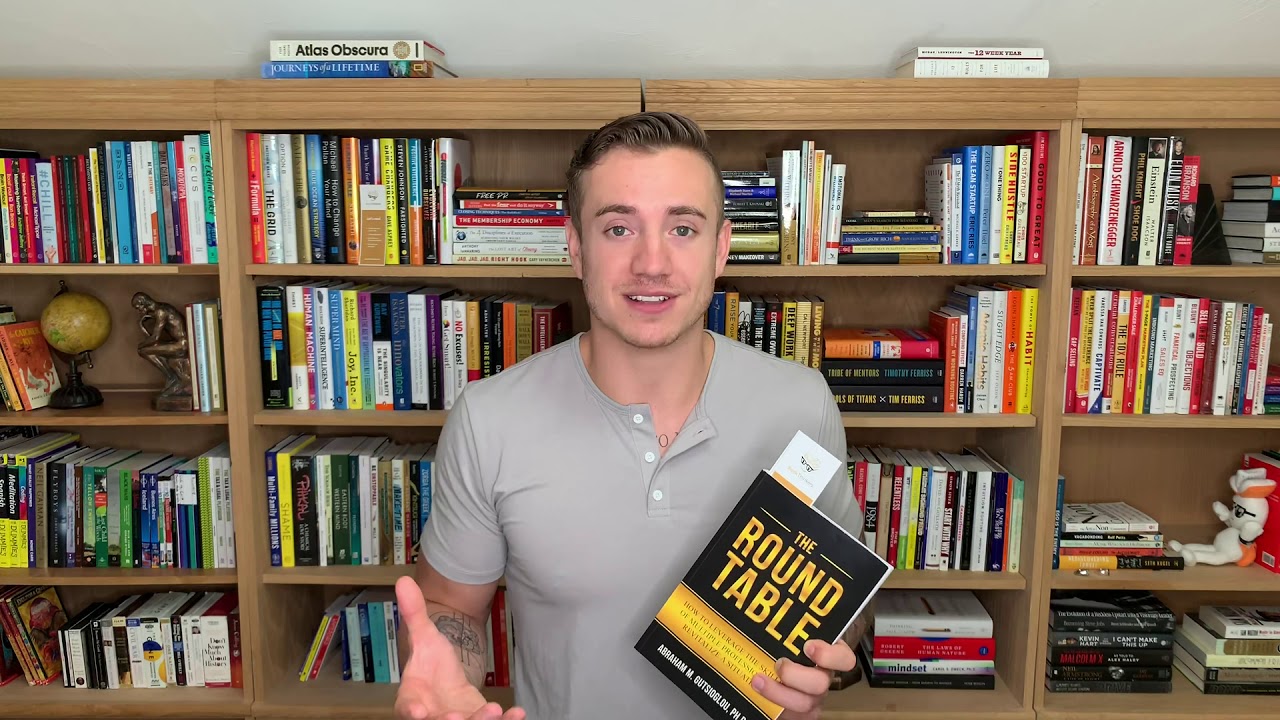
Nick Hutchinson reviews Abraham M. Gatsioglou's The Round Table, which teaches fixers to diagnose problems by drawing on seven professional roles: psychologist, investigator, researcher, diagnostician, air-traffic controller, campaign strategist, and lawyer. The diagnostician's framework uses eight categories—symptoms, impact, timing, location, roots, blockers, support system, solutions—to map business challenges.
Chapters
Hello, Book Thinkers family! Today's book tip is going to come from The Round Table by Abraham M. Gatsioglou, PhD. The subtitle of this book is How to Leverage the Skills of Multiple Professions to Revitalize a Situation. I loved reading this book because this entire book is a metaphor for something that I've been doing for a long time. It actually all started a couple years ago when I watched a TED Talk and the presenter on stage said, hey, listen, audience, You can read books in all of these different professions, in all of these different disciplines, and you can pick and choose what's relevant to your life, put those tools into your tool belt, and then choose when to use them. You don't need to use all of them every day, but what reading a book might do is prepare you for a situation that you haven't tackled yet. But when you reach it, you'll know what tool to use and you'll be more successful, or you'll have less of a difficult time overcoming that challenge. So this book is very similar, and I think that in one of the opening paragraphs Abraham does a fantastic job at describing exactly what the roundtable is. So he says, imagine this: a challenge has presented itself where your client needs a fixer. A fixer is somebody who's a turnaround specialist. They can go into a situation, properly analyze and diagnose the situation, turn it around, fix it, revitalize it. That's what a fixer is. They need your help turning things around. Visualize yourself sitting at the roundtable. A place where all perspectives are respected and all professions are treated as peers. That's important because you need to be open to analyzing things from a lot of different perspectives, and you need to respect all of them. As you sit there being your cool, calm, and collected, uh, self, you take a look and glance to your left at your psychologist. Your psychologist is the person that you leverage when you need psychological expertise. Then as you move clockwise around the table, you make eye contact with your investigator, your researcher, your diagnostician, air traffic controller, campaign strategist, and lawyer. What's nice about that metaphor, the round table, is that you get to sit there and look everybody in the eye and understand and respect what they do and what they can bring to the table. Now, if it's situation 1, You might need 3 or 4 of those perspectives. If it's situation 2, you might need all of them. If it's situation 3, you might only need to leverage the skill set and expertise of one of them. But the nice thing is that day or night, they're ready for you to leverage their expertise. What this book does is bring you through each one of those 7 professions and tells you where it's appropriate to leverage the skill sets of those people and what are the skill sets of those people. And then they talk a little bit more in depth about how you can learn more about those professions, what skill sets you should expect to understand about them. There's a lot of great information in this book. One of the biggest takeaways for me was from the diagnostician— how to properly diagnose a situation. And under a subparagraph called differential diagnosis, there's an understanding that when a doctor is looking at symptoms, it could relate to a lot of different illnesses or diseases. So what they need to do is ask that client or patient many questions to help properly understand where those symptoms are pointing. And what they actually do is they create this chart with a bunch of sticky notes, and there are 8 categories. So in each one of those categories, they put a bunch of different sticky notes that helps answer their questions. And I'll tell you what those 8 categories are in just a moment. And then they try to create patterns, or they try to notice similarities between the different categories. The same thing can be done in business. So when I read these to you, look at it through the lens of business, or you being a fixer looking at a situation and trying to do better by your client in a business situation. So the 8 are symptoms, impact, timing, location, roots, blockers and barriers, Support system, and solutions. I'll read a couple of these just to give you an example of what belongs in each one of those categories. But remember, you're trying to help differentiate your diagnosis. You're trying to make sure that the symptoms point towards the right solution and that you're tackling the right root cause. So impact, for instance, impact on the organization, team, self, or individuals. Sometimes people don't look at it through that lens and they don't try to differentiate where those symptoms are affecting. Timing. When do symptoms, behaviors, and challenges come to the surface? Location. Places where it occurs. Is it widespread or is it isolated to a group of people, to a specific division of your company, to a specific customer? Those are all things that you want to think about when you're looking at problems in your organization. Roots. Possible causes and triggers. Blockers and barriers. What is getting in the way or could get in the way of it stopping or getting better. Support system: people or things available to support, provide, and sustain progress. So these are all different categories to help think about, but it'll help you properly diagnose the situation. That's one example or exercise in just one of those different 7 categories or professions that helps show you a little bit about what this book's about. I love this book. I think that if you're somebody who in your professional day-to-day life has to analyze situations and then provide solutions, You should probably read this book. Abraham, you did a fantastic job. And with that, I hope everybody has a fantastic day. All right, bye.