Unlock Your TRUE Potential | with Adam Hergenrother
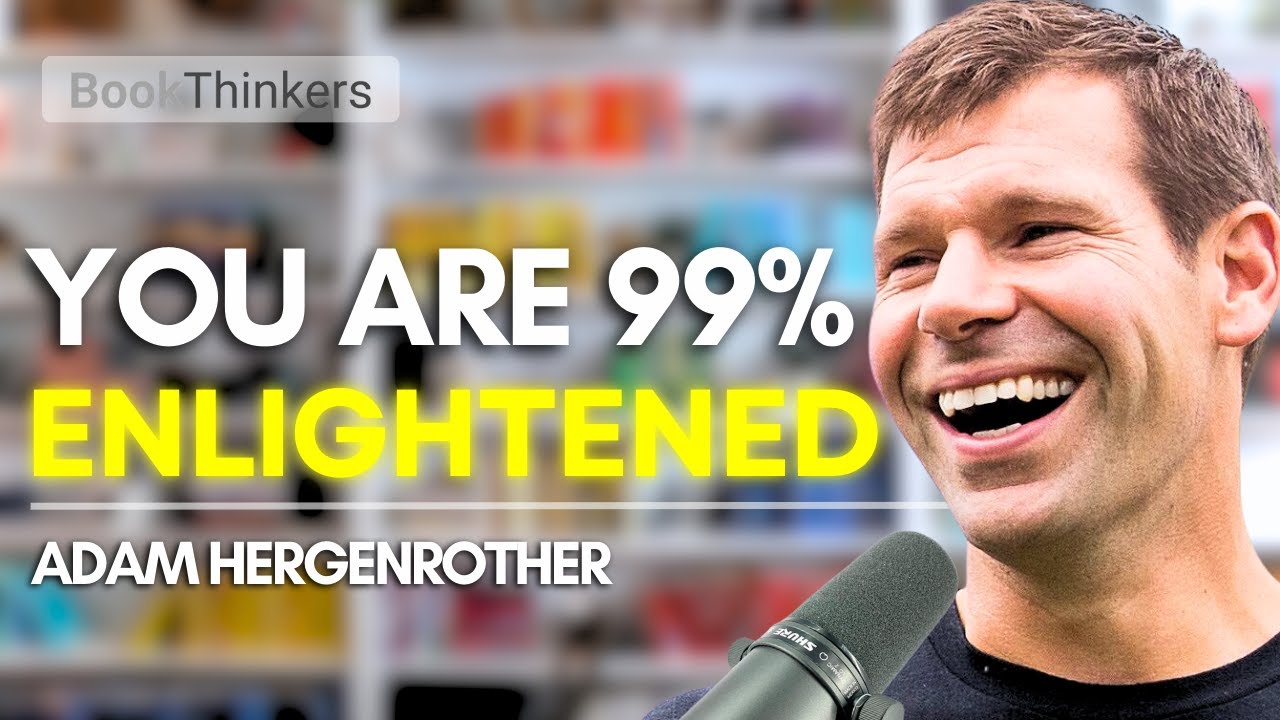
In this podcast episode of the Book Thinkers Life‑Changing Books Podcast, Adam Hergenrother discusses his personal transformation from a troubled, overweight teen to a successful entrepreneur and author of The 200% Life. He explains that conventional success—money, fame, power—is a distraction that leaves a lingering void. True fulfillment comes from aligning the outer world (external actions) with the inner world (thoughts, emotions, spiritual awareness). Hergenrother introduces his 200% Life framework, which blends personal growth, Transcendental Meditation (TM), and a practical "Relax, Release, Act" (RRA) process for handling disturbances. He describes the concept of "people, places, and things" as temporary crutches, and explains samskaras—stored energetic impressions that shape emotional reactions. By developing emotional fitness, releasing samskaras, and surrendering to the deeper self, one can achieve a life that feels both outwardly successful and inwardly complete. The conversation also touches on his mentorship influences, the book he most often gifts (The Untethered Soul), and practical advice for listeners seeking to move from external achievement to inner fulfillment.
Chapters
It's not about renouncing anything out of life. It's actually about leaning into the 100% outer world and leaning into 100% inner world. And when those 2 things align, your life actually ends up being a 200%. We're, we're told that success is getting money, fame, power, authority, leverage, so that we can then go out there and control the situations around us so that we're not disturbed.
Yeah.
I think people use people, places, and things, right? A lot of people use people. People use business. People use money. People use fame, power, any of that. As a way to distract themselves from themselves. Life, you're actually 99% enlightened. I mean, seriously, you're already there. All these other things pass right through you like you're a sojourner in the midst of the quality of nature. You're just here. Because once you accomplish whatever your goal is, again, it could be the Olympics and you win a gold medal, it could be a business, it could be having a family, it could be getting a job, it could be, you know, traveling to a new country, whatever it is, you, you get and accomplish these things, at some point it just dawns on you That this doesn't work. Why am I still feeling this void or this itch? And it's because—
Adam Hergenrother, welcome to the Book Thinkers Life-Changing Books Podcast. We're excited to get to talk to you and learn about your new book, The 200% Life. We're excited to get into it. I'd love to start with 15-year-old Adam, 100 pounds overweight. You turned to drugs to cover up your insecurities, but one day you decided to change. What happened in your life that made you want to change everything at such a young age?
Luke, Nick, thanks so much for having me on, and I appreciate all the work that you guys do and the value that you add to your audience, your community. So, I know how much work goes into it. So, thanks for doing what you do.
Thank you.
That's a great place to start. Thank you. Up until that moment, I was really living somebody else's life. I was really insecure about myself. I was really— I don't say this much publicly, but I was actually lying a lot, like little white lies, like things like, they're like, oh, did you— Run that mile. It's like, I ran 2, right? Like, whatever it was, like, just trying to always posture to try to be somebody that I wasn't so somebody would look at me and almost like not look at like who I thought I was at that moment. And this all kind of came to a head when I was about 15 and I was 100 pounds overweight, like you said, in the recreational drugs, failing classes, and that role model student you wanted your kids to hang out with in high school. And finally, one day I came home and I put Celine Dion on. I mean, I know it's Celine Dion, but for some reason, that track was going. And I stayed up. I was in between half crying and half visualizing and just something inside. And it's kind of more of a knowing. I think we all have these experiences when the chemistry of a transformation in our body, we kind of bring ourselves to these moments where we have these opportunities to kind of jump through. I think a lot of people fail to take that last step, which is the scariest one, which is to kind of jump through the hoop. And for me, I'd probably been faced there before, but this time, it was I think I'd suffered enough that it was worse going back to the life that I was than the fear of the unknown kind of going forward. So, I just decided to take that step. And the next day, I stopped hanging out with all these friends, if you will, and they hated that. And we ended up 2 weeks, it was like police were called every day because there was fights and they broke my windows. They threatened me with knives and guns. I mean, dude, it was really bad. And finally, towards the end, we got in one big battle and we ended it. And from there, it was my brother and like 10 of his buddies from college came down and that was That's basically it. And they let go of me. And actually, somebody else asked me this question. The funny thing is too, it's not funny actually at all, but most of those individuals are in jail or dead. So, it just goes to show you the path that I was on. And I think some of them are really good. They just got caught too far. But anyway, so I made this change and it really gave me the confidence and courage to realize that I didn't need to be somebody else than I wasn't.
Yeah.
And I wasn't perfect at it at that time, and I still am not perfect at it. But it was that turning moment in my life because I think there's these orientation points in our life, guys, that would just kind of just nudge us in a different direction. All of a sudden, we look over to the left and we see a whole other path, and that path brings you to a whole other set of states. And that ultimately was that first step for me, was to kind of orient myself and take that control and bring myself through high school and into college that way.
I'm so curious about why do you think they wanted to hold on to that old version of Adam so badly? And then how did you— like, I know I have a difficult time cutting people out of my life, especially family that I love that are holding me back. But how did you— I mean, they're breaking your windows. How did you get out of that as well?
Yeah, I think that's a great question. I think they actually All wanted to get out, and I don't think they knew how. And I think so the minute somebody else kind of you know moves away from your group, it instantly makes you look at yourself and go, "We're all losers." All of us were right. That's what we were. And so I think when somebody defects from your group like that, that's then going like, "Oh, are we that bad?" And so I think it made them feel even more like a loser because we were acting that way, and they all essentially wanted to get out. They just had no idea how. And so I think that's ultimately why it got into a big battle. that way in my life for that way. What was the second part to that question? Because it was good, actually.
Yeah, the second part to that question was, well, now I'm blanking. So it is, well, it is because he actually hit unmute and he was ready to say something. So I'm like, oh man, you go. All right. The second part was like somebody like me, I have a difficulty Cutting those people out, right? So how did you get yourself out of there even though they were pulling so hard to get you back?
You know, it wasn't hard. Once I made— I look, like I said before, we— none of us were really good individuals at that point. We were good inherently, but the actions we were taking at the moments were not good. So it was very easy to cut them off. And then of course, once the first thing happened, there was never a pull to never get back. But it started with a decision, and I think this is that chemistry of a transformation that people go through. Once I had decided, it was decided, and there was nothing that was going to pull me back. And that's actually that emotional fitness that I gained from that is what really brought me through bringing myself into buying my first investment property in college and then taking that same level of energy and bringing it into business and then taking that same level of intensity and energy and actually bringing it into my Edward life to here we are today. So, it's really that level of that taste of emotional fitness. that, um, A, you don't need anybody else in life in order to make you feel whole and complete. And number 2, you can really develop this emotional fitness that's inside. And once you decide, you can decide.
Nick, I don't want to hog this whole thing, but man, I probably could.
Keep going.
Um, so, you know, you hit on something which was you, you don't need others to be whole. And I think so many people are so terrified of being alone with themselves and they feel like they need others in order to go to the next level or even be comfortable with themselves. They need others to like validate them. How did you figure that out? Was it just because it was part of the spiritual awakening and how could others do the same?
Yeah, I think people use people, places, and things, right? A lot of people use people, people use business, people use money, people use fame, power, any of that as a way to distract themselves from themselves. And I think that's ultimately what people are doing with that is so they don't have to face themselves and do the inward work. For me, it happened, you know, I've shared the story with you both, but like when I was about 26 or 27 years old in that range, I had a $500,000 goal of net income. And when I hit this, I thought for sure there was going to be some fruit tree in my backyard that was going to grow up that was feeding me total well-being and peace at all times, right? I mean, it's kind of, you know what it is? You know what people define? This is, people define success like we're sold the, we're told that Success is getting money, fame, power, authority, leverage, so that we can then go out there and control the situations around us so that we're not disturbed. That's really what people mean when they get when they mean success. You know, if you go get all these things, then you can control the things around you so they don't hit your stuff inside, so that you're constantly putting yourself in a situation where you feel relatively okay. And that's ultimately what people are. That's at least what I bought into. And so when I hit this number, you know, I was at a holiday party and I went to my mom, who's the most unassuming individual and just doesn't care about money at all. I think most people probably know somebody like that. And I was like, hey, Mom, I made like half a million dollars this year. And she was like, oh, that's great. Pass the ketchup. In that moment, I was like, she doesn't care. And then I asked a deeper question, though, which was, do I even care? And that was, again, a second orientation about a decade later from my first one of going, what is the point of all of this? Why have I attached myself and my worth to money and to fame? And again, I thought it was so that I could get this defined level of success where people would bow to me and I could control situations and get them the way I wanted to. But once you realize, when you go down that path, you realize that getting what you want is overrated. I know it's not a popular answer that people like to do, but the reality is, think about all the things you've gotten in your life. Are you set? Do you feel whole and complete? Is there another thing you have to get in your life? And of course, the, the answer is yes. Every luxury item that you once wanted that was a really luxury item, once you got it, it's no longer a luxury item. Then there's another luxury item. This is why billionaires buy yachts and then a bigger yacht and then a bigger house and then a bigger house. That's why I love Charles Feeney, if you guys follow him at all, who recently passed away. But he had amassed an $8 billion fortune and had houses in 7 different countries, yachts, limousines, everything. And then one day, he woke up and realized that this is not the life I want to live. And he secretly gave away $8 billion over the course of his life. And his last— about a year and a half ago, Warren Buffett interviewed him. And he had less than $2 million, had a rented apartment and whatnot, and did those different things. So, he actually ended up giving all his money away because he realized that wasn't it. It's also the same reason why the last book that Steve Jobs ever gave away was Autobiography of a Yogi. It was the self-reflection pieces of this stuff. Because once you accomplish whatever your goal is, again, it could be the Olympics and you win a gold medal, it could be a business, it could be having a family, it could be getting a job, it could be traveling to a new country, whatever it is, you get and accomplish these things, at some point, it just dawns on you that this this doesn't work? Why am I still feeling this void or this itch? And it's because most people get attached to things outside. I always call them the nouns— people, places, and things— that they use as almost a crutch in their life to make themselves temporarily feel better inside. And it works, though. That's the problem with this. It's like a drug. If you're trying to quit drugs, if you keep taking them, they're going to make you feel better momentarily, but it's digging a deeper hole. The same thing that we're doing. We're just using the outside world as a drug of trying to kill, get what we want, control the situations, get something else, whatever that case may be, for temporary relief inside. And that's what we do with people, and that's what we do with other folks. And when we do that, it's not wrong. It's just we're now waking up in a society of realizing this doesn't work.
So, to sort of play this back, there's a quote from your book, Success without fulfillment is the ultimate failure. And so, I want to try to understand something a little bit more here. What you're saying is oftentimes people go after the material success almost as a way to build up like a defense mechanism around themselves because they're looking for control and that control relieves the anxiety of uncertainty. It gets a predictable environment where you can't catch me off guard type of thing, but they're not actually doing the inner work. They're not actually looking for fulfillment or healing. So, what is the next step? Like, okay, I understand that money is not the end goal. As you kind of joke around, sometimes you need to make money before you can actually believe that. But okay, let's say we believe that. What's the next step? Like, what are you teaching us to do? I shouldn't go after money anymore, or is money okay and I should be doing something else?
Yeah, it's a great segue into the 200% life, right? It's, it's really a question that I wrestled with for a long time. Especially even when I first started making my orientation of an inward journey, when I asked that question at the holiday party, I then started getting into Transcendental Meditation, which was kind of my gateway drug into spirituality, if you were, if you will. But for 3 years, it was, it was half fake, right? Like, I literally was trying, you know, it was almost like trying to convince myself that I was further along the path than I was. And I was still way addicted to money and power and all of that, right? Even to this, even to today, I have to be careful because You come around money, and sometimes I can find myself instantly in this unconscious state of driving towards money, and I have to pull myself out of it really quickly. So, we all have these little triggers. Mine happens to be that. The thing is, when you think about it, life is not 100% external and it's not 100% internal because we do live in this 200% life. So, it's 100% internal, which is the voice that's in your head. the emotions that you have in your spiritual heart. Every— and you don't even— you don't have to be a psychologist, you don't have to be into spirituality, you don't have to be into anything to understand that we all have this voice in our head, right? We also all can tell the difference between what irritation is and what jealousy is, or I'm no longer angry, I'm actually now sad, because we're in there experiencing that. And we also have— we all realize that we don't probably want to sit in a cave Indian style reciting haikus next to a fire because it's not even comfortable to sit that way anyways. So, it's not about renouncing anything out of life. It's actually about leaning into the 100% outer world and leaning into 100% inner world. And when those 2 things align, your life actually ends up being a 200%. The first step in this process is to recognize and be aware that there is an inner world. There is another 100% of life that you can start living, which is the first part. You wouldn't start building a house with its roof, right? You want to build the foundation first. Which is why people keep using things outside as temporary fixes. If you just start working inside again so that the work that you're doing creates more lightness and joy and peace and excitement and enthusiasm in your life, then the outside world actually happens to become more of a playground for you. It doesn't hold as much stress. Now, it's not a light switch for most people. Eckhart Tolle might be one of the only examples that that happens to, but very few people do it in like a night and then they're like, That's why also Eckhart Tolle spent three years on a bench because he couldn't handle the amount of energy he had in him. Most people, what it starts to do, they do the inner work or the real. I just call it personal growth, right? Which is something that used to bother you. You let go. You I always call it relax, release, and act. R R and A, right? Relax. So let me just go slowly for this, and you guys can can backfill this. So an event happens outside. This could take a simple one. An email comes in from someone. An email you don't like. You instantly are now disturbed. Now everyone can relate to that. Your energy just shifts, right? You were fine. You saw the email and you're like, fuck, you kidding me? Right? Like instantaneously. Now you're disturbed, right? That's what it means to be disturbed instantly in that moment. You can respond from that disturbed spot, which we've all done before, right? So, all of a sudden, you send that email, then you read it the next day when you're clear and you go, why did I write that email? What was I thinking? The reality is, is you weren't thinking. You were responding from a disturbed place. So, the first step is to go recognize that you're disturbed, relax around the energy. So, if you're feeling frustrated from that email, you don't try to relax frustration. It has its own energy and its own code to it. You relax around it and let it work its way through you. As it works its way through you, you're relaxing and you're releasing the energy. Then you act, but you're acting now with clarity. And if being a leader means making really high-quality decisions, or being a parent makes being very high-quality decisions around your parents, or whatever the case role that you're playing outside, the clearer you are, the better decision you will make. So when disturbed energy comes in, you relax around the energy, you release the energy, then you act, then you send that email. And I promise you, you instead of responding from the energy that is trying to serve you. Because you're disturbed, you now are sending an email to try to solve the problem that's in front of you. That is the difference between doing inner work first and then relying on the outer world. So when you do the two, when you follow the 200% Life as a guide and as a book and a model in your life, you end up achieving things outwardly that you never thought was possible. At least that was the story for me, because you start relaxing, releasing, and acting. And you actually become much more harmonized with the flow of life, which has been here for 4.5 billion years. And you've literally been here for 30, 40, 50, 60 years. It would literally be like reading a 300-million-page book and reading 2 words of it and going, I know what's going on, right? That's literally what people do when they get down. You drop down in here, you're here for literally half a second, and you're out. You don't know how you got here. We don't really know where we go, but we know we're here for a period of time. And we have all these experiences. Once you start relaxing and releasing and acting, you start to become aware of who you really are. That's why for thousands and thousands of years, there's been transcripts and pyramids and other areas that just says, you know, know thyself, self-knowledge, right? All these breadcrumbs. It hasn't been go get what you want, Luke, right? Like they weren't described on temples that says go figure out your life's path, right? Or, you know, go tell me how to go get that house, right? That's only in the last 50 years that we've started manifesting that type of energy. Now people are going back and realizing and asking bigger, deeper questions, which is, who am I? Who are you?
Right?
And I think that's the, that's the place where you'd really start.
I just want to add a quick reflection on this and then I'll pass it to Luke for the next question. I've been meditating on and off for 6 or 7 years now. And I think the biggest difference for me is exactly what you're talking about. As an external stimuli comes into my brain, I have a little bit more space to work from a place of logic instead of react emotionally. And that processing, that relaxation state for a second has been extremely valuable for me. In fact, I think it's changed my entire life. Now, when we were with you, we all decided to sit down and do a 20-minute TM session together. And you introduced me to the world of TM. And I actually decided to go and through the experience and now I practice. I'm not at 100%. I'm not practicing twice a day every single day for 20 minutes, but I am very consistently practicing once per day, and I'll get to twice a day soon. But I just wanted to highlight the impact that you've had on me, and now you can find me talking about the power of Transcendental Meditation with everybody. So I wanted to thank you for that. And then, you know, you could react if you want, then I'll kick it to Luke for the next question.
Well, you, you described it beautifully. It's— that's what it is. It gives you space So that you don't get caught up. I think the most precious moment in human history kind of that you experience on a daily basis is that moment that you have right before you touch the emotion. And we all know what that means, right? Before you engage with the emotion that wants to take you over, right? You have that opportunity to just say, not going to do it. By the way, it's very strong. And what happens is the more work you do, the further that separates. So the less pull there is. For you to engage in that emotion, but you'll like you'll we all will fall into it. I'll give you an example of this yesterday. I was at a I coached a lot of sports for my kids, and none of the kids were doing like they were just kind of all over the place, and my son was not passing. And so finally I was like I started yelling for about fifteen seconds. I was like dude, what are you doing? Like yelling. I was like I literally had lost. I stopped, and he walked over the sidelines. He started crying, and I was like fuck. I was like, man, I just— and I was like, I'm sorry, buddy. I was like, I overreacted. I got caught. I use it as an example as to reference this. I also bring this up because no matter how much work we do, it's like, I don't know what— I was perfectly fine, and then all of a sudden he was going down there and he wouldn't pass, and all of a sudden I was just in it, and I just— I lost that moment for a second. And it's important when that happens, because it's going to happen, that you just recognize as quickly as you can and try to move past it to release the energy again as fast as you can.
So what do you think is the purpose of us having emotions then? If they— because it seems like you're saying that, oh, just don't react to them ever, leave them, push them aside. So what is the purpose of them? Like, what do they do for us?
It'd be amazing to realize how dull life would be without having any feelings of your heart or emotions. It would be very bland, wouldn't it? The whole beauty about having a human experience is for consciousness itself to experience itself. So you're in there as the witness, witnessing emotions, witnessing the voice, witnessing your spiritual heart, and you're witnessing all the events that are happening outside. And so basically, life consciousness has this ability for us to feel emotions. The heart and the voice is all things that we get to take in as providing depth to life. Can you imagine if there was no— like, you couldn't feel your heart, right? It would just be literally— it'd be like a robot. I mean, essentially is what you would do. So, the thing that actually makes life, human life, so special is the depth that we can feel. But that also means when you lose somebody around you, which you will, I mean, everyone's going to die. When you lose somebody around you, you feel the depth of that loss. You can cry, you can mourn, you can feel it. But that's the whole point is that you feel the lowest vibration that your heart can bring you to. And then when you have tremendous success and whatever that means to you outwardly and you're having that and your heart flutters high. You feel that to the same level. That's the beauty about giving this array of keys that your heart can play, and that gives life a tremendous amount of depth here.
And Luke, just for you, I wanted to add sort of the visual that came to my mind is when I was— when I used to be super emotionally reactive to things, it was like the highest of highs, but the lowest of lows, and then the highest of highs, and then the lowest of lows. And now I feel like I've taken that spectrum and I've condensed it just a little bit. I've condensed it more on the negative side than I have on the positive. So now when I dip, it's not as bad for me anymore, right? The consequences are lower because I won't go there. You know what I mean? But I still feel like I do experience a lot of the highs. I have the memory of what the lows felt like. So there's still that comparison. So that's sort of how I think about it a little bit.
Yeah. You just realize that you are the one witnessing the fact that you feel your heart low, you feel your heart high, you feel the fact that there's a voice in there talking to you. And again, it's not about not leaning into life or taking advantage of it or not feeling that. The whole point of this is to feel it fully and not cling to it or not push it away, but it's to actually— when you relax and release, you're feeling the whole depth of all the emotions. That's when people think about surrender, they think of it as passivity, about lying down and allowing a lion to eat you or pushing away emotions. It has nothing to do with— it's actually feeling the totality of life, which is what people are missing, by the way, which is why they feel inauthentic or they feel like they're living a false life. is because they're not truly feeling. And that's what ultimately, you know, people fear death for that same reason. They fear death because they still think that there's some experience that they're needing to have because they're waiting for that experience to feel life fully. Whereas if you feel life fully, you don't look for death, but death can take you anytime because you have nothing else to experience because you've experienced the fullness of life.
It's funny, the thought that was coming to my head when you were talking about all that, which is great, and I want to talk a little bit more about death. First, I want to, um, explore this, this, these emotions a little bit because I think about myself and I am much better than I used to be. But I used to be a very, very depressed person, very full of anxiety. And I still have those, those moments and those struggles, but they're not nearly as bad as they were before. And when I think about the emotions and viewing the emotions and kind of taking that perspective outside it, I'm not doing Transcendental Meditation yet. But I have been meditating a lot and it does give me that space. And what I noticed is that I used to get upset and cry. And then what would happen is I would actually get mad at myself for being upset and that would make me more upset. And then it's like you have this compounding upsetness instead of taking a step back and allowing yourself, just like you said, just to feel it and be like, okay, yeah, I'm sad right now. All right. And then let it pass.
Yes.
Because what happens is you just get stuck in this roller coaster of those emotions. You're angry, you're sad, you're angry, you're sad, you're angry, you're sad, and then you'd never never can actually feel any of them because you're just constantly in this vicious cycle. So I'm glad you mentioned that. And I remember when we were with you, we had the privilege to spend the day with you, which was awesome. You talked about this concept of samskaras. Is that how we say it?
Samskaras.
Samskaras. Yeah. I would love for you to maybe talk about that because that was so helpful for me. And I still, like, I talk to my kids about that. I talk to And I never know what the word is, but I'm like, they're like rocks. And I would love for you to explain it.
Well, and sorry to jump in here, but I mentioned that I started to implement TM. But Adam, you have to realize, like, Luke is almost a totally different human being after we spent a day with you too. So I just wanted to give credit where it's due because, like, we spent a lot of time in the car together after we were with you. And Luke just, like, would talk for an hour straight about exploring all of these subjects. So I just had to throw that additional context out there for you.
Thank you. Thank you. Well, I appreciate you doing— both of you doing the deep work, right? We're just here as a signpost. So, mascara is an ancient Sanskrit word that comes 2,500 years ago. Again, breadcrumbs, right? They created it. And basically what happens when an event occurs outside, people do one of two things. They either push it away— actually, they do one of three things. Most events, 99% of the events that are happening right now, they're not bothering you. Like the earthworms that are mating outside my house right now, they're not bothering anybody, right? The leaves that are falling off the trees right now isn't bothering anybody. In fact, the person that just left the company that you don't even know about isn't bothering anybody. In fact, the 30,000 people that have died in the last hour we've been on this show hasn't bothered anybody, right? It just— all these events are happening. 99% of life, you're actually 99% enlightened. I mean, seriously, you're already there. All these other things pass right through you like you're a sojourner in the midst of the quality of nature. You're just here. What happens though is we have these personal experiences. We at least categorize them as personal experiences. And then we decide whether or not we like or dislike the experience. So, give you 2 small examples. You have a rattlesnake. A rattlesnake feels different than a butterfly. When a rattlesnake comes in, you go, I don't like the way this rattle feels. I don't like it. And so, it's almost like you have hands in there and you push away the experience. The minute you do that, you then have stored an energy event because every event has energy, right? We all know scientists will tell you this. Psychologists will tell you this. Everything is energy. So the event comes through, you feel it as an energy, as electricity, right? And if you don't like it, you push it away. It's like it's not coming in here. Every time you do that, that's called a stored samskara. And this is why circles are the most powerful form in the universe is because they can stay still and keep moving. So you store it as a circle samskara inside you. Then you say, well, I like this butterfly. It landed on me. It's the best experience I've ever had. I want more butterflies. So now you're clinging to an experience instead of allowing it to pass through you. So you store that one too. The reason why there's a lot more negative in our lives is because we store 95% more negative things that have happened to us than we store positive things that have happened to us. But we basically store all of these events that happen to us that have not passed through us and that we either like or dislike, and now they're in there. So now a moment outside happens. And that's why the 3 of us are in a room and a moment happens. It affects each of us differently based on what we've stored as samskaras. So, we've all had different experiences. That event occurs, it triggers or highlights what we have stored inside, which then creates the emotion that people feel. That's why instantly people go, well, I got really angry by what they said. And somebody goes, I was actually really excited about what they said. Same moment, 2 totally different experiences based on what you have stored inside. When you do the deep work and you start releasing all of those samskaras, you just have the experience. There's nothing stored. There's nothing clung to. It just passes through you like everything else does. When you drove this morning to work and you did, the white lines in the road bother you? They just passed right through. That's how life should feel. I mean, that's ultimately the absolute freedom that people are after. Which is being able to walk through this world undisturbed, not being hit, being able to handle life. I said this the other day on a podcast: personal growth or spirituality, whatever you want to refer to it as, it's just being able to handle reality.
That's it.
Because when you can handle reality, you can handle anything. And therefore, on that path, is you able to just clearly identify and find solutions And act to contribute to whatever is being asked of you.
I think we found the COVID photo for this interview, Luke. We are already 99% enlightened. What an amazing line.
You are.
Loved that. Powerful stuff. You know, I'm curious, like, let's maybe fast forward just a little bit, or we're— I don't know, this is like 160, all the way in another place. Before you wrote your book, 200% Life, like, Where were you at and why did you want to get this out into the world?
Yeah, you know, for me, it was a way to memorialize it. And one of my spiritual teachers, when I was consulting with him about it, he basically said, it's really good to be able to reflect on where you are. And so, what I mean by that is you memorialize where you are and you can bring everybody else up to that point based on where you are. And there's a lot of people who need to be brought up to many different points. And then later on in your life, you can look back and see the progress that you've made by memorializing it and bring people to the next phase, which is one of the cool things, right, about being able to do this. Also, podcasts are a great way of doing that too. But in a book, in a memorialized way of a very succinct way of putting it together, it'll, it'll help bring people to that next phase of their life. And of course, there's always next phases that I need to experience and go through, and we all do, regardless of what that is. But this is that attempt. It's also really, I think it's time. I think you write a book when you have something to say and it was being asked so much in our conversations among, you know, I have 1,000 people that work for me. So, like, people were asking a lot of these questions. People wanted this information. And so, it was a great way of, instead of regurgitating the same thing over and over again, it was being able to put it in a model that people could relate back to because, as you know, spiritual or personal growth work There's nothing tangible. You can't really see it. You can't measure it with KPIs. So people feel like they're failing all the time. And so this provides them a roadmap, a model, clarity to be able to work through the book and hold and go back to throughout their course of their inward journey.
I know we're getting close to the end of the show here, so I'll ask my final question and then maybe Luke has a few more. 2-part question. Part number 1, That moment that you hit $500,000 and your mom says, pass the ketchup. From that point, you've built this massive company. You just highlighted it. You have 1,000 employees. Do you think that releasing from your desire, the monetary success is what enabled you to grow a company that does $1 billion a year in revenue?
You know, I think there's plenty of people that are extremely egoic that are way wealthier than me and have built bigger companies. So I think you can become successful But like you said earlier, success without fulfillment is the ultimate failure in your life. And for me, once I realized that money— look, money can't be the reason why you're here. Building a business can't be the reason why you're here. Once I oriented and saw that in my own and I really experienced that for myself, money was no longer the motivator in my life. I enjoy being able to do things with money. I, when it comes to me, I accept it. When I have months that doesn't come to me, I accept that as well too. And so the things that you do is you just allow— you just allow yourself— look, you kind of think about this way. In each moment, you have a choice. You can be enjoying the experience that you're having, or you can be working on the part of you that's preventing you from enjoying the experience. And either one of those allows you to act. And when you act with clarity of nature in the progression that you are, the things will unfold for you exactly what it is. If you're a janitor and you show up every day with tons of enthusiasm and energy, You're not going to be a janitor for very long. If you are a leader that is showing up and contributing in whatever way possible, you're going to be doing something at a larger level, most likely, if that's your path, right? So there's— you don't have to be a spiritual teacher or writing books or to do any of these things. I know plenty of ordinary individuals that are just in love with their life, right? And, and they're, they're, they're high down their spiritual path, uh, and that happens to be theirs, right? So I think The more the point of this is, is the more you the work that you do, the path becomes undisguised. I think for most people, the question that I get more than anything, which is I just want to know I'm doing what I'm supposed to be doing. That's it. And so, and stop. So what I always tell people is stop asking the question because you're asking your mind a question that it cannot answer. You're asking your mind to tell you the purpose of your life, and it doesn't know the purpose of your life. It only knows the experiences that you've had. Life knows life's purpose of your life. So, the minute you get out of mind, you fall into the purpose of your life, which then gives you the ability to act in accordance with why you're supposed to be here.
Mic drop. Oh, other hand. Mic drop. Second part of this question, and thank you so much today. This has even been clarifying for me. I mean, we spent a day with you. We got to listen to a lot of your lessons, but it's great to to hear some of this a second time. And for anybody listening today that wants to hear my perspective on the book, over the next couple of months, we'll be doing a bunch of posts related to the book, you know, short book reviews and things like that. But okay, here's my last question, part 2 to my last question. What book have you gifted the most over the last couple of years outside of your 2 books? What book have you gifted the most?
Yeah, The Untethered Soul by Michael Singer. Is by far. Yeah.
I know he's a mentor of yours and you've had a chance to spend some time with him. So yeah, thank you for that.
He's an amazing human.
All right. Well, like I said, before we hit record, we could talk to you for like 3 hours, no problem. But for the sake of time, I'll ask my final question that I ask all of our guests, which is this. You just, you die and all the stuff that you've put out, the courses, the books, everything disappears, but you can leave the world with a single piece of advice. What would it be?
Surrender.
Easier said than done.
Yes, it is. I mean, it's the hardest thing you'll ever do in your entire life. Surrendering is the hardest thing you'll ever do. And what you're surrendering to is you're surrendering to that part of you that you're trying to defend all the time. You're surrendering to that part of you that acts like a 2-year-old toddler that is spoiled. You're surrendering to that personal part of you that's always pulling you down. Once you surrender to that, you're completely untethered. And once you're untethered, you're free to be who you are.
Gave me goosebumps. I love it. Well, Adam, thank you so much for coming on our podcast. We've had an absolute blast talking to you. For our listeners, where can they go to find out more about you and find your book?
Awesome.
Yeah, you can go to adamhergenrother.com. You can also go to Amazon and purchase the 200% Life. The Audible version will either be out by the time this recording comes out or pretty close to it. So you can go to Audible and grab it there as well too. But adamhergenhofer.com links us to a bunch of free downloads that we have, stuff about the book, podcast, all that, all that good stuff.
Amazing. Yeah. And we'll have it all linked in the show notes as well. Well, thanks again, Adam. We appreciate you.
Of course. Thank you both.
More from Nick

Napoleon Hill’s “Think and Grow Rich” is a timeless classic #selfhelp #personaldevelopment

4 Books to Help You Get Better at Decision Making #selfhelpbooks #bookrecs #nonfictionbooks


Have you read this book yet? 📖: The 5AM Club by Robin Sharma #selfhelpbooks #robinsharma

Dan Sullivan on Listening to Your Customers Instead of Watching Your Competitors

5 Books That Will Boost Your Financial Intelligence #financialfreedom #nonfictionbooks

The People That Preach the Loudest About Virtue are Usually the Most Power Hungry



Books are the greatest mentors you can find #selfhelpbooks #businessbooks #successmindset

Let’s fight this toxic instant gratification culture together 📖 #selfhelpbooks #jimkwik