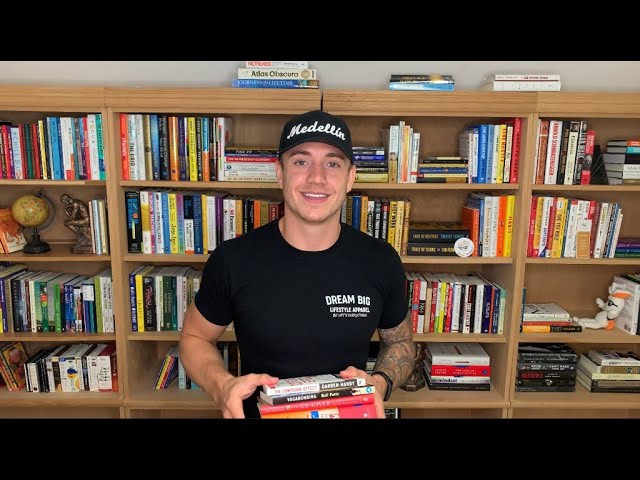
In this YouTube video, Nick Hutchison answers a frequent viewer question by sharing the five books that have most shaped his life in recent years and explaining how he has applied their lessons. He begins with a brief overview, then discusses each book in turn: Rich Dad Poor Dad (financial literacy, the importance of learning rich money habits), The 4‑Hour Workweek (location independence, the idea that reality is negotiable, remote work lifestyle), The Go‑Giver (the law of compensation – income tied to how many people you serve, and the law of receptivity – staying open to receiving), Vagabonding (overcoming misconceptions about long‑term travel, recounting his own trips to Costa Rica, Argentina, Uruguay, Colombia, Aruba, Canada, and upcoming travel to Portugal and the Azores), and The Compound Effect (small, consistent 1% improvements compound into massive results). For each, Hutchison shares personal anecdotes, concrete actions he took, and why the concepts resonated. He closes by encouraging viewers to read the books, share their own experiences, and wishes them a great day.
Chapters
Hello, Book Thinkers family! I'm often asked the question, what 5 books have impacted your life the most over the last couple years? What have you done to implement the lessons you've learned, and why are they impactful to you? So that's the purpose of today's video. First, I'll give you the titles of each of these 5 books, and then I'll go back through and describe how I've applied those lessons to my life. So these are in no direct order, but number 1 is The Compound Effect by Darren Hardy. This book talks about, well, you've guessed it, the compound effect, how small steps in the right direction can lead to a very disproportionate outcome. So I'll talk about that in just a minute. Book number 2, Vagabonding by Rolf Potts. A couple years ago, I had done zero world travel. Frankly, I was interested, but I just had a lot of negative preconceptions about long-term world travel. I thought it was expensive. I thought it needed to be experienced in short bursts, but this book helped bridge that gap for me. Number 3, The Go-Giver by Bob Burg and John David Mann. This book holds a very special place in my heart. There are 2 laws that I'd like to talk about out of the 5 specifically. The 4-Hour Workweek by Tim Ferriss. You know what, Tim Ferriss, thank you very much for writing this book. It's completely changed my life. I'll do a longer form video on this later, but I'll also talk a little bit about it in this video. And then last but not least, Rich Dad Poor Dad by Robert Kiyosaki. So since I'm holding this one, I'll talk about it first. This is the first book that I read in the personal development or self-help or financial space, and I loved reading this book. Not only did it encourage me to read a lot more, but it taught me the importance of financial literacy and a financial education. I had only learned about money in the home, and what happens is the rich get richer, the poor get poorer, and the middle class continues to struggle in debt because money is only taught in the home. If you're born in a poor family, you will learn poor money habits. If you're born in a middle-class family and your parents or your mentors all struggle in debt, you're going to, you're going to be raised thinking that that's okay. But if you're born into a rich family, you learn rich money habits. Well, people like Robert Kiyosaki, they're rich and they're going to teach you rich money habits. We're all forced to play the game of money, so you might as well be good at it. That's one of the biggest lessons from this book. It taught me that I can go out there and read books by these very influential and successful people, learn how they did what they've done, and then apply those same tactics to my life. Highly recommend this book. So going backwards in order, The 4-Hour Workweek by Tim Ferriss. I loved this book. Not only did it get me to be a remote employee working from behind a computer and be location independent traveling all over the world, but it taught me one very important lesson. Reality is negotiable. Actually had that tattooed on my wrist. I don't know if you could see that in the video, but that's a not-so-subtle reminder that society has all of these pressures. It's created this artificial box that we all live in. This is okay, that's not okay. But guess what? Reality is negotiable. You can live whatever kind of life you want. The subtitle to this book: Escape 9 to 5, Live Anywhere, and Join the New Rich. The new rich control their lives. They They do what they want to do and they live lives the way they want to live them. This book unlocks the key to doing so and provides a ton of different frameworks that you can apply to your life to help accomplish some of those goals. Read this book. Then we have The Go-Giver by Bob Burg and John David Mann. I read this book very early in my reading career. It's a business fable, meaning it's fictional. It's not nonfiction like a lot of the stuff I talk about, but there are 2 laws that I really love. Number one is the law of compensation. Your income is determined by how many people you serve and how well you serve them. Book Thinkers is a good example of that. I'm providing content, I'm providing value to people, and then I'm receiving money in return for my audience. You know, you guys come here to watch videos and to learn things from books And authors and publishers, they want their books promoted. So every once in a while, and it doesn't happen all the time, I'm linking up with these people, reading their books, promoting their content, providing value, and my compensation is earned because of that. And then the other one is the law of receptivity. The key to effective giving is to stay open to receiving. A lot of people say, no, no, no, I don't need anything in return. All I do is give, give, give. I'm so altruistic. But that's not the case. You need to stay open to receiving. It's a cycle. The more you give, the more you receive, and the more you receive, you're able to give more. That's such an important lesson from this book. I also love this book because it's so warm and it leaves you with that fuzzy feeling that everything is okay in the world and that there are good people. Read this book as well. I mean, Bob Berg and John David Mann, you've done such a fantastic job here. And then the last book— oh, 2 more actually. So Vagabonding by Ralph Potts. A year and a half ago, I hadn't done any world travel. But just a brief timeline: in December of last year, I went to Costa Rica with my friends in Central America for a week, and I had such a fun experience, and I got to practice some of the Spanish that I had been learning. Then in January, I decided to do my first long-term solo travel trip. I went to Buenos Aires, Argentina for five weeks. By myself, and it was such a fun experience. And while I was there, I also did a trip over to Montevideo, Uruguay, and I loved that as well. Then with a couple of my friends, I went to Medellín, Colombia. I was there for 2 and a half weeks, and that's why I decided to wear this hat in the video. That's a location that a lot of people think is dangerous, right? South America, Pablo Escobar. But I had such a fun experience, and I got to experience things that I'd never experience at home. Then I went to Aruba for a week, which is a nice little island north of Venezuela. And a lot of people are scared of Venezuela right now because of the government and the corruption and everything. I mean, there's no money. Everybody's kind of fleeing the country. Aruba is only a few miles off the coast, but I had such an amazing experience in Aruba. It's like a little paradise. And I've also been to Canada quite a few times this year, and I love it. Montreal is such a beautiful city. I just got back from there before recording this video. So long-term world travel is possible. I had a ton of misconceptions about how it's done. Needs to be experienced in short bursts. You only get so much free time every year for vacation. It's so expensive to travel. Wrong, wrong, and wrong. This book will help bridge that gap. So if you're interested in travel, I highly recommend reading this book. I'm going to continue to travel. I'll be in Portugal next week and the Azores, which are a group of islands in the Atlantic that are technically Portuguese. As well as a couple other places later this year. If you want to travel, read this bad boy. And now for the last book, The Compound Effect by Darren Hardy. This book has probably had more of an impact on me than any book that I've read for a couple reasons. It taught me that small steps in the right direction over a long period of time will lead to a very disproportionate outcome. A great example from the book is that if you are in a plane And that plane is taking off from LA and going to New York City, but at the time of departure, the nose is off by just 1%. As that 1% compounds over a long period of time, you will end up in a very different place, either in Delaware on the south side or up in upstate New York, 150 miles off course in either direction. That's crazy. Now, what happens if that 1% difference is applied to our lives? a very positive way. What happens over time as that compounds? Well, you're going to end up in a very different place. Now, taking that same rule, what happens if you apply 20 or 50 1% changes to your life? Where are you going to end up? It's so exciting to think about that. So in total, these are the 5 books that have had the biggest impact on my life over the past couple years. I highly recommend all 5 of them. If you've read them, let me know what you think. If you've read a couple, let me know what you think. Have they impacted your life as well? I'd love to hear back from you. And with that, I hope everybody has a fantastic day. Bye.