Building a Big Business Is A Good Thing - If You Want it. Nicola Corzine
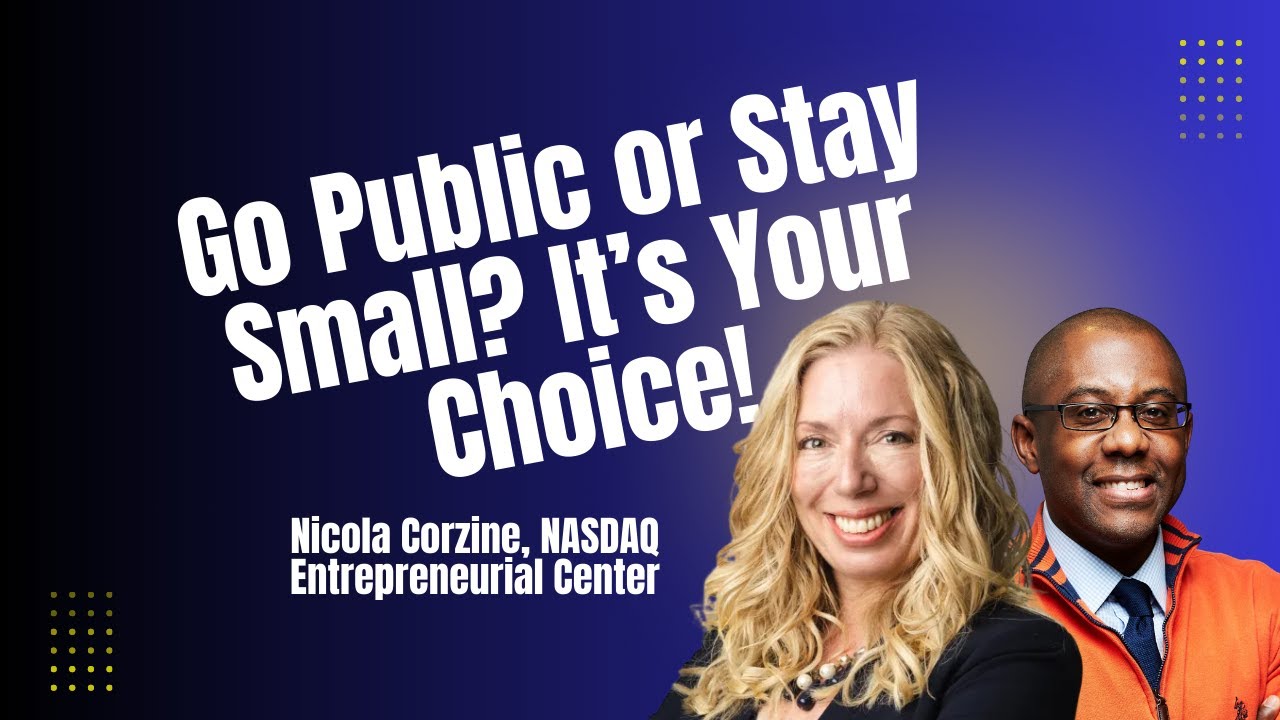
In this December 2025 episode of The Rundown, host Ramon Ray interviews Nicola Corzine, Head of the Nasdaq Entrepreneurial Center. Nicola shares her immigrant‑family origin story, early entrepreneurial ventures—including a UK startup that was acquired by Microsoft—and the hard lessons she learned about product‑market fit, the limits of capital, and the importance of listening to customers. She then explains how she transitioned from founder to angel investor (Band of Angels) and eventually to leading the Nasdaq Entrepreneurial Center, a pro‑bono organization that supports under‑resourced founders worldwide. The Center delivers on‑demand classes, 3‑month immersive cohorts, a responsive mentorship platform with 1,500 mentors, and maintains one of the largest real‑time datasets on entrepreneurial progression, serving over 125,000 entrepreneurs. Nicola defines “underserved” as a mix of geographic, socioeconomic, gender, and identity barriers, and stresses that access to networks and support is the core obstacle. She outlines repeatable success factors—authenticity, likability, persistence, strategic milestone focus—and common founder mistakes such as confusing task completion with learning and mis‑sizing advisory support. The conversation moves to capital pathways, exit strategies, and the decision to go public versus other liquidity routes, highlighting a free Capital Pathways Workbook and the need for early, transparent planning. Finally, Nicola emphasizes the importance of balancing high‑growth and Main‑Street entrepreneurship, arguing that all boats must rise for a healthy innovation economy, and invites listeners to explore the Center’s free resources and research.
Chapters
Hey everybody, thanks for being here on The Rundown with Ramon. My name is Ramon Ray, publisher of ZoneOfGenius.com, and as promised, we have another amazing interview. I know I say that all the time, but each interview I have is the most amazingest and is the best and best and best ever. Nicola Corzine, I hope you are well. Thanks for showing up today. Thanks for being here with me. I hope you, your family, whoever's in your life on a personal level today are doing amazing.
Oh, thank you so much. It is such a treat to be here. I could not think of a better place to be here almost mid-December as we're getting ready to close 2025 and getting to talk with you and your incredible entrepreneurs that you reach every single week.
I appreciate that. Indeed, indeed. And shout out to our mutual friend, Nellie Yusupova, who I've known for over 20 years. She didn't quite make the introduction here but she was part of my brain being triggered to reach out to you. So, let's begin on 2 levels. You can answer whichever one you want to answer first and I'll remind you of it. But a little bit about your journey, who you are, and then a little bit about the center that you're running. So, take your pick. We can go either direction. Either way, the two will blend.
They always do, as good origin stories should. I'll start with me personally because I think it's a little bit different. It always makes sense when you look backwards but never quite in the moment of building. So, I always start by saying that I am the daughter of an immigrant entrepreneur. That matters because when I was a little girl, at the ripe age of 9, I learned that we were moving from England, from my home base where I had known, to America and specifically to California. And we had a very small nucleus of a family, so that meant my sister and I my mom and dad. We're all moving out here because my dad had reached his limits, he felt at that time, of being able to build a company that could create generational wealth for his family in the ways that he wanted to. And so, we packed up our bags and we landed in San Francisco Airport. And we stopped for lunch in a little spot in Central Valley called Modesto. And little did I know it at the time, in my head, I had grandiose visions thinking I'd be living in Disneyland with Mickey Mouse, which is all I knew of California at the time. Not quite. But we did end up being enrolled in school and having a home by the end of a week, all with this very big vision that my dad had of becoming an entrepreneur in a country that was going to allow him to realize his big dream. As you can imagine, growing up with an entrepreneur was a wonderful opportunity for me such that when I fast forward went to university in England, I couldn't get a job. I called my dad up and I said, you know, Dad, I'm stuck. I need some money. I want to travel around Europe. Come on. That's why I'm here. And he said, well, look, if you can't get a job, then you need to build something that people want. And that started me on my own entrepreneurial journey of sorts. So I did. I started a company in the UK that became a great standalone business.
And so I want to understand one thing. So you were in UK, you moved here as a child.
Yeah.
You grew up, did whatever, did blah blah with school and etc. And then you started a company back in England. Is that correct?
Back in England, yes. I ended up choosing to go to college in England to get to know grandparents and cousins and all the family that was back there. And obviously needed a source of income to go realize that dream myself. And that was my motivation for finding my way into entrepreneurship. And when I moved back stateside, I ended up Knowing that I needed to take a moment to break from university while I was trying to figure out what I wanted to do. But what I knew I really wanted to do was to build something that people wanted and to get that sort of visceral reaction of putting something meaningful in the world. So, built a second company, ended up getting acquired by Microsoft. And then, because I thought I knew it all—
You got to say that slow. You got to let that marinate. I don't know what the next of the story is. Whatever it is, you got to let that marinate a bit. That's kudos to you. That's nice.
Thank you.
By the way, maybe you said already, but what was the The premise of the company.
Digital integrity. It was right at the time when digital rights management— you're in content, so you know that— it was a very big deal. And everyone started focusing in on— and this was a very important insight for me that has shaped my life in ways that I didn't realize at the time. But everyone was sort of gravitating towards protection of content, trying to make sure that it had a wrapper that allowed the owner of the content to really be recognized and rewarded for said content. And we took it from a slightly different angle. We were curious if we could identify where content was showing up for brands, or in our case, for students who had been copying perhaps content that they were not attributing to the right authors. And that vertical focus of being slightly different, but at the right moment and the right time ended up getting us a possibility of being acquired by Microsoft. So, our company was And of course, because as good entrepreneurs do, you think you've figured it out. There's an equation that makes sense. So, you're gonna go do it again. So, I had the bug and I went to go do it again and figured the secret to the success was raising the right amount of money to force a market to open to you. Little did I know that was not the secret to success. The secret to success is listening to your customers above all else and making sure what you're building really matters to them. So, we thought more money would change the hearts and minds of customers rather than customers knowing what they really uniquely needed. And we ran out of money and I had to go through a very hard period of laying off a ton of incredible talent and realizing inadvertently we'd made some really foolish mistakes. So, that was a moment for me to pause and reflect and say, maybe I'm not ready to do entrepreneurship yet, but what do I do? Where am I? What do I do when I grow up? Yeah. Back in that question of all. And I ended up having some of our backers for the second company that had started a first-time fund. for immigrant entrepreneurs in Silicon Valley. Nice. And they said, well, look, why don't you come over here and help us find some really good entrepreneurs to invest in? People that are coachable, people that care passionately about building a better world forward, people that you'd want to do business with, people that you'd want to go work for. And I kind of jokingly said, I didn't even know that was a job. But yes, happily, I would love to lean in and do that. And a year later, I'd made some good location choices of entrepreneurs. And I got recruited to co-lead Band of Angels. And if the audience doesn't know, because it's very insular of Silicon Valley, Band of Angels is the original angel group in all of America. So, it had chapters of Hewlett-Packard and Symantec and all the brand names that were part of it. And I got to learn from them for a decade what it really took to lean in, roll up your sleeves, and ask entrepreneurs how you can help. Not how you can tell them what to do, but how to get out of their way and let them build the companies they need to. But doing it in a way that they needed the support in those early days. And I absolutely loved it. During my time there, I had the great honor of being part of Startup America, which under the Obama administration had really sought to look at where entrepreneurial regions were being left behind just because they weren't—
And was that run by Steve Case? Is he part of that? Or that's a different organization?
He was part of the original team.
Yes, I remember the name. Yes. Okay. I mean, or yes.
Excuse me. And then, I was also part of the establishment of the Angel Capital Association, which was born out of Kauffman Foundation with a very big mission of saying, how do we as early-stage investors make sure that we're supporting and treating early-stage entrepreneurs with the right support that they need? All of this really went back to my roots. See, it always comes back. Full story, long story, but it does get there. Yeah. Of saying, Every single founder in the world should have access to the resources they need to build wherever they choose to build. Because only when we do that can we really unlock the innovation potential in our global system and bring vibrancy to the communities that we call home. And yet that was tricky to do. But I thought of all the things that were worthwhile doing, we should be able to do that. As luck would have it, one of my companies at the time had gotten acquired by NASDAQ. And I ended up—
Congratulations. So you don't go small. You don't get acquired by— No-name people besides the one small hiccup. You just go big. Microsoft, NASDAQ.
It takes a village. It was hardly me. It was the company that did it all. The founders behind it.
I love it.
But our firm and the founder and I had become quite good friends and he knew how passionate I was about looking at where place could be a defensibility for founders so that they could build for their families, for their loved ones, for the communities that they cared about. And he said, Nasdaq's Foundation had made a massive commitment to being able to do that worldwide for entrepreneurs.
Wow!
And they were looking for someone to lead that initiative. And so, here now, 10 years later, we started with a dream and a very generous check from Nasdaq to get started. And today, we listen and learn beside 125,000 entrepreneurs worldwide on how we can deliver access and knowledge in the field of entrepreneurship so that they can pay it forward and build even more generations of great entrepreneurial opportunity in the world. We don't take any equity. We don't charge anything. It's all pro bono. It's all underwritten by not only Nasdaq's Foundation, but many foundations across the globe now who believe in the power of economic opportunity and what's at stake if we don't get the innovation economy working for everyone, not just for a few.
Wow. I feel like I want you to run for president. Well, not really, but— So do I. So give me a for example. One, how do you track this or how do you know 100-something thousand? Is there a program, 6-month program? program, a boot camp or something? Help me understand that. First, just give us a for example of what's one of the key or several key points. Yes. Yeah.
Great question. So, I said when we started, there were a lot of accelerators and incubators in the United States. So, 10 years ago, there were 4,500 accelerators existing in the US alone. And so, if we even had the audacity to think about being 4,501, then we better do something differently or we better do something right that was not necessarily meeting the goals and the objectives of entrepreneurs. So, one is obviously we focused on under-resourced founders, those founders who had no access to networks or support systems or capital per se. 2 is we said, look, this has to be about what they need, not what we tell them they need. So, we got into the business of being acute listeners to entrepreneurial needs. In our first year, we delivered education to 2,000 entrepreneurs. When I say education, it was them saying, look, I am struggling in market with X. X could be fundraising. It could be marketing. It could be sales. It could be finding supply chain that was resilient their needs, whatever the case might be. And then, our incredible program team would go out, source the experts, bring that back in, curate a class, get them back in market so that they weren't worrying anymore about this problem that was limiting their business potential. So, we do these on-demand responsive programming support systems, usually about 10 to 12 of those types of classes per month. And then, we have our immersive programs. And our immersive programs are 3-month length programs, they aim to achieve a significant business milestone for a founder during that timeline. So they can come in and set their sights on a lofty goal. And then at the end of it, instead of just saying, look, I have a pretty pitch deck, it's really much more about a founder saying, I did something meaningful and no one can take that away from them. So it gives them not only a sense of confidence, but an air of credibility that allows them to stand up uniquely in this market, and which is very difficult for under-resourced founders in general. And then finally, I'd be remiss if I say it does literally take a village in entrepreneurship. So, we have a massive mentorship component to all that we do. It's a responsive mentoring platform, meaning entrepreneurs can go in, pull down one-on-one support in an area where they're struggling with. We have right now 1,500 mentors, mentees on that platform. Wow! The power of the choice is in the entrepreneur. It's not on the mentor side. So usually, in my old days, I would have to like send out 10 emails. Hopefully, somebody would get back to me. Then, you'd have to play calendar ninja where you're trying to get the right person to say yes at the right time that you've got available. None of that in our platform. Our entrepreneurs go straight in, book time with an expert. The expert is not judging the quality of the mentee. The expert is saying, I'm here in support of all. So, it's really changing that power dynamic that often lives between who carries that as the entrepreneur versus those that are a subject matter expert. And we are in support of founders between 0.5 and 5.5 years of age. So, we really stay with them over a 5-year trajectory. And it allows them to pull down these resources when they need it. But sometimes founders are with us deeply for the first year. Other times it's more periodic, episodic. So they're coming in, you know, there's an issue that's gone on. Founder has gone through a challenge with pivoting their business model and they're struggling at that point in time, or hiring isn't going the ways that they want to, or they didn't get the funding that they were hoping for, whatever the case might be. So they'll go deeper with us for a period of time. And then hopefully they're back to building the business that we need them to be building so that they're growing GDP for the benefit of all. And that's what we're measuring. So we actually have one of the largest real-time datasets on entrepreneurial progression pathways as a result of this work. Wow. Everything, as I say, was built on a pay-it-forward focus. So you asked how we got to 125,000. In many ways, it was starting listening to those first 2,000 and saying, okay, now you nominate the next entrepreneurs that we should be supporting. So our community really grew from within itself. And obviously it hasn't hurt that we've had some amazing foundations and funders and media that has covered us over I love
it. Feel free if you need to take a sip. I know you're coughing a bit, so feel free to take a sip of— I don't know what you're drinking, hot water.
I talk
fast though, so I want to— I don't want to, you know, give you time to take a little sip. No problem. But no, thank you for that. And, um, uh, can you, can you give me a— for— and this is a statement and a question. We know what the word underserved means and those who don't have access to— but me living in the vacation capital of the world, New Jersey, but, you know, being near that and the resources— you and I shared some common names that, you know, before I record So I'm a bit spoiled. I'm in a bubble myself-ish.
Yeah.
But I was talking to somebody, and this is beyond even race or caste or gender. It's a whole mix of things. But he was like, oh, in my neighborhood— don't know where it is, Anytown, USA— SBA, SCORE, your peers in the industry have closed, etc. So my point is, can you just talk about what this means, underserved, even a variety of ways? Because I'm like, I walk down Manhattan, there's a center of this or that. within spitting distance. But there clearly are people globally and in the US who are like, no, we don't have this or that center. We don't have incubators. We don't have access. We don't— we can't walk into a building. We can't— you know, it's different. So just unpack why that's passion and maybe what that means for those who are like me in Silicon Valley, in New York, in these big centers where they're like, who doesn't have access to this? Clearly, there's people who don't.
Very much so. Very much so. And I think you've articulated this so perfectly that place can sometimes be the common denominator, but it's not always that, that way. Sometimes it's a combination of identity and gender or caste, socioeconomic status.
Yep.
But most of the time it really comes from not having an entryway into a path of belief or a path of opportunity. And that's the crushing reality for a lot of founders where You know, when we first opened, we used to have a very large physical presence in San Francisco and then COVID and the world. And we said, we should be where our founders need us to be, not the other way around. But when we did, it was still heartbreaking to me that more often than not, when people would walk through that door with a very big marquee sign that said NASDAQ Entrepreneurial Center, they would say, I never actually thought that I would ever have the privilege of calling myself an entrepreneur. entrepreneur.
Wow.
And you ask them what they did and what they sacrificed and what they were trying to do and who they were doing it for, and they had more right to that word than anyone could ever have fully understood. And yet their belief in themselves of having access to that word was so limited. And so I think for many It's this sad barrier that has persisted for far too long as to mythology in many ways of what an entrepreneur actually looks like or who gets to call themselves that. But when you break it down, it's often access to networks and access to support systems. And we ask a great deal of an entrepreneur to have that confidence and conviction to walk into a place where they have not necessarily been welcomed before, where they don't see others that look like them. And so to change the pattern of who our entrepreneurs are and to call them that and to, and to have them call themselves that and to call one another that is everything in this place. Yeah. Because when we have been living in the declining market of entrepreneurship in this great country for far too long, it's largely because of that root issue. It's because for way, way too long, people say, I don't look like Insert your preferred entrepreneurial mythology. And, and that's why they say, I, I'm not equal to, I'm not, I'm not deserving of that kind of support.
No, I've gone through that myself. I mean, you know, just, and my wife's the one who encouraged me. I said, I'll talk about my mutual friend Seth Godin. You know, I oftentimes don't mention names, but he won't mind. I don't mind. You know, he's a, he's a mature grown man. But, you know, she's like, Ramon, you're just as good as Seth Godin. Stop saying that. I was like, OK. You know, but everybody has this thing. And often, it's just in our head, notwithstanding the actual resources we may not have, but it's in our head. And again, so good. Thank you, Nicola Corzine, Head of the Nasdaq Entrepreneurial Center.
Yeah, it's a mouthful, but you got it all.
Thank you, my friend. I was listening to— my question once— my question will be, what are some of the things you're seeing of entrepreneurial success? But I want to frame it. I was hearing an interview with Jensen Huang, I think I'm pronouncing his name right, a founder of Nvidia. And he said 2 things in his long journey. It's hard to compress all that in 30 years. He's done it to 2 things, but 2 sound bites. He said one, uh, as you may know, the Sega, the Japanese company, gave him like an extension of money or something. And he said, I think the guy just liked me. He could have said no. He should have said no. He should have called the contract off, whatever it was. But he said, because he liked me, He said, go forth. So that's one, just a conversation with you, the likability factor. Like, everything's going wrong, but Nicola said, you know what, I like this guy or this gal. Let's, let's do something. So that's number one. Number 2 was the aspect of, I think something else was happening in Nvidia's journey. And again, one of those, he had to call Nicola. Hey Nicola, it's all going bad. You don't have a right to believe in me or anything. But Nicola's like, you know what? I got you. 2 more years. So My question is, with that in mind, just what are you seeing are some of the secrets? And there are none, of course, but secrets to the thousands and thousands of entrepreneurs you're seeing, your own journey. What are they doing right? What are some repeatable things you're seeing that, Ramon, here's what it is?
I think those are very wise comments, not surprisingly, from one of the world's greatest entrepreneurial leaders that I'm inspired by every single day. And when it comes to the likability, and actually, let me take a step back and say, When we started the Entrepreneurial Center, even though it is entrepreneurial in its name, we hyper-focused and said, we're building great talent. We're here in support of the entrepreneurs themselves. So we lovingly say we love all the babies equally. And many of them have birthed multiple babies multiple times.
I love it.
And the person that you're backing is everything. And so that likability, We often talk in entrepreneurship about the gnarliness of the 2 ABCs that have you going all the time. Always be closing. You're always closing, even if you don't know what you're closing. And always be credible. But if I uplevel for a second and I say within the DNA of our amazing entrepreneurs, what is most exceptional is who they are.
Who
they are and what they stand for and the passion and the purpose from which they enter entrepreneurial pursuits. pursuits. And when you look through that lens, everything is possible because people do business with people they like.
That's right.
As a startup, there's a thousand reasons they shouldn't do business with you. There's a thousand reasons you are not the trusted jockey out there, but they're going to trust you because they see something within you that matters to them personally, and they're willing to go the distance to say yes, even though they should say And that comes from being genuine of who you are. Authentic. It's a word that gets thrown around a lot these days. But to me, authenticity is everything in entrepreneurship. It's not about just having your origin story dialed in. It's about knowing why you get up on the hardest of days and you're going to keep finding a way, even when the markets turn, even when the 800-pound gorilla enters your market, even though you didn't think they would, even though there's more money at stake for you to continue the pathway. People have to believe that you're all in and they want to be all in with you. And that's that credibility. That's that lovability. That's that, I've got Ramon every day of the week because how could I say no? And then as for persistence, it's the other side of the coin, but it's the critical side of the coin. Because if I believe and you're being transparent and authentic with us and markets are moving or the world has gone through hard winters like we've been on the last 5 years, well then of course, I'm going to be persistent and resilient beside you because I trust that you're going to find a way through this. And it is better to be right than to be out. And for a lot of people that have taken that early bet on an entrepreneur, they want— they have made an investment in that person too. Just because they're not on your cap table, just because they didn't personally write a check, they have a vested interest in your success. And they don't want to be wrong in that case, not because of fool's gold, but because they personally care about what you're building and they want you to succeed. And they want to be there with you, even when the going gets tough.
I love that. And Nicola, when you think about your own journey and what you've done, the one failure or lesson learned, you know, that you've had, combined with others, what are you thinking that people are doing wrong? And I ask that because it seems like, you know, how do you make a pizza? Just Google it or Bing it. It's out there.
That's easy these days, right?
Yeah, exactly. Market fit. Serve your customers. Have customers. Don't we all know this? I mean, there's 10 things only that make any company. I see it, right? Do you have your fulfillment logistics? The things we all know. There's no secret. But yet some succeed. Some don't succeed. And even in the same journey, like my case, I've had companies not work out. You have. So meaning anything that you could point to, Ramon, here's what we've seen gone wrong then in the hundreds of thousands of companies you've looked at or your team has served and maybe your journey, what you've seen. What's gone wrong?
Well, I will take it from the lens of like what built our framework as to everything at the center is about milestones and the imperative of a milestone. And the story goes like this. All too often, I would sit in board meetings with exceptional talent, exceptional founders. And I would have the privilege of them reading a laundry list of the things that they got done over the quarter. And I would listen to people far smarter than I around the table Who would then lean in and say, but what did you learn and what did you actually do? Because the difference of tasks in an entrepreneur's life is not the same accomplishment as the strategic learning that allows you to jump over a bridge that somebody else can't. And the problem in entrepreneurship is it's death by a thousand paper cuts. It's not about being able to have that calmness to say, what is the strategic question? That today I need to be focused on with the precious limitation of time that I have to learn something uniquely different that's going to give me an edge where others don't have, to be ahead of the curve and not behind it. We're not just reacting to it. And for entrepreneurs, having that stillness and that quietness to be able to prioritize the strategic question that matters the most to them, not to get to the end, right? Because entrepreneurship, it's a marathon, not a sprint. But if you can get to the next fork in the road with more confidence to know with the few dollars that you have to invest or the few people that you have around you that are making a choice to go with you on this journey, you know what direction you're heading and why. So it's being laser-focused on that strategic imperative that you need to know. And you break it down. And I think that's the challenge in entrepreneurship. We're either super fixated on the end, like I'm exiting to so-and-so, or I'm going to go public, or I want to create generational wealth, or I want to create a legacy. Generational wealth. I want to, I want to be on a beach with a lovely umbrella drink in my hand in 10 years' time with passive income coming in, whatever the motivation is. And yet being able to work back and say, okay, but this quarter, this moment right now, with the 2 hours that I can give to doing something unique that's going to get me closer to that goal, where do I set my sights and why? And who do I need around me? The other thing is right-sizing mentorship for your company, right? A lot of the time, we do this thing of wanting the biggest and the best name on our board, on our advisory board, on our strategic board, but they may or may not be the right person that you need right now. So it's also really crucial that you right-size your board of supporters, your allies, your teachers in the moment that matters the most, because nothing hurts more than when you go on the other side and you're like, man, I wish I would have heard that 6 months ago. Or worse, you're in a tricky situation and everyone's telling you, well, in 10 years, time when you're on that side of the fence, focus on this. That's not going to help you in that moment and in that now. And for a lot of founder fallout that happened in COVID, and especially for a lot of necessity entrepreneurs where they have no other alternative but to pursue entrepreneurship for their livelihood and for their loved ones, the imperative of knowing what to say yes to and what to say no to is more crucial than any other decision they enter into every single day.
That is powerful. Um, and thank you for that, Nicola, especially since you're tied to name and, and otherwise NASDAQ. Um, can you talk about the difference between those who go public and those who don't? And I ask it because of this demystify this Mark Cuban, right? The entrepreneur's entrepreneur who has gone public, taken company to invest in companies. He's sitting there, you don't need an investor. That's the last thing you want. Don't go public. And I'm like, dude, like, wait a minute, you're like a billionaire. Like, you do— this is your world. You're like Nicola, but you're saying don't be Nicola, you know? So can you, as the flag bearer, right, as the ambassador for going public— if I'm not pushed back— but can you just talk about this thing of, nope, don't go public, uh, don't get an investor, bootstrap it, versus though many companies globally, and especially in the American context, go public, you know, the valuations. Talk about demystify just Who it's for, who it's not for, or why go public, etc.? Talk about that.
Yeah, well, that exit date, that exit stance is an important one. I also will just, having learned way too much recently, you know, an exit isn't an exit anyway. It's just the continuation of a journey with new rules and new guardrails
and
new regulation and all the things. So the end date never truly really happens in that lane either. But I will say one of the most crucial toolkits that I'm inspired that we built was actually done with the SBA. And it was launched at the White House a few years ago for National Entrepreneurship Day. And what we looked at in that moment was giving founders the optionality to really understand the choices and the decisions they were making when it came to like how they wanted to exit their company. Because even on my lens, right, and in the venture world, in order to justify venture, there has to be a 10x return. Sometimes that 10x return can come from an acquisition, but those are few and privileged. A lot of the times you really have to go in with the belief that this is a billion-dollar company. If it can't be a billion-dollar company, then we as a seed investor know that we're not going to have a chance of achieving that kind of outcome. That doesn't mean it's the only pathway forward. Quite the contrary. But it does mean that for some investors with that mindset who also are taking in other people's money, who have an expectation of return, everything comes down to alignment of stakeholders. It always does. So look at the stakeholders, look at their motivation, look at their time exit scenario, make a decision. Does that match my goals? If it doesn't, that may not be the path to pursue right now. And so our Capital Pathways Workbook does that. It's a free workbook. Any entrepreneur can pull it down and it goes through that sequencing of asking, you know, Should I take other people's money right now? Is that what I want for myself? Am I willing to not be the CEO? Am I willing to have other people tell me what to do, who to lay off, where to grow to? If not, maybe I shouldn't be taking other people's money. And how do I feel about sharing my financials on a quarterly basis? If I'm comfortable with that, maybe I should pursue a rev-based loan. If I'm not comfortable with that, maybe I shouldn't be, you know, signing up to sort of sign off on on that visibility to my company at this stage. So all of these capital have certain expectations. Transparently, they're not always seen to entrepreneurs, especially under-resourced entrepreneurs. So it is very important to have that visibility of knowing what you're signing up for early on. Um, and then to not wish after the fact that you hadn't made that choice. So transparency is everything here. Um, when it comes to, you know, the public markets, this is a wonderful way in which you can grow and scale business. It's just another form of capital. Again, people go public not to have that exit per se, but to be able to scale into massive markets and to be able to scale into very, very large settings. The challenge is not different though than a lot of private-based companies where you're still standing and competing against others who are well regarded. And your role, if you're constantly trying to, you know, be seen as a good investment and a good choice, is to make sure that your name is being seen and name is being known. So it doesn't take away any of the pressures of performance. If anything, it magnifies them, you know, just like that ant with a magnifying lens that's being looked at all the time. And so again, for some founders, that is exactly what they want. That's their dream. That's their pathway forward. That's the liquidity they wish for their employees. It's the liquidity they wish for themselves. It's the ways in which they wish to aspire to be a $100 billion company or so. For others, that's not what success looks There are franchise models. There are dividend-based models. There are hedge fund and acquisition and JVs and all the things that founders can play with when it comes to thinking through liquidity and exits. And they should. You don't want to have that conversation too late. All of those types of things typically take 3 to 4 years to plan. So being able to be in an environment where you're not stuck going, I was thinking I was going to retire by now and I have no plan in place to actually get out of this business and who's going to succeed me? And how am I going to see the money that I want to live a dream that I had pursued for 20 years, 30 years, whatever the case might be, is not something you want to happen at the 11th hour. It's not. And again, I think for a lot of founders, they enter into entrepreneurship thinking that they'll get there, thinking that they'll spend time going there. And in retrospect, it's the one place where every single founder who goes through that process says, gosh, I wish I would've thought about this sooner because the mindset, the strategy, the alliance of supporters that it takes to exit a company in any facet is always longer, harder, and more thorough than any founder thinks. So, you know, be forewarned, get ahead of it and make the most of it. It's incredible when it occurs, but it is all-consuming and it can be a really terrifying approach when you're in
I love this. I want to give you back a little bit of your time so you'll come back and see me again and let me interview you again, and we'll meet in person. But here's what I'm hearing, Nicola, and tell me if I got this right. I'm hearing you say, for the gal that wants to play her guitar on the beach and make a living and sip some piña colada or coconut water, God bless her. That's great. If that's the calling you want, go for it. You can pay for yourself. You got your car and you're happy. We honestly support you. And you're saying for the gal who says, you know what, I want to hire 10,000 guitarists to go on beaches around the world, that's great too. But don't, don't, don't hate on the one that's the one person on the beach and you're like, I don't have any time. And don't— the one on the beach shouldn't hate on the one that's like, why is she on the COVID of Forbes? That's kind of taking— both are great. Is this what I'm hearing? Yeah. They just— it's choice, it's a mindset, it's what do you want to do with your life? life. Is that—
I love that you say that. So, so I, I, I liken it to this: Main Street entrepreneurship and high-growth entrepreneurship are critically a part of the same pie that we must rise together. You see, I live not far from San Francisco, and in the height of COVID when the heart of our small businesses left San Francisco and tech companies looked around and we said, where's our San Francisco that we want to build for? And build with. And you could say that up and down every single place in America at one time or another. We've all gone through it and we all come back from it, hopefully. But I assure you, I promise you, entrepreneurs build in community, whether high growth or whether mainstream America. And when we do it out of balance with one, or we forget the other side of the coin, then all of a sudden the ripple effects is a magnifier and we lose the innovation economy for all. So for me, it is, and for all of us in the Entrepreneurial Center and all those foundations and funders who are entrepreneurs who are a part of it, really realizing that you can only— all boats rise. But also, if you don't have those boats rising together, then you don't really have an entrepreneurial progression that's possible in a country or a nation or a world.
I love it. Nicola Corzine, I'm voting for you wherever, whatever you're doing. I'm voting. I'm on your team. I'm voting. I'm gonna get the bumper stickers out right now. I got the little badges. Vote for Nicola. Anything, anything else you wanted to say before we close? I feel great. And, and I know we'll talk again and again, but anything else that was on your mind?
No, come visit us at nasdaqcenter.org to get access to all these free resources and webinars and toolkits that we've talked about today. You'll also find our most recent research on what are the places in America that are advancing innovation economy for all. So we have 20 metros that are not the coastal ex-bac That you can dig into and, and maybe be inspired to go visit them and see a little bit more about what they're doing and who they're doing it for, and hopefully continue to inspire and build up more opportunities for entrepreneurs in your own regions, wherever you may be listening from.
I love it. We will include this in the show notes and in the article we do, and I'll probably put this on the lower thirds or something right there as well. So let me just stop the recording. But Nicola, thank you so much for being here today.