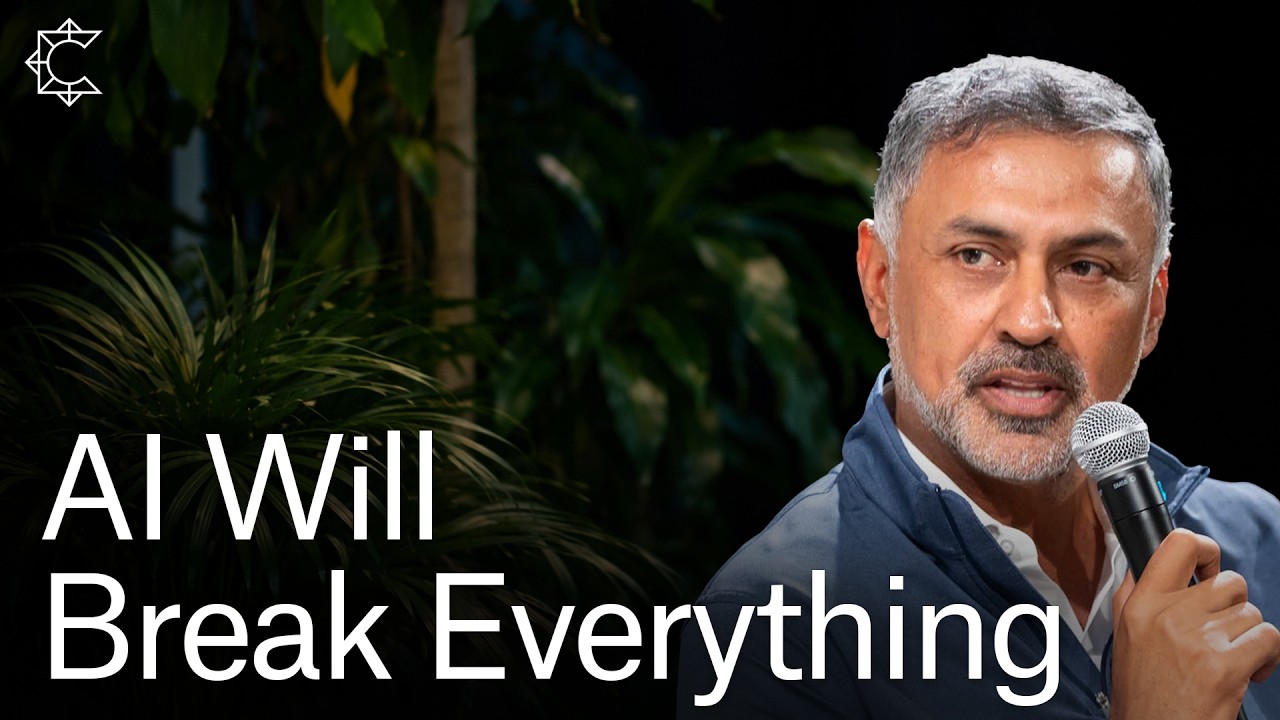
Nikesh Arora: AI Is Moving Faster Than Our Intuition | India AI Impact Summit 2026

Nikesh Arora warns that AI is advancing faster than governance can keep up. He points to autonomous systems like Waymo and household robots as signs of what's coming, and identifies three urgent problems: who's responsible when AI agents act, mass job displacement, and cybersecurity risks. He argues India's Aadhaar and UPI show how to build trustworthy AI infrastructure.
Chapters
Good afternoon, everyone, and thank you very much for being here. I want to thank the Honourable Prime Minister for bringing us all together. And as many of you were here this morning, not unlike Sundar from Google, about 40 years ago, I used to take the Prayagraj Express from New Delhi to Varanasi, a city that was a city of temples and had the revered Banaras Hindu University, which is now a hotbed of AI innovation. You've spent the morning hearing about AI's vast potential from curing ancient diseases to Dario's idea of having a country full of geniuses in a data center. Having spent my career at the intersection of major technological shifts, I can say I have never seen anything that has moved so fast from a technological perspective. Coincidentally, it was about 3 years ago I was on my way to BHU to give the convocation address and ChatGPT came out. That moment changed everything. AI is accelerating faster than our institutions, our governance frameworks, and even our intuition. This widening gap, if not handled right, is going to become a tangible threat to national security, economic stability, and social cohesion, making it a defining challenge of our era. As an eternal optimist and representing the world's largest cybersecurity company, I'm not here to throw cold water on our optimism and the idea that AI is going to solve every problem. I'm just here to come and say that for us to enjoy the benefits of AI, we have to make sure we have to solve for inclusion, for trust, and for safety. While we continue to make advances on AI. I would say at the current moment, the balance is tilted not in the favor of trust, inclusion, security. It's actually tilted in the favor of speed. You're seeing features and capabilities coming out as fast as they can, probably faster than we can absorb them. Every morning you wake up and something new happens. There are agents that are doing things for us. There are new models being thrown out which can make music. I only don't know where this is going to stop. So while we've been enjoying the capabilities of Claude, ChatGPT, Gemini, which are teaching us how to do all kinds of stuff, AI has already moved on. We're now battling towards the agentic future where the agents are going to take care of everything and we're going to kind of lose control. The challenge we have is You know, we talk about agents. If you think about it, Sundar also mentioned Waymo, a car that will drive you from point A to point B. That car is effectively an agent. That agent used to be a driver who's no longer a human being. It's an agent. It's going to drive you everywhere. That was a very expensive agent. It took a lot of training to train that agent over a lot of time. However, it does give us a glimpse into the future. A future where we can actually build a trustworthy agent that can take over the task of a human being. But I was at Google in 2009, and I remember riding in the first iteration of a self-driving car. That was 16 years ago. So, it's taken a long time to get one job replaced by an agent. So, all of those of you who are really worried that our jobs are going to go away, It's going to take a little longer than you think. We're not going to trust agents that easily and that quickly. However, for us to be able to trust agents, once again, we have to build a future where the ideas of safety, the idea of security, the idea that we can trust an agent are developed cohesively with technology, not outside of that technology. And once you get there, you realize we're not going to stop at software agents. I think if you saw the Lunar New Year celebration in China, there were robots which are dancing and flipping around much better than actually I can do. So I'm sure most of us would not be able to compete with the robots. These are version ones of robots. Imagine these things are going to be changing light bulbs and digging streets in the middle of the night when there's no electricity, there's no lights because they don't need lights. They can operate without lights. They can operate without food. They can operate without anything. There is a rumor that these are the things that are going to be sent to build the data center on Mars. It won't be humans because Mars is not quite friendly from an oxygen perspective yet. So if you believe that that's what the future entails, there's a lot of questions that it brings up. It brings up questions of how are we going to take care of these agents if they go rogue? How are we going to manage these physical agents if— how are we going to control them? How are we going to govern them? So all these are challenges that we have to solve collectively before we go ahead and go live this beautiful future of AI. So, from our perspective, from a cybersecurity perspective, from a governance perspective, I think there are 3 big challenges we have to solve. I think the first challenge is a challenge of governance and accountability. In the early stages of AI adoption, systems are advisory. You ask it to write a letter to your girlfriend, ask ChatGPT to write a letter to your parent, a thank you letter, it can do that. That's pretty cool. It's an advisory system. You can change it. You're a man in the middle. You're in control. This is great. Very soon you'll give control to an agent, which is gonna be your agent. It's gonna do things for you. That's okay too. As soon as you give control to an agent which can act with its own agency, now you have to worry about who's responsible for the actions of those agents. If you use them in a social context, who's responsible? If you use them in enterprise company context, who's responsible? If your agent starts giving away money, Who's responsible? If an agent goes ahead and balances your portfolio the wrong way, who's responsible? So there is a whole series of questions that are going to kick in from a governance and accountability perspective at an individual level, at a nation-state level, at a global level. These are problems that need to be solved. That is why we have to come to summits like this and talk about this from a public-private partnership perspective, because the extreme option is let's ban it. If you ban it, it'll go away. It's not going— AI is not going to go away if you govern it out of existence. It cannot be governed out of existence. So we have to figure out how to sit down and solve the governance and accountability problem before it's too late. If you don't solve that problem, we will erode trust in AI. If you erode trust in AI, it's going to cause a series of problems that we're not going to be able to solve. So the second problem that we're going to run into with AI is this problem of human impact. AI is currently threatening to take away jobs. AI is currently threatening to take away agency from human beings. I think it's important for us to understand how that is going to manifest itself. I think many people have talked about that every technology inflection in history has resulted in a significant period of societal and economic disruption. But ultimately, every inflection we've had, whether it's agriculture, industrial revolution, electricity, you pick your favorite one that you want, it has resulted in upskilling and reskilling of society. I think the farm agronomy production is up 20x and the number of farmers is down 90%. So, we found a way of retraining people, upskilling people without social uprising. And we need to figure out how to understand the human impact of this, how to build plans from an upskilling perspective. I have The conviction that we're going to need 5 times the number of technology people in the future than we have today. So we need people to work on these things. Who is going to train the robot who's going to dig the street? Who's going to train the robot that's going to build buildings for us? Who's going to train the robot that's going to go out and build a data center? That requires training. That requires development. That requires people who understand how AI works, how technology works. So there is a solution to the problem if you're an optimist. The solution is to sit down and plan for it and understand how to make the social change happen simultaneously while Sam, Dario, and Sundar are busy building these amazing models for the future. And last but not the least, as you know, since I work in cybersecurity, it is important to understand there is a security problem. A security problem manifests itself in many ways. There's lots of data being used and AI is going to consume more and more data. I don't know if you experienced the new models. The model says, Let me know more about you so I can be most helpful. My fear is in about 6 months, if I'm talking to my AI model, it might know more things about me than I've told my wife. So I don't want my wife to get her hand on my Gemini prompts because I'm surprised what it might tell her. But if you expand that and take that more seriously, you'll see that AI is going to become your therapist. It's going to become your nutritionist. It's going to become your advisor. It's going to become your friend when you're lonely. And you're gonna tell it things that you don't tell anybody. That's fine. Do whatever makes you happy. But when you do that, the risk is if that data falls in the wrong hands, it's not a good idea. So you have data concerns. What do you do with data that you're feeding AI? How does it stay segregated? How does it stay that belongs to you? You have a problem where we are using the biggest application today for LLMs is coding. Well, that's great. Code can be malicious. Code can be tampered with. So, you gotta make sure as people are busy writing code and rebuilding your systems, your companies, we have to build a secure system around the code to make sure that AI is doing it in a secure manner. You have problems with agents. We talked about agents. Great. How are you gonna make sure that the robot that you bought to go clean, do your dishes and your laundry at home doesn't go rogue and start threatening you? How are you gonna make sure that nobody can intercept the control system of the robot and it starts to go rogue on you. You need security. You need to make sure that this is built in a way that it can be secured, governed, and controlled. Including that, you also have to worry about adversarial AI. What if AI turns against you? How are you going to make sure that we build security systems? Where is the kill switch if AI starts to act in a way that is not good for us? I'm not trying to scare you. These are all problems that we can solve collectively. But there are problems that we have to tackle whilst we're busy getting excited about AI. So we have to solve the problem of governance and accountability. We have to solve the problem of social and human impact, and we have to solve the problem of cybersecurity or safety as we build these AI models. However, despite the complexity of these challenges, I remain deeply optimistic. I think this optimism is because of the unparalleled strength and progress we've seen. In 3 years, we've actually painted a future which none of us had imagined 3 years ago. So if we can do that, I'm sure we can collectively solve the problems if we put our hearts and minds to it. And I know there are many such companies that are inclined in such a way. There are many governance bodies that are inclined towards solving this problem because we have something no model can replicate. We have human judgment, we have shared values, and we have the ability to collaborate. So I think that's important. That is why we come to places like this to talk about this with each other, to collaborate to be able to solve these problems. India has already shown the world what is possible when innovation is paired with inclusion through digital public infrastructure systems like Aadhaar and UPI. They demonstrate how technology deployed with public good in mind and scaled across a vast population can leapfrog traditional development methodologies. I hope we can apply the same energy in India to solving the problem of AI to make it more inclusive, more fair, More social, more trustworthy. With that, thank you very much for listening. Jai Hind! If you like the video, do like, comment, share, and subscribe.
More from Nikesh

Nikesh Arora on the Frontier Model Problem: Breadth vs Depth | The Future of Token Costs



From Ghaziabad to Silicon Valley: Nikhil Kamath x Nikesh Arora | People by WTF | Ep. 11

