Amazon vs Shopify (my HONEST opinion...)
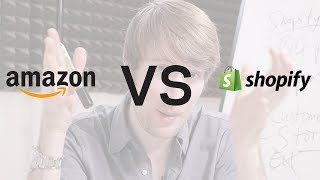
Oliver Denyer compares selling on Amazon versus Shopify based on his own experience. Amazon gives you traffic immediately but takes a cut and controls your customer relationships. Shopify is yours to build but you have to drive your own traffic from scratch.
Hey, how's it going? It's Ollie here. So in this video I wanted to put together a little bit of a comparison should you sell on Amazon or Shopify, and hopefully you'll be able to make a decision on which one to sell on or the very least learn a little bit about both platforms. So before we get started, I really, really want to see you on Thursday's live Masterclass. And it's just going to be such an amazing session on these sessions. The best thing about it, hands down, is just how fired up everybody gets. I bring my best content to the table, we've got a room full of people. It's like a virtual event, right? And we're all focused on learning and moving forward. And I think you're going to get a lot out of it. So I've put a link in the description at the top of this video. You can go get signed up. It's 100% free. I'm going to teach you how to build an Amazon business with just $100. And yeah, it's a great place to learn. There's going to be a Q and A. And also I'm going to give you 15 smash hit products to sell on Amazon just as a thank you for showing up live. So get registered for that. Now onto the comparison. Amazon or Shopify. Now here's the thing. Past few weeks have actually been pretty crazy for me because I've been building a Shopify store to complement my Amazon business. So there's Amazon business going on in the background, as you know, and I run it all remotely and I was thinking, how can I increase my income? Obviously you guys know I sell courses and coaching, right? And I make income from that. I also make income from Amazon. I was thinking, should I grow the Amazon business or should I try something new? And I was feeling, you know, when you just feel excited about a new opportunity. And Shopify showed up. So I was like, you know what, let's give this a shot. So now I'm actually in a perfect position to make this video because I've got a little bit of experience with building a Shopify store and obviously I've got three years experience with my Amazon store, so I can give you a good comparison. So let's take a couple minutes to have a look at both these platforms and I can break down for you the pros of each, the cons of each, and then you can decide which one's best for you and hopefully you'll learn a little bit about each one as well. So let's start off. Make sure you can actually see where I'm right in here. Let's start off with Amazon because I know it really, really well. Is that even on screen? Can you see that? Let me write it a bit low. That's better. Okay, that's much better. Awesome. I think there's two on there. Okay, whatever. Let's just pretend that, you know, this is all really, really professional and well edited and we'll move swiftly on. So what's good about Amazon? What's bad about Amazon? Well, with Amazon, generally you're going to be selling small, cheap products. Now obviously I don't mean cheap as in bad quality. All your products should be awesome quality. They should be valuable. They should really add to people's lives when they buy them and use them, no matter what business you're in. What I mean by cheap is the price point is usually between sort of 15 to 60 pounds or 15 to $60 if you're selling in the US. So this is like the impulse buy range where people really don't think twice before pressing add to cart and it's not going to make a dent in their wallet and it's not going to be a major decision for them to buy these products from you. The reason for this is because of just the practicality. You're going to be storing stuff in Amazon's warehouse, which is the next point I'm going to be talking about. And at the end of the day, you don't want these products to be too big because if they are, the fees start going up. And if you're importing them from China especially, then things just get more and more expensive and more and more hassle. So small and cheap products work really, really well. Which brings me to my next point. The great thing about Amazon, as you well know, is FBA Fulfillment by Amazon. You can buy a ton of products or a small amount of products. In fact, you can just send in one product and store your stuff in Amazon's warehouse. But you don't have to store stuff in your own living room to run a business on Amazon. In fact, they will store your stuff in their warehouse. Right? You pay them like a fee, small fee. Every time you make a sale, they ship the product to the customer. They deal with all the returns, all the questions and everything. So all you have to do is find hot products and like 80% of your business, all the stuff that takes all that time, usually for e commerce business owners, is handled by Amazon themselves. So that's a big, big, big plus for Amazon in this Amazon vs Shopify comparison. Another one which is a major, major important aspect of any online business is traffic. Now, with Amazon, they spend probably millions. I don't know their budget for advertising, but I mean, it's probably millions driving people to their site. You've seen Amazon adverts everywhere, right? They follow you around. When you look at, I don't know, a pair of boots or something on Amazon, you'll see it on Facebook, you'll see it on Google, you'll see it on all these websites. And they spend so much money trying to get people onto their platform. Plus everybody knows Amazon and they trust it. So if you want to sell your stuff on Amazon, you don't have to worry about traffic. It's being handled right? The only thing you can do to boost your products is maybe a bit of PPC pay per click advertising, which is within the Amazon platform. So it's nice and easy. And also you can do promotions, give your products away for free, and that will increase your position in the search results and therefore get you more sales. But really, traffic on Amazon's done for you. It's really, really, really simple. And then finally, UK and EU selling on Amazon is amazing. You can send all your stuff into a UK fulfilment center or any fulfillment center in the EU and they'll sell to European customers for you. Right? FBA works all over the whole of Europe. Obviously selling in the US is great as well. So you've got both options. If you live in the uk, you can sell here, live in the us, you can sell in the us, or you can do, you know, both, or either or. And it all works really well. So some good things for Amazon here. Let me just flip this over and then we can talk about Shopify. So cool. Shopify. Let me find the place where you can actually see what I'm writing. I think it's about here. Okay, man, really need to go get my hair cut. I'm starting to get out of control. Anyway, Shopify. The good thing about Shopify is that you can sell big products. Now with the store that I'm launching at the moment, they're not tiny little products. I'm not selling like, you know, spatulas or garlic presses or anything like that. The stuff I'm selling is huge. I mean, like really, really big. As in this is like items of furniture, like really, really big products. Now you might be thinking, well, how do you do this? How do you logistically get all these massive products and ship them to customers? Well, actually, I Don't. The great thing about Shopify is you can drop ship with Shopify now, if you can find a supplier who will store your products for you, kind of like FBA does, you can get them to drop ship products to your customers when you make sales. So therefore, because they're handling all the logistics, you don't have to see or touch handle any of the products and they can be as big as you want them to be. So the awesome thing about this is, I mean, you can charge a lot, right? Your products can be really, really expensive. The average price for products in my store is about $1,000 each, which is really, really good. And that means the profit margins are huge as well, right? I mean, if you're working on 30% profit margins, which is pretty reasonable, then each sale is going to be about $300. So that's something you can't quite do as effectively with Amazon, as far as I know, with strategies that I'm aware of that have been actually proven to get results. But Shopify, it works. Now, here's the thing, right? This is where it gets a little bit weird, because when you're doing this stuff with Shopify and you're dropshipping and you're selling big products or small products, whatever it is, you have to handle all of your customer service. So when someone buys something from you, if they've got questions about it, if you know they're hesitant to buy the product, they're going to email you. They're not going to email Shopify with Amazon, they email Amazon and Amazon handle it all and they ship the product to the customer. The customers contact you when you're selling on Shopify, they want to call you and you're going to have to get the product to them on time. If it's late, they're going to get annoyed. If you've got returns, you have to deal with the returns. And yes, you might be dropshipping, which is cool, but that's totally fine. But then you're going to have to tell your supplier to deal with the returns and you still have to be there overseeing the whole process. So this is very time consuming and it's much nicer to be able to send a load of products into Amazon fba, but with the bigger profit margins, maybe, maybe it's worth it. I'm doing both at the moment. You have the option to sell on Shopify at some point, but again, there's pros and cons to both platforms. Now, in addition to having to deal with customer service, when you Sell on Shopify, you can't just click the press, you know, add a product button and then magically have a product on a beautiful website where there's loads of visitors. You actually have to build your own store on Shopify. So this means you have to get good at kind of graphic design, little bits of graphic design, or hire someone to do that for you to build your logo, have to lay out your store in a good way. You have to spend hours optimizing, tweaking that store so, so it converts well. And trust me, there is never enough conversion optimization you can do to one of these stores. Like any tweak, like if you put a button to the right or an add to cart button top right, or you change the size of the dollar sign or the color of the buy button. Like all of these things are going to affect how well customers respond to your store and whether they buy or not, percentage is going to go up with each change. So you start to become like really obsessed with all the elements of your store. Now on Amazon you can't do this because every single page is the same. And Amazon have spent millions researching how to optimize their store and the whole checkout process and everything to a T. So you have to build a store. And that does take time, which is annoying because it takes time, but again, it's good because it gives you flexibility and you can do things your own way, which, which is kind of nice too. Now in addition to this, you need to build a store. But Nobody goes to shopify.com to buy stuff, right? Every single Shopify store is like its own website. So people have to find your store somehow. So in order to actually get sales, you have to do your own traffic. You have to spend money on usually Google adverts, product listing adverts. Like, you know when you type something into Google and it goes to the shopping tab, you have to buy adverts there to drive people to your store. Now again, this is, this is a double edged sword because, or a double edged coin or I don't know the expression, whatever it is, right? There's pros and cons because on one hand on Amazon it's so nice. You're already on a site where there's loads of customers, customers and you don't have to do this stuff and shopify, you do. But on the other hand you have control. So if you can get your cost per sale and advertising really, really low and you get good at it, you can be very, very, very profitable. And imagine you spend one pound on advertising and you make two pounds in sales, you get a return of investment of 100%. How much money you're going to throw into advertising? Right. It will just go on. You could put in a million, get out a million, right? In theory. So you have to master traffic on top of all the other stuff you have to master, such as customer service and all that stuff. Now, in addition to this, from my experience, EU selling on Shopify, especially with the drop shipping method, where you sell big stuff, isn't really that simple. You could just sell in the uk, but a lot of companies aren't too familiar with, with the whole drop shipping thing. If you want to do drop shipping with Shopify, really you want to be based in the us. Now look, I'm experiencing probably the same thing that you're experiencing right now. If you're just starting up an Amazon business, like when you try to do a new thing, like, and you go onto a new path, you start to realize very quickly that there's hurdles, right? There's hurdles. And if you can overcome these hurdles, man, it's so worth it. But they're hurdles nevertheless. For example, I'm probably going to have to set up an LLC in the us, which is fairly simple. But in order to have an LLC and run an American company, I also need an American bank account. Now, getting an American bank account isn't as easy as it sounds and there's a possibility I might have to actually go to the US to open this up. Right? So that's a pretty big obstacle. Now, when you work with suppliers with Shopify, a lot of the time they'll ask you for things like a reseller certificate and other stuff like that to make sure you're paying the sales tax. In the US that stuff can get pretty complicated and you have to have all your ducks in a row lined up before you start making any money from your store. So if you live in the us, that's not going to be a problem. That's fine, you can sell in the US and have any issues, really. But if you live in the UK or Europe, then doing this Shopify stuff does have a few hurdles before you get going. So in summary, I mean, which one should you choose? Well, here's the thing. I'm obviously massively biased because I've been selling on Amazon much longer and I teach Amazon and to be honest with you, I love it. So it begs the question, why did I choose Amazon first? Because I knew about shopify 3 years ago when I was just getting started with e commerce. Why didn't I start with Shopify? Why did I start with Amazon? Well, I think it's more approachable. I think you can just, it's the one platform where you can just buy something, throw it on the platform and you will get sales like you with Shopify. You cannot do that because again, you've got this issue of traffic. You have to spend money on traffic to get people to see your products. And probably the first 30 to 60 days you're going to be throwing money into advertising with no clue of what you're doing and you're going to spend way more than you make. It's a big learning curve to actually make money from advertising profitably and effectively. It's a big skill set to learn with Amazon. You just buy stuff, you throw it up there. If it's ranked well, it will sell right? And that's nice. That's a very, very, very nice situation to be in. So that's why I started with Amazon. It's more, more accessible. You can start with less money. You don't have to fiddle around with customer service, building stores, sending traffic. And there's the beautiful thing of arbitrage which I loved doing in the beginning of my Amazon journey and enables you to grow your money really, really fast. So I think Amazon's a better place to start then I think maybe Shopify is a good place. Once you've got a good brand that you're selling on Amazon Marketplace you can sell that on Shopify too and build out your store and send traffic and have more control over your customers, keep their email addresses and market to them with a back end sales system and all this stuff that's really advanced and fun and awesome. So that's my opinion. What's your opinion? What do you think? Amazon or Shopify? Have you tried Amazon? Have you tried Shopify? Do you have any thoughts? If you do comment below, let me know. And man, I really can't wait to see you on Thursday's live Masterclass. Again, the link is in the description for that. We can continue the debate whilst we're live and I'm going to be teaching you how to to strategically go from zero to six figures a year selling on Amazon with a four phase formula that is working really well for me and my students. So thanks so much for watching this video. I hope you found it informative, interesting, fun, entertaining. If you want more videos like this, let me know in the comments. If you've got any other suggestions for videos, again, let me know in the comments. I'd love to know. And I'll speak to you very, very soon.