In this solo video, Kevin Moyer, a Philadelphia property manager and attorney, explains why rents in the city are poised to rise through 2028. He frames rent levels as the intersection of supply and demand, noting that a massive influx of new apartment permits from 2021‑2024—driven by near‑zero post‑COVID interest rates and the sunset of Philadelphia’s tax‑abatement program—temporarily flooded the market and suppressed rents through 2025. That supply surge has now been largely absorbed; new construction pipelines have dried up, with few future permits and only modest office‑to‑residential conversions on the horizon. Simultaneously, operating costs for landlords (labor, insurance, property taxes) have risen, forcing many marginal operators out of the market (the “bottom‑out” effect). With demand expected to stay steady or grow modestly, the combination of limited new supply and higher costs creates a new equilibrium that will push year‑over‑year rent increases from 2026 onward, continuing into 2027‑2028. Moyer advises property owners to consider timing of sales and notes that operators who survived the low‑rent period may see improved financial viability under the upcoming higher‑rent environment.
Chapters
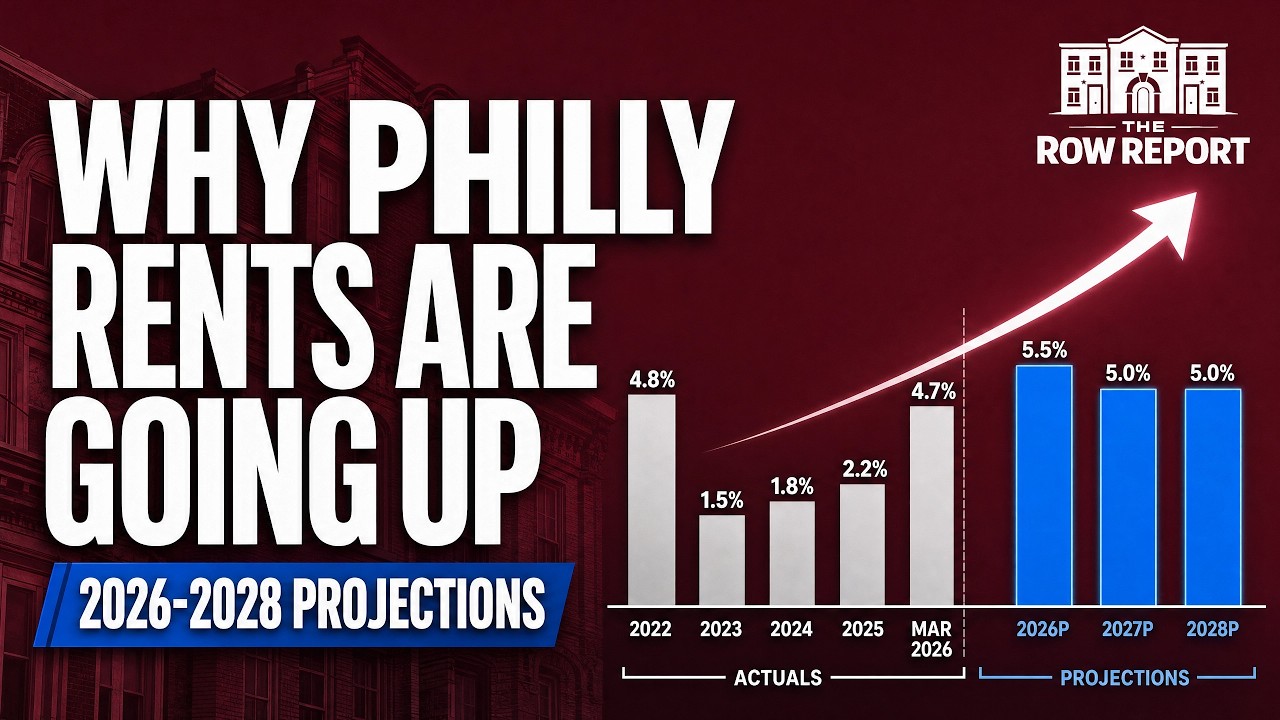
Hey guys, Kevin Moyer with The Rowe Report here. I'm a Philadelphia property manager and attorney, and I want to talk to you about why rents are going up in Philadelphia. So rents are really just a product of the intersection of supply and demand curve. So I'm about to show you and explain why there will be a new equilibrium soon. Rents will be increasing. Philadelphia has enjoyed rent stabilization, if not slight decrease, over the recent years due to an influx of recent supply, but But that is largely saturated at this point, and there is— there are not significant new projects on the horizon that will be adding toward the inventory. So for that reason, I think you will start to see rents increase. Why do rents have to increase? Well, they have to increase to keep up with rising costs that housing providers are facing in the form of labor, in the form of insurance, in the form of property tax increases. All the costs are increasing, so it's not making sense at the current price point. Because it's not making sense, some of the bottom operators are dropping out, and there will be a new equilibrium where rents will rise. So if you're a property owner and you're selling right now, you're selling at the bottom. When I say that, I mean in an operational cycle, not necessarily in a price that you can get on the market. I'm not talking about real estate prices, I'm talking about operations in the form of rent. So let's take a look at some of the data and put the numbers behind this message that I'm spreading right here. It all starts right up here in 2021, a huge influx of permits housing hit the market. Really two main reasons: interest rates dropped to zero shortly after COVID, money was largely free. With that, investment dollars poured into the city as investors were looking for a productive place to park their money. And then number two, of course, was the sunsetting of the abatement program in Philadelphia. So the abatement gives relief of a portion of property taxes to incentivize new construction, and it really did that over the decade preceding 2021. And, uh, and wrapping up in 2021, it, it jump-started new construction in Philadelphia. A lot of these projects that were permitted in time to take advantage of the sunset started and came online in the subsequent years here. 2022, '23, '24 all had a huge splash of new apartment starts, new inventory hitting the market. What did this do for rents? Relatively speaking, it suppressed them in '23, '24, '25 as there was a glut of new inventory and housing providers were competing for tenants on the market. You saw a lot of, uh, 2 months free rent, 3 months free rent to move into places as a lot of large multifamily were looking to suck up, um, occupancy of these units. So this huge splash of inventory in '22, '23, and '24 hitting the market really suppressed rents all the way through '25, and now you're starting to see it in 2026. And look, I am feeling it in 2026 too. There is a new appetite for rent increases. Uh, there is less competition in the market for tenants. The inventory has been soaked up largely. So because of that, uh, you're starting to see rents rise to where they need to be for operators. Again, I'm not advocating for high rent. Uh, I, I don't, uh, enjoy renters struggling with higher bills, but I'm explaining the realities of a market. It's supply and demand, people, and that's what it comes down to. And operators have not been able to operate or to provide and add new housing to the market at the current mathematical equilibrium. So that's about to change. Here are some projections I have. These are rough, but I really do think that, as you can see, the projected new starts and authorizations are low. There's no— there are more conversions really than a lot of new projects happening. There are some office conversions that are in the pipeline in Philadelphia to add a couple thousand units, but new construction has really dried up significantly. Uh, you can see the apartment starts here, projections are low, permits and projections low all around. So what will that do to rents as the bottom continues? Remember, the bottom's dropping out, so there are new units adding. I'm not talking on the demand side about household formation, that's a deeper conversation, but let's presume it stays steady or increases nominally. You're always having units drop out as well, aging out, units that can't operate, fire, lost to L&I, uh, uninhabitable. You're always having the bottom dropping out every year as well of the rental inventory. Places that could rent in 2022 are not able to rent anymore in 2026 for a variety of reasons. So the bottom is dropping out. New growth is not keeping up with demand, and because of that, you're going to see an increase in year-over-year rent. So a lot of owners that were hanging on kind of by the skin of their teeth in '23, '24, '25— you couldn't increase rent to match your expenses. You could not increase rent 7% to match the increase in your expenses in these years, or else you couldn't retain tenants because they could go to other inventory. That time is coming to a close right now in this operating cycle. I'm already feeling it in 2026. The rest here, '27 and '28, will also have rent increases. As we reach a new equilibrium. So if you were thinking of selling in 2026, talk to your realtor about the numbers that you're going to get. I'm not speaking about prices, but if you are an operator, I do think there is reason for optimism that the numbers will— you are, you're on the other side of some numbers that didn't make sense on your books that will allow you to, allow you to continue to operate.