Wealth Inequality: Causes and Consequences
Owen Zidar, Antoinette Schoar, and Atif Mian discuss why wealth inequality has surged: the 1986 tax reform created 1,000 private business owners for every Fortune 500 CEO, all with $25 million plus. The bottom half relies on mortgages with 85% loan-to-value ratios. The top 1% saves aggressively while the bottom 99% saves near zero, forcing down interest rates and inflating asset prices.
Chapters
Okay, welcome back. This is our first of 3 panels talking about research and ideas in the space of inequality and the future of work. We've got 3 fantastic panelists with us. I will tell you then, my name is Simon Johnson. I'm co-director of the center. And we have Atif Mian from Princeton, Antoinette Shaw from MIT, and Owen Zidar from Princeton.
Hi.
give you a little bit more introduction of each of them as they take their turns at the podium. They will present each for 10 minutes. They've got some really interesting and insightful slides. We'll have a short discussion among ourselves up here, and then we'll open up to you and hopefully take as many of your questions as we can before we wrap up at 3 o'clock. Okay, so first up is Owen. Owen is Professor of Economics and Public Affairs at Princeton's Department of Economics and the School of Public and International Affairs. He's also the director of the Industrial Relations Section, a research associate at the NBER, and former co-editor of the Journal of Public Economics. Owen, 10 minutes, over to you.
Thank you so much for having me, and I'm going to talk about 3 things: who's really rich in America, how they got there, and how they shape society. This is something that we've been working on with Eric Zwick. It's going to be a book coming out in September, so if you're interested, We have a very fledgling substack called Everywhere Millionaire, which you can sign up for updates.
Okay.
So I want everyone to picture a very rich American. And chances are, if you're like most people, you might envision someone like the top of this pyramid, like Elon or Jeff Bezos or Bill Gates or Mark Zuckerberg. You know, in the conventional view of who's rich in America, really, puts an outsized focus on the very top of the pyramid, yet these people have— they make up a tiny sliver of who's actually rich in America. I think some of this conventional view of who's really rich just stems from a lot of media attention in terms of tech and finance on the coast that has its roots in the Gilded Age and isn't as rooted in data. If you try to find out who's actually rich in America, it's really hard because rich people don't answer surveys. And so, you know, basically what we do— it's amazing, actually. The Fed pays, I think, like $20 million to run the SCF. It collects a few thousand. I think it's like 6,000 people, and they have a 10% response rate at the very top. And it's just really hard to do that. And they, you know, they have people working extremely hard. Because people don't answer surveys, we have whatever is told to us, and there's a lot of activity in the coasts. This shapes a conventional view about how you get rich in tech and finance. I don't think it's very representative when you actually look in the data. We've been working for about a decade with the Treasury Department doing systematic work on everyone, the whole country. everyone who shows up in tax returns. And we have a pretty different view of who's rich. Yes, those groups at the top of the pyramid are there, but there is this hidden world of private business owners who is substantially greater in number. And wealth is much more widespread and geographically diverse. A lot of them are from mundane businesses. And so one stat to crystallize this is that for every public company CEO that gets a lot of attention, there are 1,000 private business owners who have at least $25 million in wealth. 1,000 people for every one, you know, so there's a ton of attention on CEO pay and all these issues, but if you look at the inequality data, that's not as important as the rise of private business owners. So what this graph is showing is one of the most famous graphs in economics from Thomas Piketty and Emmanuel Saez. They show the share of the income and tax data that goes to the top 1%. And it's a big U-shape over time. And so if you focus since 1960, the blue line is basically their series. And if you stop that line in 1985 and say hold fixed the share of top 1% incomes that come from pass-through business or private business, you get the orange line, which is about half the increase in the top 1% share. So this is really quite material. For the rise of top income inequality. And what's also interesting is that, you know, this happened right after a big tax reform in 1986 when personal income tax rates were lowered and corporate rates were raised a little bit. And so a lot of people formed these new entities called pass-through businesses where income shows up on tax returns. But what's really interesting for researchers like myself is that this for the first time created a paper trail between who owns businesses and the firms making profits and their workers. And so we could link them together and learn about who's really rich for the first time. And again, in aggregate, this group is just much more important than groups that get a lot of attention like the Forbes 400. If you take all of the people who have $10 million or more who own a private business, They have an order of magnitude more wealth collectively than the Forbes 400. The second question is, where did they come from? There's interesting debates about the health of the American dream. When you find out stories of who's really rich in America, you hear all sorts of stories ranging from stories we tell about this family who held the wedding of the century. car dealers who spent $60 million to fly everyone to Paris and have Maroon 5 play. And they're a 4th generation family, so some of them inherit it. But a lot of them are self-made in the sense that they didn't have a family firm. Our best guess is it's about 3 out of 4 people at the top are self-made. And if you look at data systematically on everyone who started a business since 2000, in a project I have with Raj Chetty and John Van Reenen and Eric Zwick, and Guy Dossi. We find that most entrepreneurs of star businesses, so those are in the top 10% of revenue or employment growth in the beginning, come from the poor or the middle class. But that's not to say that rich people do not have very important advantages in entrepreneurship. If you look at the rate of founding, rich people have 6 times the rate of founding that poor people do. do in terms of parental background. So how are they getting richer? There are 3 kind of classes of things I want to talk about in the remaining couple minutes I have. So there are economic explanations, there are political explanations, and there are policy explanations. So economically, you know, how can you get greater income? You can basically, as a business owner, you can either grow the pie or you can get a larger slice. And if you look at our data from this paper we have called Capitalists in the 21st Century, what we do is we kind of decompose income growth of private business owners into the bigger pie and greater slice part. And from 2001 to 2014, a measure of the bigger pie, which is value added per worker, went up by about $10,000 per worker. Of that $10,000, business owners got about $8,000 of it. For those $8,000 in growth, about half of that came from productivity growth. There are stories of relentless work ethics and people really doing a lot to generate more activity, but the other half came from getting a larger slice. What this graph shows is for firm owners in the top 1% and 0.1%, how the economic pie of their firms was divvied up between workers and owners. So if you look at the graph on the left, you can see in 2001 workers got about 62 cents out of every dollar, and that fell by about a little over 10 cents by 2014, with owners getting a larger share, especially in tax-advantaged forms Over time, so part of the economic explanation for why pastoral owners are doing well is because they're creating a larger share or getting a larger share of a growing pie. The second thing is in the political system; it's really striking to see how represented these private business owners are. in politics. There's a political scientist, Nick Karnes from Duke, who tried to summarize the influence of rich business owners in a quip. He said, for most people, most elections comes down to an important choice. Would you rather be represented by a millionaire lawyer or a millionaire businessman? It's true empirically. Decamillionaires are 10 times more likely to be in Congress than they are in the general population. If you just look, and it's even more striking at the state and local level, by the way, especially mayors, there's low pay. The main people who can afford to do this are business owners. If you look at tax writing committees, which is one thing I focus on, about a quarter of these people are private business owners. There are fun examples if you look in Congress. People who own McDonald's franchises, car dealers, construction firms, et cetera. And they're all over. One of my favorites was Ron Johnson, who's a senator from Wisconsin. If you follow kind of tax debates closely, the biggest business tax cut in US history, he basically held it up because he said you need to do more for these private businesses. And in the article, it reports that his family owns one of these private businesses. So just to wrap up, I think this is one force that's led to a decline in tax rates. And so I think 2 of the main drivers of rising wealth are lower tax rates, which create a snowball of accumulation as you keep more of your pay and reinvest it in your business over a long time. I think that generates a lot of wealth. And lower interest rates and the Great Moderation also boosts valuations of long-duration things like private business. To wrap up, there is a huge class of wealthy business owners at the top. There are a lot of policy and economic changes since the '80s that have enabled great wealth accumulation. They're geographically dispersed. There's basically an auto dealer in every district, and that really matters for their power. I would argue that in terms of key legislation like the signature legislation legislation, the OB3 Act, in the Trump administration, you know, Elon Musk got a lot of attention for Doge and things, but in terms of this landmark legislation, he was basically a loser compared to wealthy business owners. So he, you know, there are a lot of EV subsidies that got cut back and energy credits that got cut back, whereas the auto dealers in Congress got a 20% deduction that, you know, was basically cost Medicaid, cuts on the order of $800 billion. There was state and tax— state SALT cap workarounds. And there was even a new deduction for buying a car. And so when you look at the details of legislation, I think you see these people everywhere. I think that's my time. So thank you.
Our next speaker is Angela Schworer. She is the Stuart Myers Horn Family Professor of Finance, MIT's Sloan School of Management. She's won awards for outstanding research, entrepreneurship, and finance. She's the co-chair of the MBR Corporate Finance Group and an executive editor of the Journal of Finance. Antoinette.
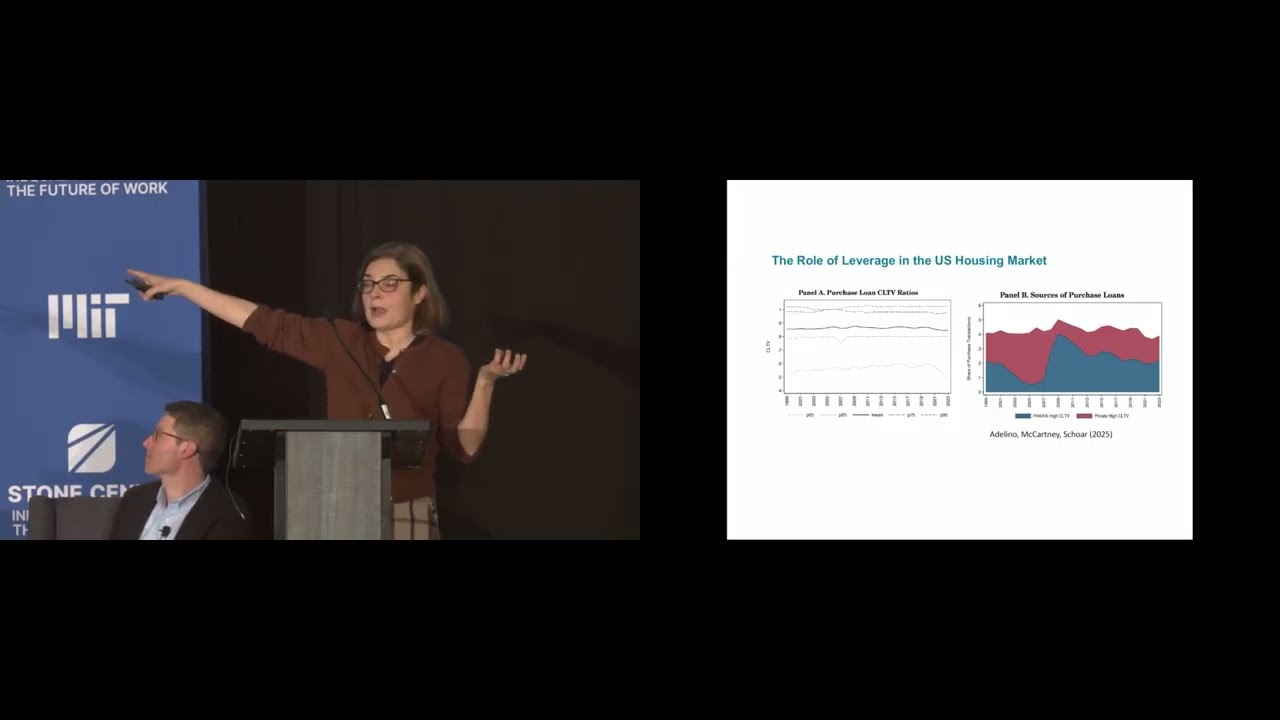
Thank you very much. So nice to be with all of you. And it's very well timed, obviously, this talk, by design, because Owen talked to you about the upper end of the income distribution and the rich. And what I wanna show you a bit is how the 99% thereafter are actually accumulating wealth. And this is from the Survey of Consumer Finance that Owen just mentioned as well, right? If you look, so this is from the Richman Fest. I just wanted to show you, if you look at the blue bars, right, the blue bars are the top 1%, and what this graph graph does, it breaks out for you how the portfolios of different parts of the income distribution in the US are set up. And what basically, what you see is for the 1%, exactly what Owen showed you, right? Most of the majority of their wealth is in business ownership, some in stocks, the equity market, a little bit in real estate, and not just their own housing, right? But then look at the the dark blue bars, which are the 25th to 50th percent of the income distribution. And here you see, right, why by the way 25th? Because people below the 25th percent of the income distribution in the US are not homeowners even. And so, you know, they are out of this picture. But what do you see, right? What you see is that the majority of people's wealth in lower income bins is due to housing and is held in real estate. And this graph is a little bit stupidly done, but I still wanted to show you this. Why is it 152%? It's because it doesn't net out the value of equity with their debt. And, you know, so what this shows you, you know, very dramatically is not just that the majority of wealth of poorer people is in housing, but also that it's very levered housing. Right? So there's a lot of mortgage debt that is used to acquire housing. And then you see, right, when you follow the blue bars down, that becomes slightly less levered for, you know, each 25th percent or each quartile of the income distribution. So why do I start with this? It's in a way to tell you, right, that for people below the, say, 5% or even 10% of the income distribution and wealth distribution, in the US, right? Housing is a major factor in their wealth accumulation. But, and this is kind of where I wanted to show you some work, some results from my work, is that because housing is so levered and because in the US we are spending a lot of taxpayer dollars to actually subsidize access to the mortgage market, we need to be very careful how we design policies. And I will come back to this. So this is where I want to go. But I wanted to— I will now show you a few facts for yourself to judge so that you can think about, you know, the housing market. So let me show you one fact from a recent paper we have in AAR Insight with Manuela De Lino and Ben McCarthy. So what do you see if you stare at the left side side of this panel. This is since 2000 or 1999 in the US, the distribution of loan-to-value ratios at purchase, right? This is the amount of loan that people take against housing wealth when they purchase a home. And you see the dark line is the mean. And the mean hovers, as you can see, right, somewhere around 85%. So 85% of a person's— a person who buys a home finances 85% of this with mortgage debt. Now of course over time they pay some of it down and, you know, the better your income is and so on, the quicker you might pay it down. But look at the top bins. So this is the 75th and 95th percentile of housing. purchases actually have 97% or even 100% LTV ratio. So everything is purchased with mortgage debt. And you see, the interesting thing is that didn't change in the financial crisis. So I'm showing you this basically since from 2000 to 2024. It's completely flat. And you might say, how the hell can this be, right? We heard there was a mortgage crisis, there was a 2008 crisis. You know why this is the case? So this is my right bin. My red picture here is because all that changed is the source of the high LTV loans. And so what you see here is in red is privately underwritten high LTV loans. In blue are government— Government loans. Insured vehicle of high LTV loans. What are those? This is basically FHA loan, Veterans Department. So these are LTVs above 90 or even 97%. Why do I show you this? It's to show you that highly levered housing or mortgage access is basically the norm in the US. And throughout, prior to the financial crisis, in the financial crisis, and especially now, it's actually government-subsidized high LTV loans. Look at my blue bars here, right? That are giving people access to the housing market. Once you see this, you basically know that it's the US government underwriting a very large part of our housing market. So how is the US doing this? Or how are we doing this, right, as a regulatory body? And that's the part that I want to show you that makes me very concerned. So one quick fact is, if you look at this graph, what this graph shows you is that there was a massive disruption in who got access to credit during the financial crisis. And what do you see here is that If you look, the orange dots are the, across the credit score distribution, the mortgages that were made pre-2008. Yeah, I can do this. This is for 2007, but I can do this for every year pre-2007. It would look like the orange bar. But look at the blue thing. The blue thing is 2009. Loan or mortgage purchase origination. You see this massive drop-off in, I mean, basically for people below the 660 credit score bin, okay? And if I go forward, right, you would see the same graph. I didn't want to overwhelm you, right, for 2010, '11, '12, and so on. Why is this troubling? Because it basically means that people that have lower credit scores actually had much harder access to enter the housing market, given how important mortgage is. And now you might say, oh, maybe serves them well because didn't we have just a financial crisis in 2008 where people defaulted? But I have a lot of work which here I don't want to repeat, right? But that actually shows the housing market didn't tank because of the poor people having small small mortgages with a FICO score below 660. The mortgage market tanked because rich and upper middle class people, which are the people that kept their access to mortgage credit, as my orange bar showed, right? They were the ones defaulting after 2000 or in 2008. So in some sense, we punished the wrong people, if you want, after the 2008 crisis by tightening credit to lower FICO people. Now, lower FICO obviously is very correlated with lower income. Let me just show you, it's not just kind of my opinion. You can see if you look at these, this is flows into housing and stock of housing. The blue bars on the bottom are the people, on the left are low FICO people, on the right are low-income people. Basically what you see is that post-financial crisis, it's the low FICO and the poor people who really suffered in terms of not being able to buy into the housing market, while actually higher FICO and richer people recovered very quickly in their access to mortgage credit and also in their access therefore to purchases.
What's interesting post-2008.
Now, final thing, why is that so important? Because actually what the point I want to make is that it's not just regressive that, you know, we are basically subsidizing the Fannie, Freddie, HUD, you know, FHA by giving, by subsidizing interest rates, but we're doing it way more so for the richer people who have better access to credit and therefore better access to housing. But that's not everything because if you look at my graphs here, it also means by tightening credit countercyclically for the poorest people, you're forcing poor people to become pro-cyclical housing buyers while you're allowing rich people to buy when prices are low. While, you see, what happens here is because we tightened credit for the lowest income and the lowest credit score bins directly after 2008, it took them till 2015 to even come back in the housing market. This is when prices already were high. Let me just quickly, because lots of people have made that point, it's even more unfortunate because young people were caught in that dislocation may probably in, you know, kind of involuntarily, I mean the regulator didn't mean this, but younger people in the US mechanically have lower credit score because it takes time to build a credit score. And so young people with low credit had the hardest time post-2008 to start, you know, and get into housing and so on. And of course many people have said, right, that young people are, you know, young, young families are having a problem entering the market. But I just want to show you that there is actually a big policy component in why the market and why the access to credit acted the way it did not facilitate access to mortgage and therefore to housing market for younger and for poorer people. And the only thing I want to say at the end is that obviously there are many factors that play a role. And it's not just the financial structure and financial policy that plays a role here. But why I'm particularly concerned about this is, number one, right, policy is something we have hopefully a bit more control over than changing fortunes of people who are either affected by AI or not affected by AI, right? All this is much harder to control. And the other thing is, if you look at how much money we are spending in subsidizing and thereby guaranteeing Fannie Mae, Freddie Mac, HUD, and so on, right? The CBO, the Congressional Budget Office, has estimated that about $30 billion a year is the subsidy to Fannie, the implied subsidy to Fannie, Freddie, and FHA in subsidizing more affordable, mortgage rates, but remember, they're affordable for the middle and upper middle class. The poorer people, as I just wanted, you know, tried to show you, right, actually don't benefit as much from it because due to how we regulate access to that market, we make it really hard for them. Thank you.
Our third speaker is Professor Atif Mian. He is the John LaPorte Class of 1967 Professor of Economics, Public Policy, and Finance at Princeton University, Director of the Julius Rabinowitch Center for Public Policy and Finance at the Woodrow Wilson School, and the author of a book, The House of Debt, which is very widely positively received on the issues he's gonna speak about today. Thank you, Atif.
Thanks, Simon. So I'm going to start by talking about Marriner Eccles, who was the Fed chairman during the '30s. Quite influential, I would say. The most important, biggest Fed building is named after him in DC. But the reason I'm talking about him is that he lived through a period— Owen talked about this rising inequality, which all of us know about. He lived through the previous such episode. When inequality in the US was at its highest at that time. And now we have sort of gone back to that in some sense and perhaps even more. And in one of his testimony to Congress, he made that remark. And I want to dive into this more because in my view, this is a very important lesson that perhaps was forgotten since then and is actually This is just the one main point I'm going to make, that this, the intuition behind this comment of his is the core, one of the core reasons behind our ongoing debt fiscal crisis. Okay, so that's the connection I'm going to try and make. That's, I'll try and do that in the 8 minutes or so that I have. So what does he say? He says, it is utterly impossible for the rich to save as much as they have been trying to save. and save anything that is worth saving. Okay, he's talking about the problem of inequality interacting with the propensity of the very rich to save. So why is that a problem? Well, the basic fact that we need to keep in mind is that the propensity to save out of either income or wealth is very different across the wealth distribution. Here is one illustration of what those saving rates look like. They are extremely high at the top end. You can see that at the top 1%, the saving rate is much, much higher than the rest of the population. In fact, if you look at— this is also very important— if you look at the bottom half, their saving rate is essentially zero, which is to say they are essentially living hand to mouth. They can eat what they hunt, so to speak. This is extremely important because if you think of the financial system, it has to maintain a balance between the supply of credit, which is coming from these savings that people are putting into the financial system, and the demand for that— those savings, which is the credit demand. That flow is disproportionately impacted given these saving rates. That flow is disproportionately impacted by the super rich. By that, I mean the top 1%. It's a very important point, often underlooked. What that means is that when we talk about inequality from a macrofinance perspective, which is what I'm doing here, it's not the Gini coefficient that matters. It's really share going to the top 1% that matters, because what really matters is what happens when you multiply that with the saving rates. And those are very different at the very top end. OK. All right. It's a very fundamental fact. Many people have shown this saving rate. Now imagine making this economy more unequal at the very top end. What's going to happen? You are going to boost the aggregate gross supply of saving. And your first response might be, especially if you're a macroeconomist, that's terrific. More saving means more investment. But here's the first kind of depressing piece of news. Investment in the US has not risen at all as a share of GDP. In fact, it has trended downwards for whatever reason. I think that's a super interesting question, but let's take that as given that investment is completely inelastic. Well, now we have a problem, a conundrum. If saving rates are what you're seeing here and income inequality is rising, saving is expanding, but if investment is not absorbing it, where can this saving go? And the short answer to that question is that if you look at the financial system and you look at the aggregate macro, numbers, this additional saving has been channeled not into investment, which would have been productive use of this saving, but unproductive consumption expenditures via debt primarily. OK. And you can— we can actually measure that. And this is from a recent paper of ours that we call, for obvious reasons, The Saving Glut of the Rich, where we show that as a result of this, So we can actually measure where this money is going. So we can look at net debt plots of the top 1% versus the bottom 99%. And notice that exactly when Owen says the inequality starts to rise around the '80s, exactly at that point in time, you start to see a big divergence of people at the top 1% accumulating debt as an asset through the financial system. And they are lending that, holding claims on who? The bottom 99%. the remaining 99% of the population. And remember, it's not the bottom 50%, they're out of this market. It's really the middle 50th through the 90th, 99% who are really borrowing this from them. But this serves a very important purpose, which is that at least we have found a use of this saving. And so that helps equilibrate the macroeconomy. And so you might say, this is perfectly fine. What's the problem with that? Well, the problem with that, we have to do a little bit of theory. But the key problem with this is that this unproductive debt is not generating any return, number one. Number two, the rate at which the private households primarily are borrowing this, that r is greater than the growth rate of their incomes on average. This creates a problem. It's not sustainable. These imbalances are permanent if inequality remains as high and saving rates remain as high. Something has to give. So this is, we wrote a theory paper where we show the only thing that must happen to make this consistent for the economy, to save the economy from collapsing is that the interest rates need to fall. And that's what happens. They continue to fall so that this borrowing, more and more borrowing is sustainable. And that's fine as long as you can do that until you hit 2008. And then the question is, now this private borrowing stops. People don't want to borrow or banks are not willing to lend, whatever the reason might be. The key question is, if the economy is still as unequal as before, what happens next? And that's where I'm going to move kind of the second act of this story, if you will, which is the only— there is one player who has that special privilege. Now I'm going to come to the government and the fiscal policy. The government has that condition reversed. They can borrow at a rate that is less than the growth rate of the economy typically in the US. That now they can borrow in a way that is sustainable all of a sudden. So they can pick the baton, if you will, from the private sector borrowing and start. But for them to borrow and spend, they need to run fiscal deficits. So However, so there is a necessity to run fiscal deficits basically. The problem, however, is it's easy to ramp up, much more difficult to ramp down fiscal deficits, which is where we find ourselves today. You must maintain yourself in this Goldilocks region of running fiscal deficits just high enough to avoid falling into a recession, but not too high that the debt becomes unsustainable. And the problem is we have gone beyond that Goldilocks region and now we are running the economy too hot, if you will. But it's politically very difficult for all the reasons that the government is shut down today to pull yourself back to a more sustainable position. Is this— does this story have merit? Let me just give you some proof that this is not just story I'm telling you. This is total credit to GDP in the US consolidated for households, corporates, and the government. If you look at the growth in total credit to GDP from 1980 till 2008, all of it essentially is private household debt. Not much happened on the government debt to GDP side. But when they could not borrow anymore, the economy demanded more credit. Otherwise, there would have been a major recession. So it had to be the case that if the government was forced to run much higher deficits post-2008, and that's exactly what you see, that private debt to GDP is flat since 2008, but it's government debt to GDP that has picked up the slack because somebody has to absorb those excess savings coming at the very top. Let me end with this picture, which is where we sit today. In fact, if you look at the primary deficits of the US, they have largely been zero. So the US has actually run a tight ship from post-World War till 2008. Primary deficits were close to zero on average. Since 2008, primary deficit to GDP has been extremely high. 4 percentage points of GDP on average. Obviously, we have ramped up since then. And they don't show any sign of coming back, of clawing back. CBO is making that projection in the red, but we'll see if it happens. And that is where we stand today. I think it's a real fiscal crisis potentially that we are facing. But again, the key point I want to make is that inequality is at the root of this debt and fiscal crisis that we face today. And it's a deep structural problem, which AI, by the way, will only make it much worse. Thank you.
Okay. So, 3 fantastic presentations, and yes, you can line up to start— oh, no, he wasn't lining up. You can get ready to ask questions, but I have a few questions first. And let me start with— the first round is about trying to see to what extent these are— this is one integrated picture, or to what extent you disagree all about anything. 'Cause I thought I heard a lot of agreement. Let me start with Antoinette. So in your story and also in the other stories, there's like a structural component of what's driving inequality, and then there's a cyclical piece, right? Something that happens as we go through the cycle. When you listen to Owen and Atif, how do you feel about the relative importance of those factors in explaining what's happened to inequality?
That's a good question. Like, I now sound like ChatGPT, like, wonderful question. How could you ask an even smarter one? No, but, right, so it's a very good question. I think it's very hard for me to, you know, kind of pontificate on which of these stories are more important. I think they all contribute to the picture that we're seeing.
Structural versus cyclical, which speaks to you?
No, I think, so I would say, I was not trying to say that the story I was trying to tell is a structural one that, however, gets amplified because of the cyclical nature. of it, right? And I think Owen's story, in a way, is more focused on kind of the top 1%, where housing really is not so much the problem, right? I mean, and it's not the problem because they are too wealthy. In fact, if you saw the Wall Street Journal this morning, the wealthy in the US are now— the wealthy top 5% could buy the entire real estate of the country.
OK.
So there you go. You know, but they can't in fact buy enough housing, you know, and that's maybe part of what Atif is saying, right? To satisfy, you know, the savings demand that they are having. I think, you know, the story for the top 1% in my mind is really interesting and it's super important to me, you know, because I work also on venture capital and private equity. equity, right? I have a view on this and what might have actually fueled, even though I'm actually, I feel, you know, kind of entrepreneurship really important for wealth creation in the US, but there has been a shift. I think, you know, Atif's story in my mind is probably, you know, more orthogonal to what I'm telling because it encompasses more than just the housing market. And then the other question maybe I have for Atif is, is that there is, of course, an international dimension. Because it's not just, right, in the US, the US wealthy using their savings to lend to the US poor, right? But there's actually a huge amount of savings glut from the rest of the world that gets recycled via the US. And in some sense, that has been fantastic for the US, right? That's why we have so many jobs and finance, even if you guys might not like finance, but it is a big driving force for American wealth creation and job creation and so on, right?
Doing God's work.
What?
Doing God's work, the finance sector.
I'm not saying that they're doing God's work, but neither is anyone else, right? We are not, I don't think that's required to allow people to have a living. So as you see, I think that the macro discussion is obviously much more varied.
OK. Owen, your reactions? And also on structural, cyclical, what do you think is more important in driving inequality?
I mean, I think these are long-running trends since the '80s. So I think it's more structural. In terms of housing, it's kind of fun. One opening fact is there are more 5,000-square-foot homes in between New York and San Francisco if you take a road trip than the homes themselves. I think people just lose sight of these things. And so if you kind of go to any nice lake or mountain and ask who owns these $4 million homes, you'll find a lot of these folks. And I agree fully with Antoinette that housing is not the main thing at the top. top, in part for reasons like Atif pointed out, that it's just hard to deal with that much money. I mean, what I think is interesting is when you have a concrete view of who's really prevalent at the top of a business owner, thinking about their savings rate is kind of hard. There's a big difference between foregone consumption that I'm actively putting towards something, or I'm just— there's a lot— there's a decrease in interest rates, and now my business, which is basically having the same cash flows, is now worth twice as much. And how— what the second one shows up as, as a savings rate, is not entirely obvious to me. Ben Moll has a nice paper about savings rates if you account for asset price growth or not. And so that, I think, makes it pretty complicated to know just how big of an aggregate flow there is in terms of savings. Now, Atif has thought more about this than me. And so, but anyway, to me, that makes it hard to just really put a clear view in my mind of the savings rates of these private business owners.
Got it. Atif, structural or cyclical, or how do you put the pictures together?
Jeff Bezos recently got married, right? So, and everybody was complaining that, you know, not everybody, but at least some people were complaining that how much he spent on the wedding. And the only thing I was thinking was, you know, he should have spent more.
I agree.
That's the structural problem. I mean, that's what I keep saying. I mean, the problem, the key problem is Jeff Bezos cannot spend, it's not physically possible for him to spend the amount of money he actually generates. So I wish him well, I hope his marriage lasts, but he should spend— But he cannot spend more. No, no, no, no, no, but he should, You should do something, you know, you should spend more. So that's the structural problem. That's what I'm trying to highlight here. You know, it's the basic economic force is supply equals demand. We have forgotten that perhaps, but I think when we talk about AI, supply still has to equal demand, by the way. And I think that's going to be the fundamental problem in my view that is going to again show itself through the financial sector and so on. I just want to, one other, Antoinette is exactly right. In the interest of time, could not talk about the international dimension of this. But it's, I mean, the US is like the money center, so it absorbs a lot of the foreign savings as well. But if you look behind what's behind those savings from China and Saudi Arabia, Korea, and so on, it's some of the very same factors that I highlighted.
Right.
Which is, again, it's the top 1%. I know Gini coefficient has gone down internationally, cross-country and all of that. But the share of income going to who saves the most, has gone up. And that's the problem. That's China's state capitalism is putting all the surpluses into these very high saving rate institutions because they are all running a financial repression regime. And that's one of the implications of that, that you're going to be channeling surpluses into these high saving rate corporate sector and then the government sectors. And so it's isomorphic to to everything that I said. And I think that's a fundamental problem. The problem we now face is connecting it to the first session perhaps, that the same players who have these very high saving rates and at some level are contributing to these issues, they have become politically very powerful. And I think it's a real question and a real challenge of who pushes back. I mean, the congressman was saying, you know, we all live below the API and it's not clear who's going to speak for us. in that rebalancing that needs to happen between the very top and the rest of us. Okay.
One more question for sure from me, and if anyone has questions in the audience, go to the mics and I'll call on you next. But just quickly, I think it's very helpful, including your replies just now. So, put you on the spot, Owen, and then Atif, and then Antoinette. Give me one or more policy recommendations that you feel are grounded in research that would actually make a difference, and you can pick whatever dimension of inequality you'd like to address, but let me know if there's some risks to jobs or growth or the stock market or something else I should be aware of as an elected politician if I'm gonna take on your idea.
So one proposal that Eric Zwick and I have made, somewhat in jest, was to party like it's 1997, which is basically to roll back the income tax code to 1997, which was a period of lower deficits and higher growth. And I think those changes would largely be modestly higher income taxes, higher dividend taxes. Danny Yagan has some work suggesting the investment impacts of that are pretty modest, slightly higher capital gains. And so I think the overall investment— the growth impacts would be modest from that. I think the most egregious one was in the OB3 legislation. There was an $800 billion line item for a 20% deduction for private business owners, and that was basically how much the Medicaid reductions cost, and that got very little play in terms of media attention, but that was a huge, high-expense item. I think a pretty bipartisan agreement that that had pretty low impacts on growth in terms of research, and so that, I think, would be the first to go.
Okay, Atif, policy recommendation.
Yeah, so I do have, in fact, the policy that I have in mind can also win me the election, which is important if you're going to propose. So the part— but it's going to be a bit, maybe some people kind of start putting labels on me, but hear me through. I think first, I would like to lower taxes on income, labor income in particular, like payroll taxes and so on. I mean, I think the taxes are too high on labor income, so I would lower taxes on labor income, middle class in particular. And I would raise taxes on wealth, okay, and at the top end. And in particular, the core problem is I think we have to think more about productive versus unproductive uses of capital. If you notice, that was the undercurrent. Let me give you a— this is why I was joking that, you know, the financial sector is doing God's work or not. The basic fact is at the aggregate level, if you think of the financial sector has basically doubled since the 1980s. Their balance sheet has doubled. And the question is, what are they doing? Almost zero of that incremental growth has gone into productive capital. All of it is unproductive consumption expenditure. First household debt, buying existing assets, all of that unproductive. And more recently sovereign debt funding consumption expenditures of one sort or another. That's a very unhealthy way to run an economy. And so I think, and so what's the solution? Well, you tax the thing that is not working. So I'm going to reduce tax, that's why I'm going to win elections. I'm going to reduce taxes on most people in this room, but I'm going to raise wealth above a threshold that will, you know, make all of us not care about it. And I think we have to go in that direction.
Yeah, I think taxing people not in the room is a Very good strategy. Antoinette, what have you got for his policy? And then we're going to—
I thought you would propose a harem for Bezos when you said— so, okay, fine. So I would say, well, you're asking for 2 things. So one thing, actually, in the spirit of taxation, I do think that the income tax loophole for private equity, even though it's not a large amount of capital that's being raised this way has been very distortive because it basically means that publicly traded firms or even investment banks and banks and other firms find it hard to compete for talent with private equity firms because they have immediately, right, a 20% or even more advantage when hiring anyone. And so that actually distorts where the most talented So that's, I think, maybe a small thing you could say, but actually has structurally made a big difference. And then the other thing which we haven't talked about is, I would really love to reform how higher education is funded, from how student debt is being underwritten in the US, and how universities are being held accountable for how they use students. When placing students into the market. And what I mean with this is in particular, we have seen this massive rise in for-profit private colleges that are brilliant at marketing and indebting their students, but horrible at actually placing them into wage-gaining jobs. And if we just at least tested the access to Stafford loans and student debt and made it conditional on a university actually creating graduates that then are successful in the labor market, that would already make a huge difference in my mind.
Great. All right, question from audience, and please identify yourself. I'm not gonna guess who you are, come on.
I'm a doctor at MIT Stone Center. So I had 2 very quick questions. One, Owen, your presentation was super surprising about, you know, the kind of hidden millionaires. And should— I guess this makes me think that this seems like good news to me, right? I mean, you know, I sort of think all the money belongs to Jeff Bezos and, you know, the, you know, very small number. Should I view this as a sign that there's like more, you know, rags to riches, more dynamism, things are less, you know, sure, it's, you know, people still have $20 million, $25 million, but that, you know, that's— That's a testimony to health, and these are a lot of these are blue-collar millionaires, right? They own an HVAC company, they own a car dealership. So just help me contextualize that. And then just a very quick question to Atif. Does the AI boom suddenly create use for this capital, that all of a sudden we're actually doing something productive with it?
Yeah.
All right, Owen.
That's a great question and something we've struggled a little bit with. There was an op-ed at some point that was like, are they heroes? I can't remember. Yeah, are they evil or— Heroes or villains. Yeah, there you go. Heroes or villains. And it's a bit hard to generalize. There's a bit of both. So, on one hand, you have stories like Dick Portillo, who started with basically nothing, was cleaning dishes in his family bathroom. There was mustard stains on the side, and he ended up selling his hot dog business for $1 billion.
Chicago.
Chicago. He didn't go to college. You know, it's hard to think there's a lot of market power and monopoly rents in the hot dog business. You know, so I think that is somewhat admirable, and, you know, it's not perfect, but I think there are— that's some cause for hope. However, when you look at some of these other industries, from beverage distributors to auto dealers, there's a lot of regulatory capture, especially at the state and local level. Physicians, there's a lot of top physician income where we have supply shortages. So I think there's a lot of rents as well. Putting a specific number on how much of this is rents, unproductive rents versus more productive activities is pretty hard, but I think there's a healthy mix of both. And so that's my answer to you.
Atif?
So David's question, if the AI investment boom is short run, and not long run. It will help in the short run in absorbing that savings supply for productive reasons, which is a good thing, number one. But if it's not going to sustain in the long run, kind of doesn't matter, number one. Number two, what is very important, even if it was more permanent, what is very important is the returns to that investment. How is that distributed? If you're going to funnel the returns effectively back into the pockets of Jeff Bezos and Mark Zuckerberg, It doesn't really help in the long run. It makes things worse. Now, let me say something even more depressing than that, which is, by the way, David said be provocative, and so that's why I'm sort of, my Bernie Sanders is coming out on stage now. The other sort of thing is that let's say that AI returns are going to be completely the opposite, that it's the middle class that's going to benefit from that return. That's great news, so I want that. But that does have one implication. That's the depressing part. The fiscal side then must react and retrench itself. Because remember, the fiscal deficits are being run in the past to absorb those supply of savings. If we have better uses for that, that's good news. Now you must pull back, otherwise you're going to push up the interest rates too much. So there is that adjustment that needs to happen. I just want to highlight that.
I guess that's the hardest part, right? I mean, you would agree, Atif, that whether this is demand or supply is really hard to know because it's also true that the government steps in when there is a lot of shortage and when, you know, people are in dire straits. But if indeed, you know, your positive scenario came out, there would be less need for subsidizing SNAP and for, you know, basically the government having to provide the services that poorer people right now might not be able to fund themselves, right? So it's not just the government having to absorb. In fact, the government, in some sense, we would all be happy if there were certain services that the government doesn't need to provide anymore. And I know, obviously, there's inefficiency in government too, but if we think about a well-functioning government.
Well, any other questions from the floor? Well, seeing none, or seeing none— okay, there's one. Yes, go ahead. Step up to the microphone. And remember to identify yourself.
Hello. I'm Vincent Abbott, PhD student at MIT. My question was regarding lots of the topics which were covered. Is why can't a lot of these issues be moderated through the typical mechanisms of interest rates and inflation? So for example, as the supply of capital builds up, interest rates goes down. Wouldn't that, for example, allow more construction to be done or create more investment opportunities? So what about the typical interest rate and inflation monetary policy? They're the same thing. same thing, mechanisms in a free market are insufficient to cover the issues you're focusing on.
So let's take this for everybody and make this your concluding remarks as well. So is there something in the market or the policy response to market changes that would bring us back to where we were before, or is it likely either not to work or the policy could actually be exacerbating I think some of the effects. So I'll come down this way. Owen, and then Atif. Owen?
Sorry, I was anticipating that was for Atif. So you said, is there some— say the policy part again.
Yeah, so it's a good question, which is, is there something about how policy operates, like lowering interest rates, for example, either as part of a market mechanism or just policy response, that would tend to pull us back to where we were before, or do you see the natural course of events, structural and cyclical, being to widen inequality?
Yeah, so, I mean, one kind of interesting thing about who is being listened to and represented in Congress, even for the Fed, for instance, I think there's a lot more conversation with these regional business owners, and so how they're doing, I think, is better channeled into monetary policy. Because they're talking to, you know, say the Cleveland Fed president much more than some other folks in the middle class who really don't have much of a direct line. That's not a direct answer to your question, but I think just the overall level of representation of this group in Congress, their influence through political lobbying and donations, you know, it's kind of interesting. People love to focus on Elon for donations, but the Uline family, which is from kind of a not central place in Wisconsin, was one of the highest donors for several things. They helped make urinals and packaging, urinal liners and packaging equipment. And so I think this channel for influencing policy is not going to get very much better until we have a better system. System of finding members of Congress from a broader range of backgrounds other than, you know, 10x business owners.
Or campaign finance reform.
Yes.
Antoinette.
Yeah, so I think it would be nice if government functions well and, you know, pulls us back from the, from the brink. My worry right now is maybe 2 things. One is that in the spirit of what Atif was saying about Bernie Sanders, right? I mean, there is basically political pressure on both parties to become very populist, but just very tribally tell the story for, you know, one side of the political spectrum versus the other. So rather than actually thinking about making, you know, the US more competitive, govern more efficient, investing in education where it's really needed, we are— I've I fear we are getting actually into more of entitlement fights. And you can hear I'm from Europe. This is something that I always thought the US was actually doing a much better job than in Europe to think about the economy as a redistribution mechanism rather than protecting the fact that the US has a lot of dynamism. Let me say one final thing that I personally worry a lot because I do research on this, but I also find that the politicization of cryptocurrencies is something that worries me big time. Because crypto is being used, forget about all the illegality, I mean, it's just the, you know, for political donations, for opacity of how government officials are being funded now. But because crypto itself has been politicized, it's now embraced on the right, vilified on the left. When in fact, you know, what we really need is good regulation to make sure that KYC, AML are enforced. But also maybe that some of the monopoly power of the existing financial system, you see I don't always defend the financial system. Actually gets curtailed. that there is competition on the right level, but not competition by undermining the guardrails that we have created over so many years.
I think good regulation was on the table and then a flood of money showed up in the elections.
Oh, absolutely.
Atif, final thoughts?
Everything I said, by the way, was in a free market system, if you will. And that's why it's such a much more difficult problem, that as long as inequality interacts these savings at the top, the economy by its own natural forces, equilibrating forces, will find it very hard to balance supply and demand. And that's why it's a much deeper problem than you can just rely on the markets. But let me tell you one fact about the way markets have worked that really worries me. And that is if you take the stock market today, the price-earning ratio is at the highest it has ever been essentially. In macro jargon, we'll say Q is very high, Tobin's Q is very high. Now, if you can, if you have such high valuations, the market mechanism you hope would work is that there is a flood of investment because everyone wants to create the next company. And we absolutely don't see that in the aggregate. This is why I said in the beginning that investment is very inelastic. I think that's a very first-order puzzle that we have all suffered from. I wish it was the other way around. But that, and so in that sense, the markets have failed, if you if you wish. Perversely, since there's always a depressing angle in everything I say, so I'll end on that. The fact that this supply side or saving is very inelastic, it makes inequality even worse. Because in the absence of investment boom, interest rates fall even more, which raises asset prices even further. And whoever owns those assets, and especially if they are monopoly owners, they will become even richer. And so we have been faced with this perverse game of more inequality pushing interest rates down, which actually makes the rich even richer through the asset price feedback loop. Hence, we need to tax the wealth.
Okay. Thank you very much, everyone. And we now take another 10-minute break because you can never have too too much coffee, at least not during our conferences.
Yes.
More from Owen

CHIPS Implementation Retrospective: Perspectives on Future Industrial Policy

Evaluating State and Local Business Incentives - Owen Zidar | O-Lab Workshop 2020