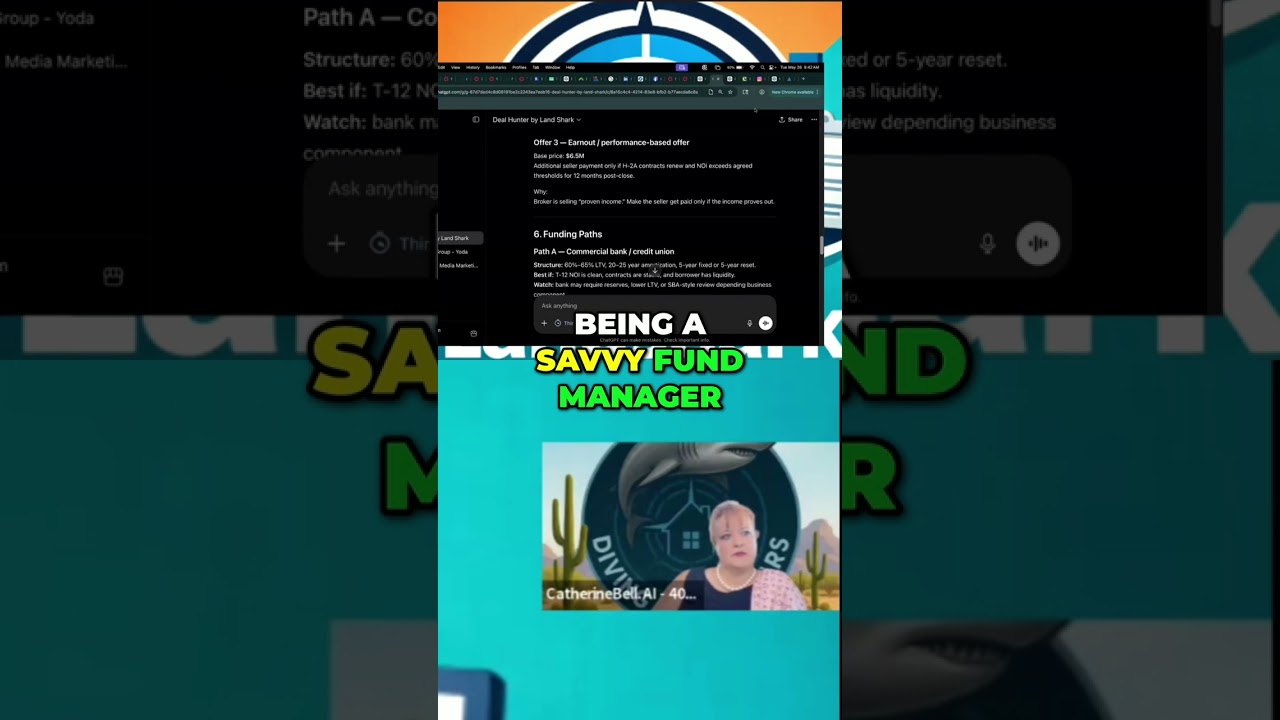
Tommy Dobczyk explains how deal structure attracts investors: transparent, high-percentage stakes signal competence. He contrasts a winning poker player with a losing gambler to show why discipline matters, points to Trump's Art of the Deal as a practical guide, and outlines four funding pathways for closing deals.
Chapters
When dealing with investors, being a savvy, being a savvy fund manager is shown in how you structure the deal. And the reason is because for my investors to see the deal I structure, because everything has to be transparent. If I show my investors that I got a deal for 25%, they're 100% interested in investing with me because they're like, holy crap, that guy's smart. Let me give him my money. He's going to make my money grow. Would you give— I had a brother that was a professional poker player and another brother that was a professional gambler, right? The one that played professional poker made money, drove fancy cars, lived in nice houses. The professional gambler, not so much. It's because the one, he could make magic tricks. The other one, he made money disappear. That's it. That's the only trick he knew. Right. So when dealing with investors, being a savvy, being a savvy fund manager is shown in how you structure the deal. The Art of the Deal by Donald Trump. And again, people are like, oh, Donald Trump, go read his books. You'll know why. Right. I'm lifelong Democrat, voted for Republican 3 times. Which one I voted for 3 times? Donald Trump. That's it. Like, I still have all my thoughts and morals of what I thought, what I think the world should be. But when it came to running a company and a business, he figured it out and knew how to do it. He knew how to structure deals. Anyway, so one of the other things it does is it shows us how to find ways to structure it and funding paths from commercial banking, seller financing, private money, bridge refis.