Keys to Cash Flow: The Airbnb Luxury Play in the Florida Keys 2
George Salas presents the Empress Methodology for buying and running luxury Airbnb properties. He screens markets for regulatory stability and supply-demand balance, applies a strict 20% revenue-to-purchase-price rule, and designs experiential properties to drive occupancy and reviews. A Texas property he bought for $455k projects $132k annual revenue.
Chapters
Katherine's on a plane, so we're bringing team and teamwork to it. So George, why don't you just give us a little bit about— Katherine knows you a lot better than me, but I can't recreate her introduction of you. So for anybody new, why don't you just give us a little bit of who you are and then go for it for the presentation.
Absolutely. My name is George Salas. I'm a short-term rental operator. I've known Katherine for quite a few years. So we met through Race Masters, and which is a mastermind that she was part of. I think she's coached it for many years as well. And then I was part of the, part of the group for 3 years in a row. So we've been great friends since then. I actually joined some of her, some of her AI trainings, okay, about a year ago. So we've been great friends since there. I love what she's doing and the impact she's making in the world. Myself, kid from Peru, been building a short-term rental vertically integrated platform for just quite a few years now. So I'm super excited to be here. I live in Houston. I've got a 3.5-year-old, and I'm excited to bring all of you massive value today. So thank you. You're very welcome.
Awesome. All right, we'll look forward to it.
Awesome. Well, let's pick back up where we left off on Tuesday. So thank you everyone for being here again. And if you weren't here for the first one, We're going to switch it up just a little bit today. So super excited to be with all of you. And again, today I'm going to walk you through the Empress Methodology. This is the framework we use to identify, acquire, and operate high-performing short-term rental assets. I call them experiential short-term rental assets. So, and our goal here is not speculation. Our goal is creating a repeatable process focus on risk mitigation, capital preservation, and predictable wealth creation. I won't spend too much time on this slide, but just so everybody knows, today's presentation is educational in nature, and all projections are estimates, not guarantees. They're all for informational purposes, and the purpose of today is to explain our methodology, track record, and investment approach. So before discussing, uh, methodology, I think it's important to establish credibility, right? What you're seeing here is a result of almost 10 years of hard work, but also 140 deals, 140 short-term rental.
You lose George?
Oh, I think so. I was like, I thought it was—
annual revenue per year.
Oh, there you're back.
Can you hear me?
We can. We lost you for a second. For a second.
Got it. Got it. Okay. I was mentioning to Laura that I was having some technical difficulties here. I don't know what's going on, but just let me know.
Solar flares. We'll dance with it, George. No worries.
All right. So the most important thing here is not the numbers themselves. The most important thing is the consistency behind them. So let's jump into the next slide here. So a little bit about myself. So this journey or methodology, let's for say, wasn't developed in theory. If you looked at the timeline, you'll see several major chapters. In my life, right? The Valley represents the early struggles of a kid from Peru, moved here, didn't speak English 25 years ago. The crash represents a difficult setback and lessons learned. I've always been an entrepreneur mindset or an investor, but I never actually— I didn't always knew and had the skills. So it's always great to be here. I'm a learner for life. So learning every single day has been one of my core values, right? So I love to say that and I thank you for being here. By the way. So, and the rebound came through discovering and scaling what we call our short-term rental model. Okay. So, and that started in 2018 and I've done all kinds of deals by the way. So starting from fix and flips and wholesale deals and owner finance and notes and short-term rentals and renovations, and we're fixing to do some boutique hotels. I'll operate the short-term rentals, but, and then, and then we had a reset here. During COVID where we had to reposition and reevaluate where we were at and change the path to the next level, right? To where we were going next. But what you see here is far right, the result of all those lessons. So, and I've combined them into the system, into what I've built here. So I'd love to show you that. And the reason for me, it's very simple. I'm just here to bring you value and as everybody else is in the group as well. So. Now, the biggest difference between most short-term rental investors and what we do is simple, right? Most investors start by looking for a property, right? We start by eliminating the risk. So if you look at the left side of the slide, that's how many people invest, right? They buy close to home, they buy what's available, they look at the property first, they hope the numbers work. And I I'm going to be honest with you. I did that when I first started myself because I didn't know any better. Right. I didn't know that. I was just hoping that the deal would work because I had a great location, but I didn't have certainty there. Am I still good, Laura?
You're good. I love your— I love basic furniture to sleep heads. That's a great line. We've managed some Airbnbs as well, Katherine and I in the past. And we did, I think, a little bit closer to your model of definitely experiential or themed. I wouldn't say experiential, so I'm interested in that, but themed, themed Airbnbs. But I love the furniture to sleep heads.
That's exactly—
so some of them are that way. You're right. They're like most of them, 4 rooms and sleeps 25. And you're like, holy crap, right?
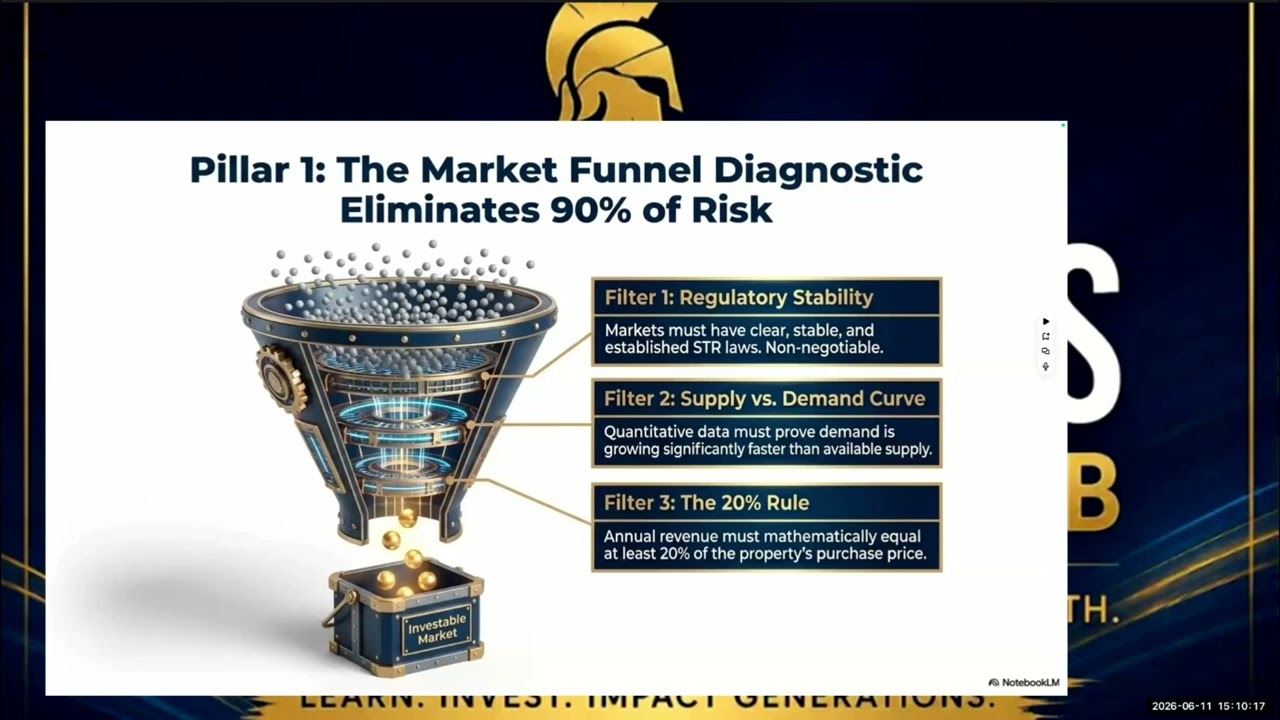
Most of them are going to be your basic right now. There's 3 categories of them. So quickly, you've got your basic. Then you've got your model homes, which is really nice homes with a lot of bedrooms and then also just furniture. And then you have experiential, right? And this is the next level, experiential, when it comes to beautiful amenities and places where people can actually get experiences and create memories there. So we focus on that little niche. And then within experiential, there's— that's a bigger, like, generic word, right? So Within experiential, you've got even a more niche category, right? So we love benchmarking on the top, top performing properties because we know we're going to hit those numbers. But anyway, we'll keep going here. So on the right side of our process, we start with market filters, right? So we understand supply versus demand. We want to understand regulatory filters and stability. We benchmark against the top 10% listings, and we stress test our underwriting in 3 different scenarios and really always go in between worst case and realistic. Okay, so now let's start with pillar number 1 of the method. Okay, so pillar number 1 is market selection. Before we evaluate a property, we evaluate the market, right? The first filter is regulatory stability. We want to make sure that the city allows regulations, as well as understanding if that property or that market that you're looking at has a ton of HOAs, or you're in a market where maybe there are a bunch of HOAs, or maybe the cities have actually installed regulations a long time ago, so they're going to be, they're going to be right in the middle. And we like the middle of the market regulations, not too strict, not too open. So for us, if regulations aren't clear or supportive, we just don't move forward, right? So the second filter is supply versus demand. Our objective here is the evidence that demand is actually growing faster than inventory, or are at the same pace, right? Now, that's in general what the market says, but when you have the top properties, you're narrowing down. So even that metric alone is good to understand a market, but it doesn't make it or kill a deal, right? So the third filter is revenue potential, right? So you'll see that expanded then on the next slide. So only after a market passes all three filters does it make sense for us to go through with the property. And 9 out of 10 properties that we'll look at, they just don't pass these filters. And so these filters are essentially 3, but we literally have a checklist of about 10 things that we want to make sure that happen. Okay, so now let's talk about probably the most important rule of all. This rule is our main screening method, right? So if the property simply does not generate 20% of its purchase price, in revenue, the concept is simple. We do not move, right? So that doesn't mean it's going to be profitable because taxes and insurance can make or break this deal, right? At times, 20% now is— especially in markets that are prone to hurricanes and natural disasters, you'll have higher insurance, like Texas is one of those, right? So for us, if projected revenue doesn't meet our threshold, we just don't buy it, right? So discipline is really important here and matters more than the deal volume. Okay, so also many investors fall in love with a property and then they try to make the numbers work. And I don't know if you have, but I have. When I love the property, I was like, "How does this work? How does this work?" And you try to find different angles, lowering here, lowering here. What happens if this happens? What happens if we eliminate this expense? We create more revenue. But we take the opposite approach now. Right? So, and that's the way to do it. You can't make something work if it's just not going to work. You want to eliminate the risk by having certainty that it works. And for us, is what you're seeing here, right? The property has to earn its way into our portfolio. It has to meet the objectives. And for example, this deal, we purchased it for $455,000, and the gross rent multiplier, which is the 20% purchase price to revenue ratio, was 29%. So our target revenue was underwritten at $132,000 per year, right? So now what happens On the next step, pillar number 2 is the sweet spot of the Emperor's Methodology, right? I call the sweet spot formula or the Emperor's Buy Box, right? This is when you essentially build a buy box based on what the market's telling you where you should go, right? What are those amenities that you should go? What is that type of property? The number of bedrooms, bathrooms, et cetera, right? So you'll notice the 3 overlapping factors here on the screen. The first is revenue potential. The second is guest appeal. And really guest appeal has more than guest appeal. It's just amenities and how beautiful you want to make that property and how— what's the space within and outside of that property that you can create that guest appeal, right? Guest appeal is one— the two-word, the two-word, two-word phrase, but there's a lot more behind it. The third is value-add opportunity. So if you have the room to create guest appeal in the prop— the property issue should have already a solid guest appeal. Now you can make something ugly look beautiful, but if it already looks great, you're going to spend less money, right? So then value add is massive. And what value add— there's two ways that we add value in real estate. One is by adding, renovating, and bringing it up to, up to standard and up to market. Right. So that's one way. And for us, it's the other way as well. We already do that value add in interiors of homes, right? Because most interiors are going to give you that square footage, right? So that value, but we also go on the outside and add value there because we don't just add value for equity, we add value for cash flow, for ROI, and for revenue, right? So we're adding value in the, in the way of amenities and design. That's our value add. And that does also increase the value of the property, but mostly increases the revenue long Per— So we're looking at all three. And if a property has strong revenue but weak guest appeal, we just— Right. Or we sometimes try to make that property just— But we would just spend a little bit more money. So for example, the deal that I was giving you an example on, that guest appeal piece was there, right, on this Texas deal that I had, that we have today. But we needed to do— We needed to perform stronger renovations. So we ended up spending more. And this property's cash flowing an average of $40,000 to $45,000 $100,000 a year, but we had to add the guest appeal because the property looked decent. It wasn't like, wow, right? So if guests love it but the numbers don't work, obviously we pass. Guest— if the numbers work but there's a little opportunity to improve the asset, we usually pass. So then for me, the best opportunities really exist where all three circles overlap. Okay, so pillar number 3 is experiential design. Now, I would love to have had my photos of my properties here. I know we had to redo on the last presentation. I was like, oh my That is not my design. I know we have to make like some last-minute changes.
You know, the double cabanas in the backyard?
Come on.
Right there.
Right there.
Like his and her cabanas. I love it.
It's mostly the pictures on the left. That's not the sign, right? So what happens? I know we had to make some last-minute changes, right? So this is the pillar that I call experiential design. Okay, so most investors think it's just a cosmetic piece. We view it as a revenue driver, right? For me, and obviously numbers prove the proof is in the pudding on those numbers, right? Amenities influence everything. They're going to influence your occupancy, which is going to influence your revenue. And then over time, even with both of those, you're going to influence the ADR, right? So when you're amenitizing and bringing real design, right, you're also increasing that average daily rate. It's not just the property's going to be more occupied, it's they're going to pay you more for it, way more, right? So guest experience influences reviews, and reviews influence booking velocity, right? So when you get booking velocity in any of these platforms, then you're going to get momentum on the algorithm. That's a quick trick, right? So, and then booking velocity influences revenue, right? So the goal here is to create a beautiful property that everybody's booking constantly, weekdays and day in and day out, week— weekdays and weekends, right? So, and at the end of the day, they're going to choose your property over the competitor's options because they feel themselves just having a great time enjoying and creating those memories and those experiences at your property rather than somebody else's. And they notice that when they see the pictures, right? Those pictures are pretty much everything at first. It's just that one hit that you create when you're looking photos. But if I had to summarize the entire Empress methodology in 30 seconds, would be this, okay? Step 1, choose the right market. Step 2, buy the right property. Step 3, create the right guest experience via design and amenities. Okay, everything else is execution, operations, running it the right way, right? So there are hundreds of decisions involved in building a successful portfolio. We simplify everything into just 3 steps: choosing the right market by doing research and data and understanding the numbers, narrowing that data to the right micro market or submarket to find the right property, because that data will tell you what to buy, and then really creating the guest experience by making that property the sellable product. So those 3 steps are the biggest drivers for long-term performance and risk mitigations in this, in this industry.
Great. George, it looks like your other device dropped off because we're not seeing your presentation anymore. Do you want to try to connect it, or do you— can you just talk it through at this point?
Let me see.
And we might have your thing. I can see if we have it.
Do you want to— I don't know if we've got the latest. I know some change, last-minute changes got made. Amor, if we've got it, we could display it for you, George, if that's easier.
Yes, if you can, that would be awesome.
Okay.
Sorry about that.
No, it's not a problem at all. I just want to make sure you get the most value, or we get the most value out of your time. And so let's see if Amor can do some magic.
Thank you, Amor. No problem.
So we were on slide—
Tell me what slide you're on.
Slide 10.
All righty. Let me go to slideshow.
I think we could jump to slide 11.
Okay. Just tell me if I'm showing the right thing.
Okay.
And it might actually be the one that just doesn't have the brand on the very first page, but I can go to the page that you're on.
Isn't technology super fun? No, that's a different presentation. I don't know if that'll work. That's not the presentation we were doing. Katherine created one from Notebook. Let me see if I can—
I just wonder since he knows his slides, were these the slides and I did this?
Oh, those will be a lot longer.
No, this isn't the presentation, Amor, is what I'm saying. Okay.
Oh, those are different ones.
Those are totally different ones. Let me see if I can find—
So if you guys are online here, we'd love to, while we're here, I'd love to leave some room for questions while we fix this issue here. So if there are questions, please drop them on the live stream or put them here on the chat.
Any questions for you, from you, Amor, while I—
Well, yes, I did have a question. My question was, so you talked about like the 3 most important things, like, okay, is, does this property even make sense? And you talk through yours, like what you're looking for. So what I was wondering is, one, something that I keep hearing is, oh, Airbnb, that's gone. Like that investment thing is gone. How are you finding things that are profitable that can work in this market.
I love that. So most people that are doing short-term rentals are actually mom-and-pop operators, right? We're professional operators. So the big difference between them and us, like, mom-and-pop operators are going to come with a— they're going to choose the property first. They're going to just find what they can, right? Go on that left model for that slide that I showed you guys. They're going to choose the property first. They're going to say they're going to buy as low of cheap furniture. I think I'm back here, by the way.
Yeah, if you are, then you see two devices. We just don't see your presentation yet. So why don't you try sharing?
Oh, there I see it coming back up.
Coming. So we saw your Zoom screen. So you're behind whatever I think what you were trying to show. There you go.
There it is.
We see the Wealth Engine. We see the short-term rental Wealth Engine.
Awesome. Sorry about that, guys. No worries. So the answer to that, most people that are, that are saying that they're mom-and-pop operators or they have 1 or 2, and the reason why they're saying it, it's because what happened between 2020 and today is the supply pretty much went about 1.5. So it was 1 million in 2019, it was 1 million STRs. Today there's probably like 1.6. So 1.6x. So it's much harder to make money in this business now. So, but for us, we've always gone on really cater to that top 10%. So now what happens when somebody's getting just a regular property out there, right? And they're going to go compete against those $1.6 million while we are creating very unique properties and we're creating our own competition, right? So really, we don't have a lot of competition when it comes to a lot of our unique properties. Now, I'm not going to say all of them are unique, but think about commoditizing. Like, if you're, if you're a bottled water maker and you're putting bottled water out on the market, there is no premium for that, right? But if you, if you are looking for the best heart surgeon, that best heart surgeon is going to cost you way more money. For, well, we're creating the heart surgeons of short-term rentals, right? While most people are creating the bottled waters and they're literally putting their bottled water next to the other water bottles, right? That's mainly the— hope that was a good explanation with an analogy there.
Oh, it's really good. Like I said, Katherine and I managed Airbnbs. We got out right before COVID not intentionally. It just ended up working out that way. But we similar, like I said earlier, we did themes. So we had like the man cave and it had all sport themes and stuff like that. And that definitely was— we had a lot of repeat guests and would come back year after year and we had a lot of morons. Let's just call it that. So that's part and parcel of it.
That is definitely part of hospitality. Yes, sure. Awesome. Well, we'll continue here. I know we want to be respectful of everybody's time. So here on this slide, the question becomes whether the methodology works in practice, right? So this property is an example of the framework in action, right? So the market passed our screening process, right? So the property fit our acquisition criteria. The design plan improved guest appeal and revenue potential., and then the operations team then optimize performance, right? So this is what the methodology looks like in real world. Find the market first, narrow down to a submarket, really narrow even more down to a micro market, right? Then enforce your strict acquisition rules, right? Narrow down that buy box and then focus on revenue-based design and amenities.
Simple.
Nice. Okay. For now, for passive investors, right? What matters most is in finding the next exciting opportunity, right? What matters most is finding a repeatable process. Strong outcomes are usually the result of strong systems and strong accountability and strong focus. And our focus has always been creating framework that can be applied consistently. We don't rely on luck. We don't rely on timing. We don't rely on speculation. We rely on disciplined execution, right? In numbers, right? Numbers. But even more than that, I call it qualitative versus quantitative, right? Quantitative is numbers, but qualitative is what you don't see, right? So we're pushing the trigger on those, right? So we bring management, right? We bring in acquisitions, optimize high-end CR assets, due diligence, and then dual threat returns is what we call it here, right? So we're excited about that. And then on the next slide here, when investors partner with us, they're not simply investing in a property, they're gaining a methodology. So, and again, I'm super happy to be here with the group, with Amore, Katherine, with Laura, with Tracy, with Trevor, who I haven't met yet. So I'm going to pass it on to you guys to speak a little bit about the, about the 7 Streams Investor Club. But thank you for having me again, and I appreciate your time.
Absolutely. Thanks for being here and for both episodes. And I know we're going to get that out to all of our network.
What—
before we go into 7Streams, what's the best way for people to connect with you if they're interested in learning more or being— is there anything particular? And I know we said we weren't going to do any selling or pitching or whatever, but people might want to connect with you. So what's the best way that people can connect directly with you?
Absolutely. Thanks, Laura. One best way I would say is you can go to George Salas, G-E-O-R-G-E-S-A-L-A-S, E-6, the my social medias are up there. Usually I respond to LinkedIn when people send me a message, or you can book a call just to connect there and discuss more short-term rentals. So that's probably the best way. But thanks. I'll turn it back over to you. Thank you.
Awesome.
Okay.
Thank you.
And thank you for your time and thanks for dancing with the technology. That's the world we live in these days. You don't get a late flight, you just get bandwidth issues. So very quickly, and then we'll wrap it up because we have— we are respecting people's times. These— this is a series of webinars. I'm cleverly disguised as Katherine, although I'm not Katherine today, or I am Katherine today, I guess. She's on a flight. But we have a series of webinars. They are on Tuesdays at 9 AM Pacific and Thursday at 3 PM Pacific. So each week is the— is the same speaker. We have them coming up for the— oh, I don't know, 5 or 6 weeks now or more. Is that accurate?
We have coming up till July where we'll be hopefully meeting with more of you so we can discuss like some of the things about like what are some of your investment goals? What strategies are you interested in learning more about? Because we want to support you and your growth and we're able to bring all these amazing people who have had amazing experiences. And I think that's the thing that Catherine talks about all the time is like many times We're trying to figure out the how and we really need to know the right whos. And so we're excited to be able to bring that to each one of you as you go on your journey building 7 streams of income.
Who, not how. Love it.
Who, not how. A great book. If you haven't read that book, that's always Katherine's homework to read that book. It's a, it's a game changer for sure. That's Dan Kennedy.
No, Dan Sullivan.
Dan Sullivan. Thank you. Too many Dans. Anne Sullivan has a great book, but I put in the chat for anyone the link to register for the upcoming webinars. So like I said, that's a landing page that'll get you a registration link for all the different ones that are coming up. And, and my7streams.org, you can go to and find out more about the Investor Club where these series of webinars are educational leading up to, and we're having a live event in December. So save the date for that December 1st, 2nd, 3rd, and 4th. Scottsdale. That is both a WealthWise Women, Seven Streams Investor Club, Opportunity Zone. It's going to be a, a great way to end the year and kick off 2027. It just sounds insane and crazy. But with that, I will wrap it up. George, thank you again for your time, both on Tuesday and today. We would love to have you come and attend some of the other webinars if they work for you, and certainly that event in December, if that works.
December, definitely join us.
Yes, absolutely. We'll love to get more information.
We'll get that for you. Save— pencil the date. We don't have any— we're still leading up to it, but it's definitely the 1st to the 4th of December in Scottsdale. So it's a nice time of the year to be in Scottsdale. So with that, I will set you all free. Thank you again, George, and thanks so much being here. And Roman, appreciate you. See you all on the, on the next one, next Tuesday.
All right, bye-bye.
Bye-bye.
Make sure to visit the my7streams.org website to learn about the club.
More from Tommy



Mind-Blowing Phone Farms Explained: Unlock Social Media Growth Secrets! #shorts



Planning Secret Investor Retreats with Prism Jets: The Ultimate Networking Hack! #shorts




