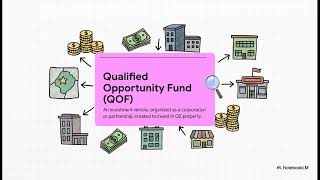
The Opportunity Zone program lets investors defer capital gains by funneling money into designated poor neighborhoods through Qualified Opportunity Funds. It requires 90% of funds to go to the zone, substantial improvements to property, and bans sin businesses. Whether it actually rebuilds communities or just enriches investors remains unclear.
Chapters
So have you ever actually heard of Opportunity Zones? It's this huge, really ambitious economic development program here in the US and it's designed to funnel billions of private dollars into communities that are struggling. But is it actually working? Is this a genuine lifeline for forgotten towns? Or is it just a clever tax break for the rich? Okay, let's get into it and break down what this program is all about. To really wrap our heads around why this program even exists, we have to start with this one massive number, 52 million. Seriously, just let that sink in for a second. It's a staggering figure and it really sets the stage for the challenge we're about to unpack. Because that 52 million, it's not just some abstract statistic. It's the number of Americans, real people, real families living in communities that are dealing with high poverty, not enough jobs, and just a severe lack of investment. And we're talking about all kinds of places, urban, rural, suburban, in pretty much every corner of the country that have been left behind by economic growth. And that really gets to the heart of the problem, right? We've had this uneven recovery where some places are booming while others are just falling further and further behind. And you can see this gap in the numbers, and it has very real, very serious consequences. I mean, look at this. In these communities, unemployment is 1.6 times higher. The median family income a whopping 37% lower. The poverty rate is nearly double the national average. And maybe the most sobering stat of all. People living in these communities have a life expectancy that's on average, average three years shorter. This is the reality that the Opportunity Zone program was created to change. So with a challenge this big, policymakers were looking for a totally new kind of solution. The idea wasn't another government handout, but a market driven approach to unlock all that private investment sitting on the sidelines. And that's really where the whole Opportunity Zone concept came from. And here it is, the official mission statement right from the Tax Cuts and Jobs Act. The goal was pretty clear. Use the tax code to create a powerful incentive, one that would really encourage investors to take their money and put it to work in the places that need it the absolute most. You know, this wasn't some idea that was just thrown together at the last minute. If you look at the timeline, you can see this concept was developed over years. And get this, it had support from both sides of the aisle. We're talking about people like Republican Senator Tim Scott and Democratic Senator Cory Booker championing the same bill. That's something you just don't see very much often these days. Okay, so here's the billion dollar question, right? How is this whole thing supposed to work? I mean, how do you get a Wall street investor interested in funding a project on a struggling Main Street? Well, let's follow the money, alright? Let's walk through this chain. It all kicks off at step one, when an investor sells something, say a bunch of stock and makes a profit. Now normally that profit, the capital gain would get taxed. But here's the at step two, that investor can actually put off paying those taxes if they take that money and within 180 days roll it into something called a Qualified Opportunity Fund or a QOF. Then at step three, the QOF's job is to take that money and invest it in a project inside an opportunity zone. And if the investor keeps their money in there long term, which you see in step four, they get some pretty incredible tax breaks. It's a very powerful incentive. So let's quickly break down these key terms you're going to hear. First up, the Qualified opportunity zone or QoZ. These are the places. They're specific low income census tracts that are chosen by state governors and then certified by the treasury. And there are a ton of them, over 8,700, spread all across the country. Next you've got the Qualified Opportunity Fund, the qof. This is the money mover. The simplest way to think about it is as a special investment fund. Its whole purpose in life is to gather up capital capital from different investors and then channel it into those designated zones. And finally there's the Qualified Opportunity Zone Business or QoZB. This is the end of the line for the money. It's the actual on the grounds project. This could be anything from a new factory to a rehabbed apartment building or even a local tech startup. Just as long as it's an active business running inside the zone. Now as you can probably imagine, you can't just toss some money at a project in a zone and instantly get a tax break. Oh no. There's a pretty complex web of rules that these funds and businesses have to follow to make sure the investment is actually, you know, helping the community. So let's look at a few of the big ones. First, there's the 90% test. That basically means a fund has to keep most of its money actively invested in the zone, not just sitting in a bank account. Second, there's the substantial improvement rule. This means you can't just buy an old building and sit on it, you actually have to double your investment to fix it up. Third, the businesses getting this money have to be legitimate, active operations, generating most of their income from the zone. And finally, certain sin businesses think golf courses, country clubs, liquor stores. They're not allowed to keep the focus on projects that really build up the community. But look, all the rules in the world won't make a difference if the program doesn't actually connect with the community itself. For this to really work, it has to become part of the local fabric of these neighborhoods. And that brings up the huge role of local partners and, and the even bigger question of how you measure real impact. And this is where a really critical group of local experts comes into the picture. Community development financial institutions, or CDFIs. Now if you haven't heard of them, they are these mission driven finance organizations that have been working and lending in these exact communities for decades. They are the real on the ground pros. But this brings us to a fundamental problem, a real culture clash. You see, CDFIs are traditionally lenders. They think in terms of debt. They're focused on managing risk, getting predictable returns and ensuring stability. But opportunity, zone investment, that's equity. It's all about high growth, taking on more risk, and looking for that big profitable exit. So these two groups are basically speaking different financial languages and have totally different goals. But even with that clash, these CDFIs are absolutely essential. Why? Because they hold the most valuable things you can have in these areas. Deep information and hard won trust. They know the market, they know which projects have real potential, and they have relationships with community leaders. They're the critical bridge that connects all that outside capital to the reality on the ground. Okay, so you've got the rules, you've got the investors, you've got the local partners. All of which leads us to the single most important question you can ask about a program this big. Is any of this actually working? Is it really revitalizing these communities? And figuring that out is not as simple as just counting up the dollars invested. No way. Real impact, true success means looking at a whole bunch of different things. Are good jobs being created? Is the poverty rate actually going down? Are kids in the neighborhood getting a better education? You have to take this holistic view to have any idea if these investments are truly creating opportunity for the people who live there. Which leaves us with the ultimate question, doesn't it? The Opportunity zone program is a massive experiment. It's built on this powerful idea that a really well designed tax incentive can get private money to solve public problems. But can it really go all the way? Can it truly rebuild a neighborhood and reverse decades of disinvestment. The architecture's there, the money is moving. But the final verdict on whether it truly changes lives, well, that story is still being written.