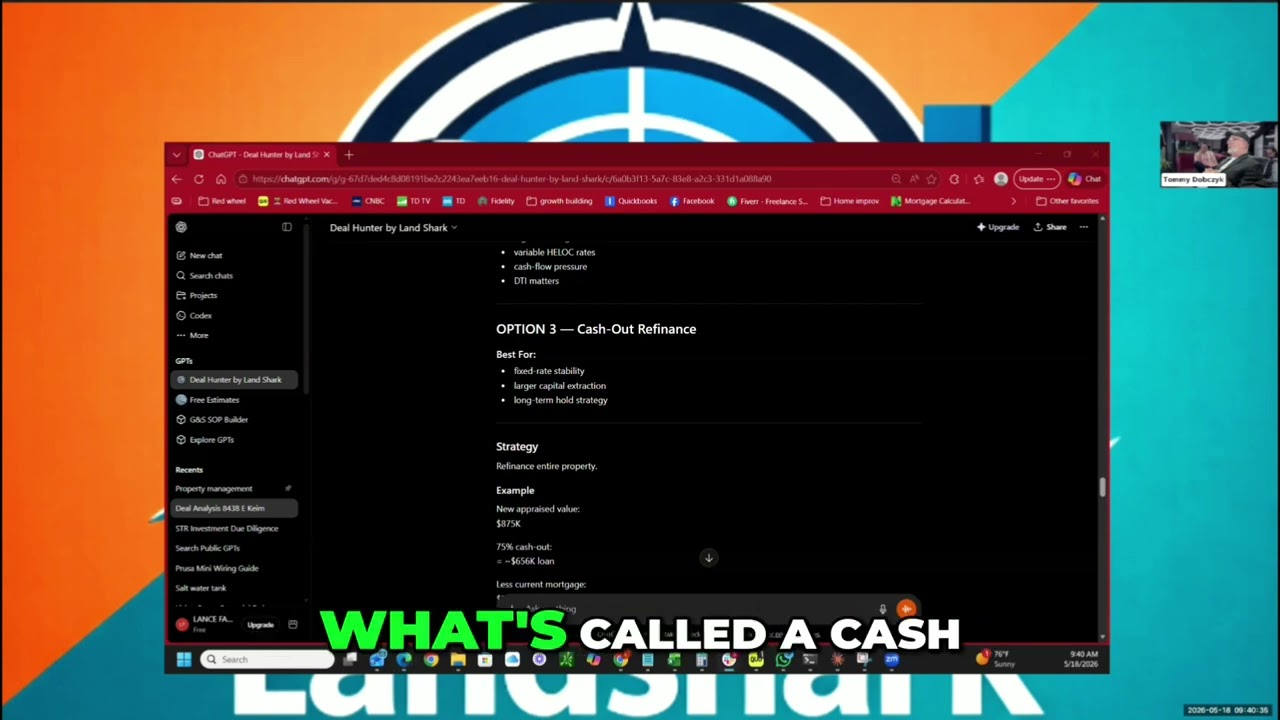
In this conversational segment, Tommy Dobczyk walks a prospective investor through multiple strategies for using an existing rental property as a springboard to purchase a larger, million‑plus property. He outlines four primary pathways: (1) selling or trading up the current asset, (2) taking a home‑equity line of credit (HELOC) while retaining ownership, (3) executing a cash‑out refinance—often framed as a BRRRR move—potentially via a DSCR (Debt Service Coverage Ratio) investor loan that allows equity extraction without triggering capital‑gains tax, and (4) converting the property to boost rental income to qualify for a bigger loan. Throughout, Tommy references an AI‑driven analysis tool that generates these options, noting that the free tier only provides about 25 % of its capability while the paid “Plus” tier unlocks full functionality. He also contrasts two investor mindsets: the debt‑averse, Dave‑Ramsey‑inspired approach versus the high‑leverage, Grant‑Cardone‑style philosophy, warning that excessive debt can lead to severe consequences. The dialogue ends with a brief interjection emphasizing that Dave Ramsey’s advice saves money but does not generate wealth.
I gotta allow.
I would like to review this property as a way for me to leverage into my next real estate rental property. I either want to sell this property or leverage it in a way that gets me into the next deal. I want to buy something over a million dollars. And so now what you're allowing it to do is just paint a picture for you in all the different ways that you could possibly do some stuff. So you're, you're in first position with this. Right. So it's going to tell you what its possibilities are based on, on the, not just the market area, but like what's available because its brain thinks like all the other real estate investors out there. I built, I built this with all of the gurus in mind. So option 1 is to sell and trade up. That's the most basic and easiest to understand. Right? Right. So, um, oh, by the way, if you don't have Plus for this, it's not going to operate at full potential. You're operating at 25% of what this thing's able to do. So on the free version, it's It's very minimal, but again, you know, when you get addicted to it, you'll go buy it. I promise. Looking at it here gives you all the pros and cons and gives you a ballpark of what you'd be able to be liquid with and keep going. Doing a HELOC and keeping the property. That's another way you could do it. It gives you all the computation that you would want without having to do very much computation. Cash-out refi. This is where you're going to do more of a BRRRR method, but you already know this. Um, uh, Lance's option here would be to get a, what's called a cash-out refi, DSCR loan. Have you looked at that? Look at a DSCR for this, um, because again, you could basically— it's like pulling all the equity out of it, uh, to reinvest without selling it and having to pay capital gains before you, you know, before you reinvest, right? So that's why it's an investor-type loan. Um, so, and they don't care what you use the cash for either. Option 4 wants you to convert it and then use the income to qualify for another loan on a bigger property. So, uh, this would be a good opportunity for you to kind of take that investor survey. Because again, some people don't like debt. Some people are what I call Dave Ramsey's stepchildren, right? And they're like, oh yeah, it's like, okay, whatever. And then there's others that are like, they think they fell out of Grant Cardone's uterus and they think that's the greatest thing in the world and they can have all the debt, right? And they don't understand that eventually they're going to have to pay it back or go to jail. You know, Grant just got a lot of rich friends. Not all of us have that, right? That's how Grant's able to stand on there.
Dave Ramsey will save you money. He won't make you money. No.
And Grant Cardone will get you put in jail. So you got to be careful who you follow.