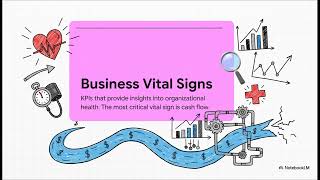
Tommy Dobczyk’s YouTube talk uses an emergency-room metaphor to argue leaders should treat their business as a living patient: proactively monitor vital KPIs (with cash flow highlighted as the most critical), stabilize crises using a CAB triage (circulation/cash, airway/customers, breathing/operations), diagnose root causes with an OPQRST checklist (onset, provocation, quality, region/radiation, severity, time), and manage recovery through a continuous ADPy/ADPI loop (assess, diagnose/prioritize, intervene, evaluate). Speaker gives concrete examples (e.g., roofing safety incidents, ad-agency client retention) and pushes a mindset shift from reactive firefighting to data-driven preparedness.
Chapters
You know that scene, right? The controlled chaos of an emergency room. A patient gets rushed in and a team just snaps into action. They're monitoring vital signs, assessing the damage, making these massive life or death decisions. In seconds, we're going to take that exact same life saving urgency and apply it to the health of your business. So let me ask you this question right off the bat. When was the last time you felt that? Because this really gets to the heart of the problem, doesn't it? Too many leaders. Maybe you've felt this get so caught up in the day to day that they become reactive. Firefighters just scrambling to put out blazes after they've already started. But what if, what if you could be a proactive doctor instead and actually prevent the disaster before it even strikes? To get there, we have to start with a huge mindset shift. I'm talking about starting to think of our business not as some machine, but, but as a living, breathing patient. One that needs constant monitoring and care. And that's the trap. You know, it's so easy to get sucked into the immediate tasks, the daily grind, that we totally miss the subtle warning signs. We miss the vital signs that could be screaming at us that a crisis is on the horizon. We're essentially waiting for the code blue alarm to go off instead of just doing regular checkups. Okay, so how do we actually do those checkups? Well, it all starts by identifying and then constantly monitoring your business's vital sign. Dig into what those are and why. They're the absolute foundation of a proactive strategy. So we all know about KPIs, right? Key performance indicators. But look at how this reframes them. It gives them real urgency. These aren't just numbers on a boring spreadsheet. They're your company's pulse, its blood pressure, and the most critical one of all, cash flow. It is literally the lifeblood of your business. If it starts to falter, the whole system is at risk. And yeah, cash flow is universal, but every single business has its own unique health indicators. You can see it right here. For a roofing company, on site safety incidents are just as critical as profits. For an ad agency, client retention is everything. These are the specialized vitals that give you those precious early warnings you need to head off a crisis. But look, sometimes prevention fails. The alarm bells are ringing loud and clear. That's a code blue. And when that happens, you need a crystal clear, protocol driven plan to stabilize the situation immediately. No guess, no panic, just a proven procedure. And that procedure, borrowed straight from emergency medicine, is the CAB assessment And listen, the order here is absolutely critical. First, you stabilize circulation. You have to restore cash flow. Now, without it, nothing else you do is gonna matter. Then you open the airway. That's your connection to your customers. You gotta communicate, reassure them, and keep that channel open. Only then, once those two things are handled, do you focus on breathing, fixing the internal operations that are failing. So you've stabilized the patient. The immediate danger has passed, but you are not done. Not even close. Now the real work starts. Diagnosing the root cause of the crisis. So hopefully it never, ever happens again. And to do that, we're going to borrow another killer tool from the medical field. The OPQRST framework. Think of it as a systematic way to investigate the pain in your organization. It makes sure you're treating the actual disease, not just chasing the symptoms. Alright, let's run through it. First up is O for onset. When did you first notice the symptoms? Was it right after a market shift? A new competitor showed up. Pinpointing when it started is your first major clue. Next is P for provocation. What makes it worse? Is there something specific that triggers the pain? Is it pressure from the board? A broken process? Identifying these triggers tells you exactly where the sensitivities are. From there, you have to define the quality of the pain. And we're not just talking numbers here. I mean, what does it feel like? Is it a sharp, sudden crisis, like a supply chain collapse? Or is it more of a dull, chronic ache, like team morale slowly draining away? Now, let's map its region. And radiation. Is this problem stuck in one department or is it spreading? Is the infection causing other failures across the whole organization? Now, we've got to get objective with severity. On a scale of 1 to 10, how bad is this really? This isn't about gut feelings. It forces you to make an honest, brutal assessment of the damage. And finally, you wrap up the diagnosis by looking at time. What's the problem's trajectory? Has this thing been festering for months or is it escalating like crazy? This tells you exactly how much time you have left to act before it might be too late. Okay, we have stabilized the patient with CAB and we've diagnosed the underlying illness with opqrs. Now we need the complete treatment plan, the whole thing. This is the master recipe to guide the business back to full health. And that recipe is called ADPy. The key thing here is that it's a continuous cycle. It's a loop. You assess the situation using all those tools we just talked about. You diagnose the root cause you prioritize. What do we have to tackle first? Then you intervene with a clear action plan. And here's the most important part. You evaluate the results. Did it work? If not, guess what. You start the cycle all over again. It's this continuous loop that creates a true state of organizational flow. See, by mastering these tools, you're doing so much more than just managing one crisis. You are fundamentally transforming your organization's DNA. You're building a system that is by its very nature, resilient and ready for pretty much anything. And this right here, this is the ultimate goal. It's that shift from being the reactive firefighter, always scrambling, always a step behind, to becoming that proactive ER doc who is calm, systematic, and completely data driven. It's really the difference between chaos and control, between just surviving and actually thriving. So what's the big takeaway from all this? Here it is. This is your new Crysis triage toolkit. Number one. Proactively monitor your vital KPIs when disaster does strike. Stabilize with the CAB assessment. Then dig deep and find the root cause with opqrst. And finally manage the entire process from start to finish with the ADPI framework. Which really just leaves us with one last question you need to ask yourself. After all this, take a really hard, honest look at your own organization. Is it truly crisis ready? Do you have the tools and the mindset to handle the unexpected? Or is it unknowingly on life support, just one bad day away from a code blue? The choice really is yours.