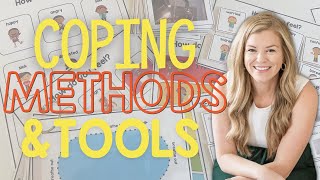
In this instructional video, former special education teacher and board‑certified behavior analyst Sasha Long presents four practical, easy‑to‑use coping strategies for helping dysregulated children regain calm. She emphasizes the importance of adult support that is non‑punitive and focused on de‑escalation. The first strategy is teaching children to name their emotions, using visual tools such as photos, clip‑art, and choice boards to help children label feelings. The second strategy involves a change of scenery—taking a walk or getting a drink of water—paired with choice menus that let the child select how they want to reset. The third strategy teaches deep breathing, illustrated with visual breathing cards, circles, and other concrete cues that guide inhaling and exhaling. The fourth strategy offers calm‑down fidgets or sensory toys, again presented through a choice menu so the child can select a tool that meets their sensory needs without escalating. Throughout, Sasha stresses the recurring themes of offering choices and using visuals to empower children, and she reminds educators and caregivers that the adult’s role during a meltdowns is to provide support, not punishment, reserving instruction for after the child has de‑escalated.
Chapters
When a child is dysregulated, it is our role as the adults in their lives to help them get back to a state of feeling safe and secure and calm. Today I'm gonna share 4 easy-to-use coping strategies that you can teach to your students to help them calm down when they become dysregulated. I'm Sasha Long, I'm a former special education teacher and board-certified behavior analyst, and I love strategies that are easy to use that we can bring into our schools, bring into our homes, that will have real results. All right, I'm gonna share 4 strategies today. One is teaching your child to name the emotion. 2, change of scenery, go for a walk, get a drink of water. 3, deep breathing. And 4, using a fidget with choices. So let's talk about our first one. Okay, the first strategy is teaching your child to name their emotion. Now this is something that adults struggle with, but this is an important skill to be able to communicate. I'm scared, I'm frustrated, I'm angry, I'm sad. Those are all valid emotions to have. And when we can label them, we feel more secure in what we are feeling and we can help kind of de-escalate the situation. Now, I love using visuals for this. When we are upset, sometimes the act of communicating, especially if verbal communication is challenging for that child, is gonna be too much, right? So let's lean into visuals for this. I love simple tools like this that say, "How do you feel?" You can use real photos, you can use clip art, you could take pictures of your child with all these emotions and really start to work on that language. Hey, it looks like you feel angry. right? And pairing what that looks like with that word. Even simple kind of choice boards like this for students with limited verbal communication can be really helpful to start to name these things. You are worried. This is going to be a really helpful tool, and if we can start to pair this and model this, we want eventually that student to be able to name that emotion on their own. The second coping strategy is go get a drink of water, go for a walk. Now this strategy is not about actually getting a drink of water. It's not like that child necessarily is thirsty, but it's about a change of scenery. This is a helpful strategy for adults. Sometimes you just need to get away, right? And that physical exertion of walking, getting up, taking some deep breaths as you're doing that is gonna help kind of reset. Whatever triggers were in that environment are now removed, and this is such a helpful strategy for being able to come back new, fresh, fresh and kind of start over. So if you're really in it and you're angry, and maybe our, our kids don't even know why they are angry, having that opportunity to get that change of scenery and come back is really key. Now I want to take a quick detour on this strategy because when I'm helping a child de-escalate, I'm all about choices. Choices is such a powerful strategy when kids are overwhelmed and in meltdown mode. It's typically communicating a lack of control. I wanna give control back to that child by letting them make choices about what coping strategies they wanna use. And I have lots of tools of different choice boards for coping strategies with real photos or with clip art, all kinds of cool things where there's, you know, different choices for strategies. And I was looking at these and I was laughing because on every single one, there's the strategy, get a drink of water, take a walk, right? These are on all these, take a walk, get a drink of water. So I wanna be empowering students to select that. There's— this is a written one. Remember, words are a visual too. This is things I can do when I feel worried. I can make a list of choices, take a break, get a stress ball, get a drink of water, right? It's gonna allow that opportunity to reset. So whenever you are offering these coping strategies, put them in some type of a choice menu and include taking a walk or getting a drink of water. This could even just be a walk up and down the hallway, a loop around the classroom, a loop around your house, going outside, getting a breath of fresh air on the front sidewalk and coming back in. But that change of scenery is going to allow that child to reset. The third strategy is deep breathing. Deep breathing literally helps you slow down your heartbeat, calm down. That extra oxygen to your brain can help you make decisions. Now with some of our students, when we teach deep breathing or taking some deep breaths when we get overwhelmed, they're gonna be like this, which might actually escalate their heart rate in the situation. So again, I love a visual for this. These are some of my favorite tools, these visual breathing Breathing Cards, because there's actually something to do. It's going to be a little bit more concrete with a starting and an end point versus just breathe. Okay. Instead, this is going to really slow you down and you can use a physical cue of these cards on how to control your breathing. So for this one, we have these little like worms and we're going to breathe in and then breathe out, breathe in and then breathe out. So we could use that as a tool. There's all kinds of different tools where, you know, we breathe in on this part of the circle. Breathe out. So you can model this. You can be the one putting your finger or helping the child put their finger, and it's gonna help them slow down. This one has 10 deep breaths for each seed on the watermelon. So it's gonna be this nice physical cue of how to slow down that breathing. Breathe in. Breathe out. So that act of drawing that check mark will slow down that breath and help regulate that heartbeat and really teach that deep breathing situation. So these visuals are a great tool. You can easily create something like this drawing on a dry erase board and then modeling that for your student. And our last strategy is offering a calm down tool or fidget or toy. Having something to do with your hands can be really helpful to help take your mind off what is upsetting you. It's a great distraction and it might meet some sensory need that is not being met in that moment. And there's a lot of great sensory tools that can even provide that deep pressure that could be kind of impacting those— that sensory system as well. And again, I love choices and I love visuals. Do we see a recurring theme here? So a simple calm down menu with some appropriate fidgets and toys that that student might use, like a stress ball or putty or a fidget spinner, giving that choice. Like, for me, I don't like a fidget spinner. That would escalate me even further. But a stress ball when I'm upset, heck yeah, that's what I want. So for your students with limited verbal skills, this is a great tool to allow them to communicate what they want or need in that moment that will help them de-escalate. In those moments where a child is really dysregulated and overwhelmed, upset, angry, meltdown, tantrum, whatever language you want to put there, it's important to remember, as I said in the start of this video, what our role is. Our role is not to provide punishment, to teach consequences. This is not the time for instruction. This is the time to help de-escalate, to help show that student that you are there for them even when things are not going well. When we walk away, we are teaching our kids that, "Hey, when you need my help the most, I might not be here for you." So, provide that support. Choices, visuals was our recurring theme through our 4 strategies, and after our child has de-escalated, then we will have that opportunity for instruction. I'm Sasha Long, former special ed teacher and board-certified behavior analyst, founder of The Autism Helper. Please follow my channel for more strategies for your classroom and your home.