4 Ways to Help Kids Transition Away from Preferred Items
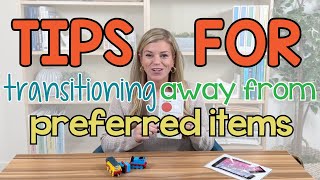
Sasha Long, a board-certified behavior analyst, shares four strategies for helping kids stop preferred activities like iPad or toys. Use token systems to reward handing items back, visual countdowns to signal time left, practice the hand-back routine before the child uses the item, and pause at natural breaks in videos or games.
Chapters
Ending time with a preferred item can be super challenging. You're having a great time on the iPad and suddenly your iPad time is over and you have to give it back to the teacher. This is a really hard situation in many classrooms and many homes, and today I'm going to share 4 strategies for ending time with preferred items. I'm Sasha Long, I'm a board-certified behavior analyst and former special education teacher. So let's get to the root of the issue, right? You don't want to give up the thing you're about to give up. It's awesome. I love playing with the iPad. I love playing with my Slinkys or Play-Doh, and I don't want to transition from a preferred activity to an unpreferred activity. We all know this, right? But it is part of life. And there's a few strategies you can add to your classroom to help make this more successful. The first one is using a token system or visual. So let's say that your student uses something like this regularly in the classroom, and I am working for a board. So if they already use something like this, a great strategy when transitioning away from a preferred activity is to immediately start working for that preferred activity again. So if you were like, hey Johnny, iPad time's all done, and you were getting that iPad back, if they hand that iPad over really nicely, the very first check mark they're gonna get is right away, right? You're already working towards your next iPad session. So from giving that iPad back, we're already working towards our next time to play with the iPad. And now only 3 checks might be a little tricky because you're like, oh my gosh, they're gonna get it in a few minutes. Feel free to scaffold that up to more checks or to just have this be for, you know, rotating between centers. This could just be for transitions. They don't get necessarily tokens within the center, they just get it for transition time. But I love the idea of having this first token or check or star that they're getting be for that appropriate transition. And that's something that you can really practice ahead of time and have this out like, hey, okay, iPad's done, but let's, let's work for it again. You're about to get your next one. That's how I'd really approach that, showing that you're about to get your next check, working towards that next iPad. Another strategy that works really well is using a visual to show how much time is left. So let's say you're playing with trains and you wanna know when you're gonna have to give it back, right? You could say, no, it's not time yet to give it back. And then as they're playing and it's getting closer to having to go to lunch or having to go back to work time, you could give a little warning. This small warning is super helpful so there's not that surprise factor. Sometimes that's the worst part, right? I didn't know I was gonna have to give it back yet. And then it's okay, it's ready to go, it's time to give it back. And then practicing giving back those items. This can also be done with a token system like this. I sometimes use this as an "I am working for," but you can also use this same idea to show how much time is left with something. So all I did was take a photo of an iPad, cut up the pieces, and let's say your student was having a 5-minute iPad break. Every minute or so, just add a piece to the puzzle to show how much time is left. Once we get to that last piece, iPad is finished. Time to go to the next activity. You do the same idea with what the next activity is, right? If it's, um, playtime, if it's a learning activity, if it's recess, you could have a picture of the playground here and be giving those pieces like, okay, iPad's done, now let's go to recess. So that could be really helpful. Another strategy that I like to do in addition to that token economy or the visual is to practice handing back the item before you play with it. This is really helpful to see what that looks like. This is going to be a great visual cue and really incorporate modeling. So let's say the student just earned an iPad break. Before they get to the iPad break, we're gonna model and discuss what ending the iPad break looks like. Okay, when we're all done, we're gonna press pause. And I'd have YouTube up, I'd be pressing pause. We're gonna turn it off and we're gonna give it back to Miss Sasha. Now let's practice. And if appropriate for the student, I maybe have them practice 2 or 3 times. Same thing with the toy. Okay, when we're all done with Thomas, what are we gonna do? You have the toy, give it back to me. Oh, good job, you gave it back. Okay, let's practice again. Give it back to me. And really going through the motor movements of feeling what that feels like of giving that item back can be really, really helpful. So that's a great tool to incorporate as well. The last strategy is one I've had a lot of success with, and this one is particular to iPad, YouTube, Netflix, games, things like that. Things that have a start and a stop time. When our students are watching YouTube, they're likely in the middle of a video when we go to take the iPad back, right? We're like, well, 5 minutes is up, or it's about to go to gym class. I need to be done with this. Okay, iPad's over. But they're in the middle of their video. I mean, imagine if you were watching your favorite show and someone came over and turned it off right before it ended. We would be annoyed, right? So find the natural breaks when using technology. Watch behind them for a minute and see like, okay, there's 1 minute left in that YouTube video. And then give the reminder like, okay, when this video is done, then we're finished. I know a lot of kids like to jump between YouTube videos, so be there so you can say, okay, you just started this one. When this one's done, We're all done with iPad. If we're playing a video game, when you see that they're on a level, okay, when this level's finished, then we're all done. That can be super helpful to find the natural breaks and can really ease some of the behaviors that come along with transitioning from a preferred activity to a non-preferred. So I hope you found these 4 strategies helpful: using that token system, using visuals, practicing giving back the item, or finding the natural breaks. We also want to acknowledge that giving back a preferred activity is hard. It is annoying, right? And if there are low-level annoyed behaviors, that's okay. If your child's like, "Ugh, I didn't want to be done with that," that's all right. That's a normal reaction. When I have to turn off my shows to go fold laundry, I'm thinking the same thing in my head, right? Of course we don't want aggression, property destruction, things like that. Those are behaviors we can target to decrease, but a little bit of annoyance is totally normal. And we can give an encouraging statement of, "Hey, don't worry, you're going to get it again," or give that praise for, "You did a great job giving it back. Let's work for it next time. You did awesome." All right, again, I'm Sasha Long. I'm a board-certified behavior analyst and special education teacher. Thanks so much for watching, and follow our channel for more behavior tips.










