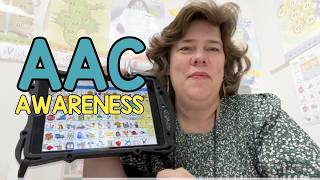
In this AAC Awareness Month presentation, teacher and mother Winnie White shares a comprehensive guide for educators, parents, and speech‑language pathologists on how to support students who use augmentative and alternative communication (AAC). She frames AAC as a voice that must be present everywhere—classroom, playground, home, and community—and emphasizes that AAC is for any learner who cannot fully express thoughts verbally, not just non‑speakers. The core message is the "golden rule" of AAC: model, model, model, mirroring how adults talk to babies. She cites a Tech Owl article illustrating the massive language exposure gap for AAC users and urges adults to increase high‑frequency modeling. Practical classroom tips include keeping the device accessible, not removing it for off‑task behavior, setting up charging stations, using core‑word curricula, and allowing spontaneous babbling. She stresses presuming competence, celebrating small efforts, and maintaining a patient, language‑learning mindset. Partnerships are highlighted: collaborating with SLPs, joining online communities, involving peers with AAC pages, and aligning home‑school goals. Winnie shares personal anecdotes about her daughter’s growing communication, reinforcing the impact of consistent AAC use. The talk concludes with a call to treat AAC as a respected voice, provide daily opportunities for communication, and leverage free training resources to build inclusive classroom communities.
Chapters
It's AAC month. Thank you for joining us for AAC Awareness Month. I'm Winnie White. I'm a teacher in a self-contained classroom as well as a mother to a full-time AAC user. AAC has been a part of my world for the past 4 years. It's opened up the closed doors of communication for my daughter and totally immersed our family into the AAC community. For those who might not know what AAC stands for, it's augmentative, and alternative communication. Today we'll be looking at how we can better support our students who have augmentative and alternative communication. So the goal is simple: to recognize that AAC is a voice, and every child deserves to have their voice heard. AAC isn't just for students who are non-speaking. It's for any student who cannot fully communicate all of their thoughts and ideas verbally. AAC gives them access to richer, more complex communication, and, and here's the most important part: AAC is their voice. Just like our voice boxes go with us everywhere, their AAC device needs to be with them everywhere too. In the classroom, on the playground, even in gym. This also extends to their homes. Parents need coaching as well on how to carry their devices everywhere that they go, how to keep them charged, the value of acknowledging their voices across all areas of their lives like school, home, and community. But don't get discouraged if they don't show interest. This is a marathon, it's not a sprint. The golden rule of AAC is model, model, model. We model AAC use the same way we model language for babies. When you talk to a baby, you don't wait for them to speak first. You just keep talking and modeling, and over time they begin to imitate sounds, words, and phrases. AAC works the same way. So teachers and staff, use the device yourself. Show students how it works without pressure and let them explore in their own time. According to a Tech Owl AAC community article titled "You Are a Model," high-frequency modeling is essential for AAC users because they often receive far less language exposure than their speaking peers. For example, while an 18-month-old child typically experiences about 4,380 hours of spoken language, an AAC user who only gets 2 30-minute modeling sessions with their SLP per week, they would need 84 years to reach the same level of exposure. So for us teachers and parents, that's a challenge to step up our modeling games. We actually have multiple devices with the same app at home, and in the classroom but that's not always possible. If that's not possible, model on your student's device or your child's device. Work together as a communication team. Make it fun and enjoyable and learn together. It builds that bond between the communication partner and the AAC user, and it opens up that beautiful relationship for the two of you to lo— grow and learn together. Every communication attempt matters. Whether a student selects the wrong button, makes a silly choice, or even seems off-topic, the key is to respond. By acknowledging their communication, we show them that their words have power. Maybe they accidentally selected dog instead of bird. You could say, "Hmm, did you mean bird? Or maybe you were thinking about dogs? Dogs are fun." That simple acknowledgement reinforces that their words matter. Now here are a few practical classroom tips. First, the device should always be present. It is their voice. Make sure it's not in their cubbies or in their book bags or you left it in the room. When you leave. Second, don't take the device away if they're off task. Think about it. We wouldn't put tape over a child's mouth if they were talking too much. Third, allow students to babble and play with language. That's how learning happens. Fourth, set up a charging station so devices are always ready. And consider choosing a core word of the week or of the day and model it as much as you can throughout the day. There are so many amazing core word curriculums out there. The first free training I did was for AAC was the CORE Project from UNC. That opened up understanding for me of the importance of core words in our everyday speech. I read that about 75% of the words in our day-to-day speech were core words. That should cause us to step back and analyze what we're spending so much time on. I want to acknowledge that learning AAC as an adult feels awkward at first. It really is like learning a new language, but just remember, the only way to get comfortable is to keep practicing. Celebrate small efforts. Try not to get frustrated and start asking parents or SLPs to remove a word or phrase or turn their devices off or turn them down. Even babbling on the device is progress. And above all else, presume competence. Always believe that your student has more to say than what you're seeing. Think about the years you spent learning a foreign language, either in high school or college. It takes years to develop language. You will make mistakes. Be easy on yourself as you learn a new system or as you are learning how to adapt your curriculum or assessment in order to meet the needs of your AAC users. This takes time to learn, but thankfully there are so many experts out there willing and ready to assist. Your SLP should be your best resource. There are amazing educational researchers out there like Karen Erickson who focus on literacy skills for AAC users. I've gained so much from joining all these learning communities on Facebook and asking questions. And exploring options and trying things with my students and then sharing with others what I have found to be successful or what I found did not work. AAC also builds stronger classroom communities. You can give classmates paper copies of AAC pages so they can interact with their peers. Add fun and personal phrases, things like, "I love you, Mom," or "Good night, Dad." These quick access phrases make communication meaningful. Encourage students to use AAC not only for requests, but also for greetings, jokes, and conversations about their favorite interests. That's how friendships grow. Talk to parents about their goals for their children. For me, I want to see my daughter develop open communication where she will be able to share her wants, desires, and dreams. I want to have a conversation with her at the kitchen table. I want to hear about how her day went. And sometimes you don't realize what's missing until it's not there. That's the way it was for me and my child. I missed not having conversations with her in the car. When I picked her up from school. But just this past week at the breakfast table, she said, "I want mama sitting." She wanted me to sit beside her while she ate her breakfast and played Zingo with her. I can't imagine what more will come as she grows in her competence with her AAC device. No one has to do this alone. Parents, take time to learn the layout of your student's AAC system. Teachers, invite your SLP into the classroom to model for the whole group. Families can add meaningful words and phrases at home depending on the agreement that you make with your SLP and teachers. For us, we have 3 devices. So I'm the one appointed to make changes to the device because I have to make sure all 3 devices work the exact same. I also want to make sure I keep the integrity of the system intact. I don't want to change anything that goes against the system designs or the motor planning in place. So we are all partners in making sure every student's voice is heard. There are so many free training resources available either through the system your AAC uses, AAC user uses, YouTube, or other coaching options. I have even participated in a few clinical trials for AAC users and their families and have learned so much about modeling wait times and expanding their phrases. You are not an island trying to make this all happen yourself. Reach out and get the help that you need because we all need help. So let's just take a moment to remember a few key points. AAC is for all day, every day, not just work time. Honor what students give you and then model what you'd like to see. Focus on giving them opportunities to communicate, not on perfection. And remember, robust vocabulary leads to robust learning. I want to leave you with this: AAC is not just a tool, it's a voice. Treat it with the same respect that you would treat spoken words. Our students deserve the chance to be silly, to complain, to tell stories, and to connect with their peers just like any other child. So together we can create classmates and communities where every voice is heard. To learn more about AAC in the classroom, check out the other videos right here on the Autism Helper channel. AAC users are such an important part of our community of learners.