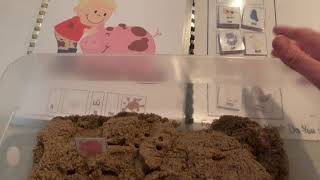
Gina from The Autism Helper shows how to extend adapted books like the Farmer Farmer series with simple activities using everyday items. Hide picture pieces in kinetic sand or beans, use a cup as a microphone for animal sounds, or make a paper-towel tube viewfinder to build vocabulary, visual discrimination, and turn-taking skills.
Chapters
Hi everyone, this is Gina from The Autism Helper. I have a new way to spice up those adapted books that you might be using in quarantine over and over and give you an idea for your classrooms because obviously we don't always need to make new supplies. We can use what we have and make them re-engaging and work on different skills. I love, love, love Sarah's adapted books. I love every single one she creates. The Farmer Farmer series is one of my favorites, so I thought I would show you how to incorporate different activities like extension activities. So maybe you've read the book a bunch of times with your student or your child, and they may— maybe they're not as engaged with picking like the pieces off here. So if you're not familiar with adaptive books, it has a repetitive language approach. It's amazing. It's predictable. I love how Sarah uses boxes to help with word placement and reading and prediction. So you would read it: Farmer, farmer, what do you see? A, and I like to point to the picture at first if the child's not familiar with the book or their early print skills. A, what is that? Pig, or maybe they don't say pig, but they reach for the pig. You can decrease the field and just have several choices out, but they put in the correct picture to match. Another way you can do this book, you can take some kinetic sand, or maybe you have a sandpit out back, or a little play area, or beans, or whatever you want to use. You could even use water. And you can put your pieces— this might not be good for the water idea— but you can stick your pieces into the sand. And depending on your child's level at this time, you may not put all the pieces in there. You might put one of the pieces in there if you want it to be more airless, and just read the book the same way. And have them pick it out of the sand. It just makes it a different way, a fun way of learning the book if they're used to doing it. You can also have a cup of the objects and sprinkle them in. You can bury them in there. You can have them maybe sticking out a little bit. And same thing with the book. So you can go on to the next page. Farmer, farmer, what do you see? Or, "Pig, pig, what do you see? A duck." And then they have to find the duck and match it. And of course, this is non-identical matching that may not look exactly the same, but that's, you're working on another visual discrimination skill along with reading and vocabulary increasing. So that's another idea. I also like, if your cup is empty, you can use it as kind of like a microphone. Kids love to hear their own voice, and I think it's super engaging. So you can put it up to your mouth and show them, you know, when you're reading the book, "Pig, pig, what do you see? A duck!" And then you can hold the cup up to your mouth and make a duck sound. Quack, quack, quack. And it makes that echo sound and it's a little bit more engaging. And then you can say, "Your turn!" And then have your child imitate or echo the sounds after you. So even if they're not imitating your words, they might be more apt to do that with just a regular plastic cup that you might have at home. So try animal sounds on this. And my last thing, I don't have an empty paper towel tube, but once you, you're finished all those paper towels in our quarantine, you can put the paper towel up to your eye and play "I see." Okay, so now you're not doing sounds, but maybe you say, you put it up to your eye and you say, "Pig, pig, what do you see? I see a duck looking at me." Okay, so you can put it right up to your eye and pretend like you're looking through like a microscope or a telescope or something, and then give it to your child and say, "Your turn." So lots of different ways that you can spice up these already amazing books and a few more extension activities for you. Enjoy adapting!