Sasha from theautismhelper.com previews the All About the Bathroom unit, a 144-page life-skills curriculum for students with autism. It combines functional daily tasks with reading and math across three difficulty levels, includes parent homework packets to practice at home, and comes with social stories, adapted books, and file-folder activities.
Chapters
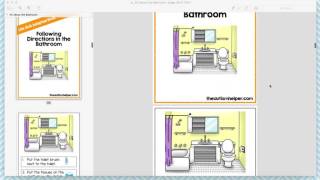
Hi, this is Sasha from theautismhelper.com, and this is a product preview of my All About the Bathroom Life Skills Unit. So there's 4 different units included in this series: All About the Bathroom, Bedroom, Living Room, and Kitchen. You can buy them separately or as a bundle. This topic is really important because our kids spend the most of the— most of their time at home, and so really taking the time to teach them the vocabulary and the uses of the words and really delving into these different areas of their life is going to be so, so helpful. And for older learners, when when it comes to language arts instruction, we really want to make sure that everything we're doing has a functional twist. So you don't have to abandon academics. Nothing— it's not like everything has to be exactly pre-vocational or functional. You should be tying in academic skills like language arts and math into your functional instruction. So this is the perfect marriage of functional and academics in this unit because you're going to work on, um, so many great language arts skills while still on this really functional and important theme that our kids need to learn about. So the structure of the units is similar if you've checked out the other videos or other units. I do that on purpose because it helps our kids when they know the structure of the activity and we just switch out the content. They can learn the content quicker because they know what's expected of them. So there's a table of contents and instructions included so you can easily print different pieces at a time or only certain sections if you want. If you don't want to print the whole thing at once, it's pretty big. It's 144 pages. There are 3 levels of pre- and post-tests. You can give the same assessment as a pre-test and then after you've completed the unit as a post-test to show growth and all of that. Great, utilize your data and all that. So Level 1 focuses on vocabulary and tracing the words. Level 2 focuses on vocabulary comprehension. And Level 3 focuses on utilizing that vocabulary and more inferential skills. Um, so 3 different levels of pre and post tests. Um, the next is the anchor chart, so a 1-page, um, set of visuals with all of the main words we use to reference for spelling, for items. I love to use these as a teaching tool. I think this would be awesome to blow up and put in the classroom. If you're doing all of the units, you could be adding each one as you go through the units. These would also be great to have in each student's binder so they can reference on their own. Next is the Life Skills Word Wall. Included in here are the visual vocabulary word cards as well as the definitions, and then there are instructions on how to create an extended word wall, which is really cool, adding in the part of speech, the category, the sentence, and the syllables. This is something you can have your students help you do, make it an interactive activity. Especially if you're utilizing all these units, you'll have a really, really stellar word wall created as you kind of keep adding on throughout each unit. So there's instructions on how to do that in there, blank pages for making the extended word wall, and then here are all the visual words and definition cards. So even making sure these aren't necessarily words we teach our kids like shower curtain or toilet brush, but really thinking about all the different words we use related to the bathroom. Next up is homework. These, um, the most important part of this unit is generalizing it to the actual environment, to the home, and that means getting mom and dad involved, getting home life involved, applying some of these concepts to the real world. We don't want to just talk about this in a contrived way. So there's 2 different versions of the introduction letter to the parents, and there are 3 different levels of homework, each with 2 sets. Each homework has 5 activities for the child to do with their parent, and then the parent can sign and return. So this is a nice way to tie this in, and then your homework is done, which is pretty awesome. Next are visuals to label, so you can label these parts of the bathroom in your own school. Also be really nice to send these home for mom and dad to use. 3 social stories, again, great to send home or to use in school: washing your hands, taking a shower, staying clean and healthy. And then there are 3 adapted books, which I really, really love. They turned out so cute. First is Following Directions in the Bathroom. A lot of our kids have following directions goals, especially this is something a lot of our kids struggle with related to executive functioning skills and receptive language. So following the instructions will work on the bathroom vocabulary as well as all those skills. So using the directions to put the bathroom items in the right spot. There's instructions for setup, how to set all these books up as well. This one looks at applying bathroom items to the activities you do in the bathroom, so some inferencing. And the next one looks at getting ready in the morning, so this is more of a sequencing book, so all the different activities you do and then at the end you'll sequence them. Again, something our kids struggle with a lot, so this is a great way to apply that IEP goal to thematic learning. Next we've got 5 file folders. A lot of these are based on ABLE's goals, which a lot of us use in our classrooms. First one is non-identical sorting. Next is associations. Next bathroom matching. Then we have sorting items by function, so things you clean with, things you dry with. And labeling parts of bathroom items. This is something oftentimes we forget about, so labeling the parts of the bathroom. The worksheets are broken up into kind of 3 different themes. The first one focuses focuses on matching and tracing and writing. So for our early learners, there are 5 different versions of each worksheet, so there's going to be no memorizing. These would be awesome to laminate, use the dry erase markers, great for centers, great for work task boxes, great for a parallel station or group work. The next ones work on matching the picture to the name, fill in the blank. Um, my favorite, favorite worksheets, the answering WH questions with the 3 visual options. These are so, so awesome. A lot of our kids struggle with questions, so this is such a great one to use. Adding in the definitions and the sentences, these would be awesome if you had that extended word wall set up and kids could work on this on their own as a great assessment tool. Next, the hardest level worksheets work— focus more on writing and inferencing and reading comprehension. So we've got writing sentences, reading comprehension based on the paragraph, a true/false set, so 5 different true/false worksheets, 4. Making lists, so creating that more expanded vocabulary. And then 5. Narrative writing. So there's, as you can see, a ton, ton included in here. Great for a multi-level classroom. Great for— I mean, I think you'll end up using a lot of this. I just really couldn't stop myself. I kept going and going. So I hope you enjoy this and this will be a helpful tool for teaching your students about the household vocabulary words. This was a product preview of All About the Bathroom from theautismhelper.com.










