In this product preview video, Sasha from theautismhelper.com introduces the All About the Park Life Skills Unit, part of a community series that also includes restaurant, grocery store, and mall units. She explains that the park setting, while seemingly simple, offers rich opportunities to teach embedded social rules and vocabulary. The unit is organized with a printable table of contents and a three‑level pre‑test/post‑test system to assess growth from basic vocabulary and comprehension (Level 2) to higher‑order inference skills (Level 3). Core resources include an anchor chart and a life‑skills word wall with visual definitions, tiered homework assignments (three levels, two sets each) to involve families, three social stories, and three adapted books that target prepositions, sequencing, and listening/comprehension through park‑themed narratives. Five file‑folder activities provide non‑identical sorting, matching, function‑based sorting, and labeling tasks. The bulk of the unit consists of three difficulty levels of worksheets (about 20‑25 per level), each containing multiple matching, tracing, copying, word‑to‑picture, fill‑in‑the‑blank, WH‑question, definition, sentence‑writing, narrative, reading‑comprehension, inference, true/false, list‑making, and writing assignments. Sasha highlights practical tips such as using extra Velcro to reinforce spatial language. The unit is positioned as flexible for multi‑level classrooms, allowing all students to engage with the same park theme at appropriate challenge levels.
Chapters
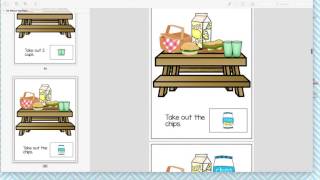
Hi, this is Sasha from theautismhelper.com, and this is a product preview of my All About the Park Life Skills Unit. So if you've checked out the other units in this series, the structure of this unit is the same. In the community series, we have park, restaurant, grocery store, and mall. I love including the park unit in here as an option because that is somewhere our kids go a lot, and there are a lot of embedded social rules and great vocabulary to work on. So even though it seems like maybe a simple kind of community location, I think there's a lot to work on, and it's fun to talk about. And you can apply this easily because you might go to the playground or park with your class. So there's table of contents included so you can print exactly what you need when you need it. There's 3 levels of a pretest/posttest, so you can give this test before you start the unit, see the scores, and then after you complete all the activities, do the posttest, and hopefully, hopefully show some great growth and have some database decision-making to do for your next unit. So Level 2 focuses more on vocabulary and basic comprehension, and Level 3 looks more inferences and higher-level comprehension. There's an anchor chart with all of the vocabulary included. There's a life skills word wall with instructions to create an extended word wall with these blank pages if you'd like. Um, there's the instructions for use in there. I think that would be a great option to tie in some literacy. All of the vocabulary words here with the definition and a visual. Next up, homework that you can send home. Love including family and parents into these units. So, so important since these are focused on, you know, more of a life skills, real-world activity. We want to be practicing these skills in the real world. So there's 3 levels of homework based on the level of skills and then 2 sets of homework for each level. Then there's 3 social stories. These would be great for you to bring to the playground if you go to the playground with your students, also to send home. Then there's 3 adapted books. The first one looks at Following Directions in the Park. This is a great one to work on prepositions, positional words in a really functional way and then also tying in that park vocabulary. And it's pretty fun for kids, you know, a lot of our escape-driven kiddos who don't love to work. This doesn't really look like work because it's about a playground, so it's kind of fun. So putting the monkey bars in front of the seesaw, putting the squirrel next to the swings. So it tells you where to put each park item. Really great for those prepositions. I also recommend putting extra hard Velcro. I tell this in the instructions, so your kids aren't just relying on the prompts of where the Velcro is. Put Velcro in several spots so they really have to know what behind and next to and in mean. Next, looking at having a picnic. Great, great for sequencing. Also a fun one because kids love doing anything with food. So you'll sequence the items that you're putting on the picnic table for the picnic, add all the items, and then there's this little mini comprehension page, which I love. Looking at sequencing, looking at comprehension, looking at quantity. Um, so this is a great one to tie in a lot of skills here. Um, Let's Play at the Park. Um, you're gonna have 3 options of what 3 people are doing and then pick the right one. Um, so this is great for listening or reading comprehension and that fine discrimination. The pictures here look similar, so you really have to attend to that when it says, "Let's blow the bubbles," which one is the one blowing the bubbles. So whether you have your students read that to identify comprehension or you're saying that to work on listening comprehension, it's going to be a great assessment. Um, 5 File Folders Non-Identical Sorting Park Associations, Park Matching, um, Sort by Function, Label Park Items. Yep, and so those are the 5 file folders. Next we have 3 sets of worksheets for each level of difficulty. There's about 20-25 each. Each worksheet has 5 different examples, so there's 5 different matching, 5 different additional matching, 5 tracing, 5 copying the words. Next, we've got matching word to picture, 5 versions. Filling in the blank, great for reading comprehension. Then we've got WH questions. These are some of my favorite worksheets. WH questions are so hard for a lot of our kids, so this gives some great response options. Writing the definition, writing a sentence with each word, then writing 3 sentences with each picture, about each picture. So we're getting a little more difficult, looking at writing narratives. Reading a passage, answering 5 questions, looking at inferencing, looking at vocabulary, reading comprehension, true/false, 5 options, making a list based on the park prompt, and then 5 writing assignments. So there's so much included in this unit. Whatever, if you have a multi-level class, this is definitely for you because you'll be able to include everyone in the same theme but at their level. This is a product preview of All About the Park by theautismhelper.com.