Back To School Tips: The BEST Leveled Matching Activities for your Classroom
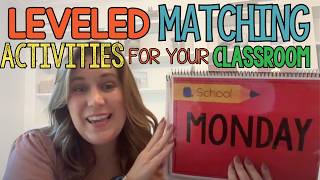
A teacher walks through a leveled matching workbook system with three difficulty tiers: Easy, Intermediate, and Complex. Each tier has seven pages per book, five books per week, and uses Velcro manipulatives that build fine-motor skills. Students rotate through levels as they master color-matching, CVC sounds, and multi-step directions.
Chapters
Today I want to give you an in-depth overview of our weekly matching workbook system. We have 3 different kinds for you to choose from, from easy matching weekly workbooks to intermediate to complex. I want to make sure that you have all of the tools necessary and all of the knowledge necessary to pick the right ones for your learners. If this is the first you're hearing about our intermediate and our complex books, don't worry, I've got a full-blown tutorial on these books on our YouTube channel. Just go back a few videos and you will find them. I want you to have all of the tools in your hands to be able to make the best choice for your classroom if you're considering these. So today what I thought I would do is I would lay all 3 out for you and show you how each of the activities steps up in complexity. Okay, I've laid out all 3 books so we can go through them page by page and you can see the difference in all of them. You can see that the covers are very similar. We did that intentionally. If you Start Your Learners here on our Easy Matching Weekly Workbooks, we wanted it to be a very familiar and routine thing for your students to be able to move through the levels. So you'll find that they're laid out the same and that they look very similar, but they're very easy to determine which is which. So I'm going to open up the very first page on all 3 books. You can see the very first one here is going to be match the pencils. Here, all we're doing is putting color with color. This is a simple matching activity. So on our intermediate book, we are matching pencils by size, big and little. And then in our complex book, we have now made that a little bit more difficult, and now we've added a third way to be able to sort the pencils: large, medium, and small. Not all of the activities go side by side like that. Some of them change, and this is a really good example of that. This is an example of an errorless task. All the students are doing is picking up the item and putting it on the board. Here in our intermediate book, you can see they're matching the color to the color word. Well, we needed to change things up a little bit for our complex learners, and so what we did is we gave them an item, and now they're finding the beginning sound of a CVC word. This is an example of another task that correlates really well together. These are all from the Monday books. You can see on our errorless matching, all we are doing is putting a milk on each tray. On our intermediate books, you can see that we are following simple directions, but we are repeating those directions. They're the same for both trays, And then here we're really following multiple-step directions. Here we are putting different items on each tray to kind of complete the order. Here's another great example of tasks that are differentiated and move in complexity as you go through the levels. So this is errorless matching. Again, we're just putting the book with the book. Here they are matching the color with the color book, so blue with blue, orange with orange. And then here for intermediate, they are sorting books. So each book has a picture. It's either a picture of a pet or a picture of a vehicle, and they are sorting the books on the bookshelf based on, um, that category. So you can see really we are moving from simple matching to matching by color to now sorting. I think this one does a great job too showing how these change and move through levels. Here we're matching identical items, so you can see they're the same picture side by side. These are the objects that the students move to make them and make a match. Here it is a non-identical match, so it's the same item but a different picture. So jackets go together, lunchboxes, water bottles, files, those kind of things. Here we're pairing items, so we are really looking at what goes together. So here we have to put the pencil and the eraser together. Here we have to put the lunchbox and the water bottle, the bookshelves and the books, the headphones and the iPad. I want to share some similarities that are across all 3 different levels. The first one is that they have the same number of pages. So there are 7 pages of activities in the School Complex book. There are 7 pages of activity in the School Intermediate and 7 pages in the School Errorless. And Easy Matching Weekly Workbook. So that stays the same. The other thing that stays the same is each set comes with 5 books total. So there's a Monday, a Tuesday, a Wednesday, a Thursday, and Friday of each level. So there's a whole week set of Intermediate and a whole week set of Complex. The other thing that stays the same, and we did this with intentionality, is that we wanted to make the is relatively easy to manipulate no matter how complex the task might be. We know that sometimes our kiddos have big skills but fine motor deficits, and so we wanted them to be able to show complex skills in a way that was simple and just manipulating these items. So really, nothing gets smaller than this carrot and celery right here, which I love because I hate when pieces go missing and they're all over the classroom. So that stays the same, that size of those objects. The other thing that stays the same is the setup. So you can see how familiar this looks for your students as they're working through these books. And so when you move a student who has mastered Errorless and Easy Matching Tasks to this Basic Skills this intermediate here, what you're gonna see is that it's a really easy transition because it looks so familiar, and it's a system that they already know, that you've already taught the expectations. You are just differentiating by pushing up just a little bit on those skills. And then the same thing happens when you move to complex. It's going to just stretch that learner just a little bit more in a really familiar and fun way. The other thing about these is that they're super engaging. My students loved these in the classroom, and it wasn't just my students, it was my clinicians as well. Regularly my OT would grab these because of the pinch and the pull action, and they love when things are Velcroed. If you are an OT, definitely give a shout out for that because you know how great it is for kids to be able to work on that. And then also my SLP grabbed these all the time. There are so many language opportunities that are built in as students are completing this. For example, if they were to put this down, "Oh, you found the, what color is that?" Now we can have them identify the color here. "Oh, you did find the little green pencil." Now we're building language, we're giving language. Those Gestalt learners especially, we can build those scripts for them as we work through these tasks. This is just one of those products that I am so excited for you to get your hands on because I know it is going to be a showstopper in the classroom. One thing I did in the classroom is that as we would move through tasks and students mastered them, I would move these to independent work. But when I only had one set of tasks, if I— when I only had Easy Matching Weekly Workbooks, I had nothing to replace that with. For table time, and so now I do. So the way I would see this working in my classroom is if a student has mastered the easy matching weekly workbooks, I would move this to independent work. Then for table work with a teacher, we would be working on this one. When students master this one, easy matching goes out of the rotation, this moves into rotation for their independent work, and now at the table time they are working on complex. And then as they master intermediate, that goes out of the rotation and complex moves into their independent work. I am so excited to see these in action in the classroom this fall. So far, our school theme books are the ones that are out. I have a hint that the fall collection is coming out soon, so definitely keep your eyes out for that. It is one of those things that, especially if you're already using Easy Matching Weekly workbooks, this is gonna be seamless to integrate into your classroom, and it's gonna allow you to differentiate and build those skills. Goodness knows, independent work, man, task initiation, task completion, these are all things that we work on in the beginning of the year. So I am super excited for you to have these in your hands before the start of the school year. If you have any questions or you want answers to something that I didn't answer here, definitely check out those other videos, but you can always leave us a question down below and I would be happy to answer it. Let me know if you use these and how they go in your classroom. I am so excited to hear from you.










