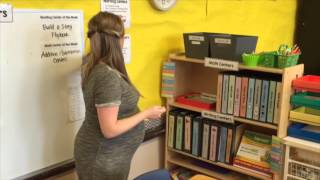
Sasha from The Autism Helper shows how to set up a centers-rotation system for mixed-ability autism classrooms. The higher-functioning group rotates through vocabulary, writing, reading, and independent work in the morning, then math centers in the afternoon. The lower-functioning group uses simplified versions with literacy bins and puzzles. Once routines are established, students stay engaged and complete varied tasks throughout the year.
Chapters
Hi, I'm Sasha from The Autism Helper, and I'm here to show you my new centers setup for higher functioning kids with autism. So the idea behind this part of my classroom is to really make sure that my higher functioning students are engaged in independent work for a longer period of time. A lot of our higher functioning students can work really quickly, so we give them some independent work and 3 minutes later they're right back with us and like, "Hey, I did it!" So I wanted to incorporate a lot of different areas into this center. I also wanted to incorporate different groups of students. Not all of my kids can do all the things the same way. So there's kind of a lot going on. It took a little bit of time to teach my students, but I'm very short-staffed this year, so I had to make sure that my kids were getting in a lot of independent work. Um, so there's basically two different groups of students that utilize the center, and they have different, um, directions based on the group. So the names of these four students, what they do in the morning, what they do in the afternoon, is clearly listed out. So when I'm hearing all that, what should I do next, what should I do next, instead of answering— and I try to really catch myself— I don't answer, I reference them to this page. Like, what does it say on your morning centers? So in their schedule, say morning centers, and then they have this mini schedule here. Using mini schedules is really great because obviously we're not going to put all this information in their daily schedule, but they can come here, problem solve, figure out what to do next. So in the morning, they do a vocabulary page. So they're going to be using my vocabulary work, um, 150 vocabulary words. Their vocabulary words are over here so they can reference from the vocabulary words for their group. They have the worksheets in their binder, so they do a different worksheet each day of the week. This has gone really, really well. I can show kind of a peek of one of these. So this is the weekly vocab— vocabulary homework, but they do it in the classroom, so they're not bringing this home, they're doing this here. So they reference these, we change these every week, and they do these by themselves. So once they're done with their vocabulary work, their second task is to do a writing center. So my writing centers are all right here. They fill it, put their name, which center they want to do. They do the center and they put it in finished work. I check all the finished work on Friday. This is super important to do because I know my kids, if I didn't check it every Friday, soon there wouldn't be so much work in here and the work would not be done correctly. So you really have to make sure there's a contingency in place for them to still do their work. So even though I'm not checking it on Monday, they know that on Friday they can get points if they have correctly done work in the finished bin. So they actually do their writing centers. Their third activity is to do the reading center of the week. So I have a bunch of great centers from Lakeshore and Pre-Made Activities. So I wrote up here on the board reading center of the week, and with a dry erase marker I add a different task. So each week I put in a different center. I kind of give them a little intro on Monday on how to do it, and then they do this center throughout the week as well. The last activity is to pick an activity from the independent work list. So I've shared this in the past, but I kind of incorporated this into the centers routine. The independent work list is just kind of a master list of anything they can do. So kind of your ideas for your early finishers. So their list is up here. They have 5 or 6 different activities they can do, and they have a certain amount of boxes that they can check off. Because a lot of my kids will go do the things on the iPad every single time, but I want them to do different things. I want them to do Word Boggle, I want them to do Word of the Week, and I want them to do typing their journal, things that maybe aren't as preferred. So they can do the iPad activities only 2 times a week and then they have to go to different activities. So this is a nice way to kind of keep control of how many times they're doing each activity. So that's what my higher guys do in the morning. In the afternoon it's all math focused. They're going to do extra math on the iPad, they're going to do a math center which are right here, and then the same thing we had reading center of the week, we have a math center of the week. So that's down there as well, and then they're going to go back to the independent work list. So this is really great because it gives activities for my higher functioning kids that are really fast. They can go through all of these and maybe do all 4 every day, whereas some of my kids just get through 1 and 2, but that's okay. So it's kind of counting for both learners. My second group's a little bit lower. They do a similar set of activities, but as you can see, the list is a little simpler and it's going to be a little bit different work because they can't do the same type of work as my higher functioning kids, so I want it to be individualized. So in the morning they also start out with their vocabulary work, and then they have similar to how they have reading centers of the week and math centers of the week, they have math and literacy bins. So in the literacy bin I put different activities. I put some journal prompts in here this week. So they do their literacy bin work. After literacy bin work they do a puzzle and quiet reading. So that's a way to— the puzzle and quiet reading at the end is a nice way to make sure that there's always something to do. Yes, I don't want them always doing puzzles, but it's just going to give something if they run out. If they get through 1 and 2, they they still have something on the docket. Same thing for math, they have extra math, their math bin work, and then they have puzzles and quiet reading. They also have an independent work list, and this is for other parts of their day. Theirs is a little bit simpler, so they have 5 different activities because there's one for each day of the week. So they cross it off, once it's crossed off they can't do it again. So again, have— pushing those non-preferred activities since a lot of our learners will kind of stick with the same few independent work activities. So this is a setup of a centers rotation. It has a lot included in here. There's a lot going on. It did take some time to teach your kids. You're not going to set this up and have them know how to do it right away, but once that we've kind of gotten in the routine, they're really good at it and they are doing a lot of different things, which I think will keep them less bored throughout the school year. This was a video tour of a centers rotation from theautismhelpgroup.com.