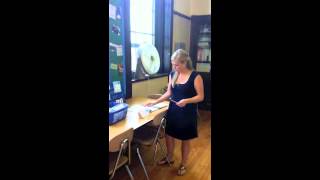
A teacher shows how to organize an autism classroom into functional centers using shelves and appliances as dividers. The setup includes shared work stations, a flashcard fluency area with timers, and a guided reading library organized by reading level, with data collection built into each station.
Chapters
So moving on, again, as you notice, like, throughout as I'm moving around the classroom, how physically divided there is, how much furniture is here, that there's clear separations on sections of the room. So shelves are a great way to separate the room. Again, this is kind of— the microwave and fridge are serving as another separation to another center over here. I only have one 3-bin work task. I know a lot of autism classrooms typically have a lot. I used to have one for each student. I don't have the space anymore, so I have 2 students share it. I know that's always not what you're supposed to do, but it works well for us, so we're okay with that. So the way these work, there are 3 very structured tasks, one in each bin.
All bus attendants, please report to the office. Bus attendants, report to the office.
Sorry. Um, so the student sits down again. Here's where they match their schedule picture. If they're using the color-coded schedule, they do one task from here. When they're done, this finished bin usually is up here. They put it in the finish. So you're working from left to right and it's very structured. There's a, there's a known end to each task. One student does it like that and the other student actually just uses all the tasks in this bin. So he knows how they're separated. He does this, does the work, puts it in finish. The data sheet for this station is right here. You're not gonna have someone run around looking for it, 'cause they're not going to. So the aide that is over here takes data, got a pencil velcroed, so it's all ready to go. So that's one of the workstation tasks we have. Coming on to over here is our language center. All of the supplies are here and the table is here. This is also now becoming writing, so it's kind of our, one of our new centers we're doing. So this shelf pretty much is our new writing center, which I'm really excited about. Um, they can take over here— these are all the schedule pictures. Yeah, come over there.
What?
Come here, look at this part. So these are all of the different activities they can do at the writing center. There's 6 binders and 2 of these tasks, and I doubled them up so I can switch them out. Um, so when the kid has writing— when the student has writing center, they can come take their name off of the clothespin and pick which one they want to do. So if they want to do Super Sentences, they clip it on, they take the binder, and they come sit here and do the work. And then there's a finished bin for everything. So that's our new writing center we're starting, so I'll let you know how that goes. That's something we haven't done before. The main part of this station is to do fluency for flashcards. Fluency is so important, and a lot of people, I think, forget about it. Fluency is accuracy plus speed. So can you do something fast, and can you do it right? So most of my kids do daily flashcard timings, either once a day or once every other day. When we do rotations where the kids are moving around in stations, typically they're in pairs. So if they're in pairs, I made this visual for either you have your independent writing binder or you have flashcards. So these 3 kids would have binders, but their pair will do flashcards with an aide at this table. So the flashcards, each kid has a set.
Miss Bryant, please. Come to room 202. Miss Bryant, come to room 202.
So each student has a set of flashcards. So Brianna has 4 sets of flashcards that she works on. She has a data binder right here, so when the aide has Brianna's flashcards, she gets a timer, which is over here too. So everything's right in the location you need it. So again, making it easy for everyone to take data, because no one's going to take data if they have to run around looking for materials. So when Brianna does her fluency timings, she'll do a minute or a 30-second timing of each set. Aide takes the data and then she goes on. And then the next day, whoever Brianna's partner is, Brianna will do her binder and the student will do their flashcards. So that's a really good and easy— the best station I ever set up. I wish I did it years ago. We've been doing this for 2 years now and it— they get so much done. I get so much good data. The aide is so great at it, has like a lot of autonomy over here. She's really proud of when they move up, and it's a great way to know what they're doing on their Master of Facts without having to be a part of it. Some of my lower students work on vocabulary, so they have sets of items— so pen, notebook, broccoli— so just lots of common items that they aren't saying. Like, this is for a student who has some verbal abilities but still really struggles to engage in a lot of verbal behavior, so he does these vocabulary timings, and this has really helped him. They also do colors, letters, numbers, shapes, so pretty much anything you're working on can go into a fluency timing and should almost. Time, money, do money combinations. Like, when you look at a dime and 2 pennies, you want to know right away that it's 12 cents. You don't think about that in a store. That has to be right on the tip of your tongue. Talk. So that's why fluency is really so important. So sorry about that tangent, but so that's our language station. Here's our guided reading library. All the books are leveled. We use Fountas-Pinnell reading levels. So that's our reading library. And down here, all our adapted books, so the books that have kind of a visual aspect to it for kids that are a little lower to engage them in some reading activities. So these are all in one spot. Um, over here is our reading center. So I've changed the ways I've used this in different years. Um, the aide that runs this station now is going to run spelling. Um, I got this at Lakeshore. This is all different vocabulary games that she's going to use with her spelling words. And with some of the other kids, she does certain IEP goals, like she'll do receptive body parts, flashcards, all those kinds of things that are separate from language that I have to be working on as an IEP goal that they will work on over here. So all of her materials go in here, data binder right in here, any flashcards she was working on. One student is working on categorizing, is all in this location. And again, I did point out over here, but each, each center has all of their own visuals. Any behavior management visuals, each center has their own. So like over here is the exact same set. So I use this 3-strike-to-time-out visual. So that's ready over here. So that's not something that everyone's running around to find. Everyone has their own. The I'm working for card is over here. So kids can pick, okay, I'm gonna work for iPad. And then when they do something good, when they finish a task, the aide will give them a star. They're stored on the back. And when they get all 5 stars, they go get computer. So this is what we use for some students. It works super well. It's really concrete. And again, each aide has their own. So that's reading and language.










