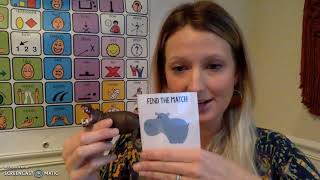
Gina from The Autism Helper shows how to scaffold matching activities for young learners, starting with sensory bins where kids place animals while making sounds, then moving to picture matching with Velcro cards and dry-erase tasks. Each level adjusts for different abilities in whole-class or small-group settings.
Chapters
Hi everyone, it's Gina from The Autism Helper. I'm here to show you how to differentiate some materials. So my favorite materials during an early childhood lesson or an upper grade, um, I have the matching task cards, the animal version. I also have the food version that I printed out, and then I have the weekly matching book in the animal theme. So say you were having— you had a little lesson, maybe you read a book during circle time on animals and then you're moving into a small work with teacher group, or perhaps maybe you're working one-on-one with the student and their goals. I wanna show you how to use these in multiple ways because obviously even in early childhood, even when I worked with 3-year-olds, there were still kiddos that needed basic skills that weren't quite even to this matching level quite yet. So I'm gonna show you that today. So the first one is after you read your story on animals, maybe you have a little, this is an old Folgers Coffee, cut the top out and I put the core word, language word, in on it. And then say you have a kinetic sand or sensory bin of some sort or just a regular bag and you can put in little animals that were in your story or just animals in general and have your kiddos, or if you're working one-on-one, take one out, label it for them, or maybe they're able to label it. Maybe they're just looking at objects and they're putting it in the bucket. So you're working on the preposition "in," you're working on labeling the animal, maybe you're saying the sounds, "Oink, oink, oink," the pig goes, "Oink," and putting it in. So that's like kind of like level 1 that you can do. The next thing that you can do with these cards, so maybe you haven't quite got to the cards but you still want to stay in the theme of learning animal names and animal sounds. So next you can take Actually, you can take this book and there are some arrowless pages in this book which I love. So you, all you have to do in this book is you're putting the birds on the branch. So you're just showing a left to right and believe it or not this can be really challenging for some students especially if they've never worked with Velcro or a left to right type of task. So you're still working on the animal theme but you're making the task a little bit more doable. Now this one's going to be harder because It's matching pictures to pictures. There's more steps involved in this one instead of just moving the animals over, but there are lots of great— put the bats in the cave. There's lots of great kind of errorless type of tasks. So that's your second one is just doing that book with a student or group of students and taking turns. And then you can bump it up a notch if your students are working on objects to pictures and you can use the matching task cards. Find the match. And then you can even cover this up for them. And you could still make it arrowless, matching the hippo to hippo. Obviously these are not identical. So this is a non-identical matching task. So this is a little bit above just matching, say I had an exact picture of this hippo, hippo to hippo. But you're matching objects to pictures and showing that a hippo can look like this and a hippo can look like this. So I like to lay them out on the table, Depends on your child, how many, or student, how many cards you might have out at a time and how many animals. But I always like to bring them up to my face and help label if kids don't have a lot of expressive language quite yet. Hippo, hippo, hippo, and match it to the hippo. I've got a little elephant, same thing, okay? And then you can also do it with the food if you have little pretend foods in your centers. Find the pizza, find the match. We're matching the pizza to the pizza. And then I really love this set because you can actually cut these in half. They're, they're Velcroed. So that's a fun way to use that card. And then of course the last way you can use it is to have a dry erase marker and the match. And so teaching your kids how to find the match. Sometimes I even will cover up and make it even a smaller field when I'm first teaching it. Or maybe I'll make it arrowless and just show them the skill. Of circling the match. Elephant! Hmm, where's the elephant? Oh, here it is! And I'm gonna circle it. I'm gonna show them, or maybe they just color it in. Or you can do a field of 2 or a field of 3 as well. I also used to love using socks as erasers because that was easy to put on the kiddos' hands and have them erase the marker boards. That was just way more fun that way. So I hope this is helpful for you, and let me know which version you try with your kids.