Differentiating Matching Weekly Workbooks for All Learning Levels
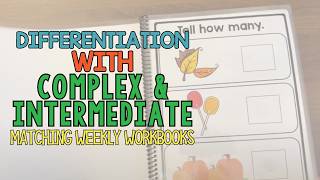
Angela Kulcsar shows how to adapt matching workbooks for different learners by changing the number of answer choices, using Velcro prompts, adjusting visual supports, and removing or adding pieces to match each student's skill level.
Chapters
I have talked to you guys about our new complex and intermediate matching weekly workbooks, and today I want to kind of break down how I would use these and scale the complexity of the tasks inside these books to meet a wide variety of learners in my classroom. So we often talk about how students age out of matching, like very, very basic exact matching skills and errorless tasks and not knowing where to go. And I've got a video on that that gives you some ideas of how to move forward. But that's one of the reasons that we made Intermediate and Complex Matching Weekly Workbooks. We knew that a similar task provided to students, but increasing the complexity of that would help students be able to obtain the skill. But there's some things that you can do as a teacher to help scale that as well when you're setting up these books that I wanna share with you today. Let's take a look at the Tuesday intermediate book. The very first task is tell how many. And so obviously there are 3 leaves here. The correct answer for the student would be 3. But how I set this up could make identifying that 3 harder or easier. So if I've got a student who is brand new to this task, maybe I only want to offer 3 as a choice the first time they count, and then have them move that over and identify 3. And then maybe as they count and they tell me it's 2, then I put the 2 down and have the student pick it up and then put it down. And I could do the same for the 6. Another idea, once the student has that, is to positionally align them. So now I'm giving them a prompt based upon the position. The 3 is with the 3, the 2 is with the 2, and the 6 is with the 6. What makes these books a little bit unique is that there are extra pieces for several of the tasks. So here I've got different numbers. As the student gets confident in this, and as I mix these around and offer them to students that are not positionally aligned, I can add in more pieces to make this more complex. This can be difficult for students because oftentimes our students, when they are matching, are trained to put one piece with another piece. That's how they've learned the skill. So here there's going to be extra pieces, and we'll need to let them know that that's okay, that there should be extra pieces. There are 3 spots, so I'm going to choose 3 numbers that go in these spots. But you can see how offering all 6 numbers is a lot more difficult than offering just 3, or even just 1. So that's an idea to be able to help you scale these. Here's another task in the same book, and we are sorting pumpkins and jack-o'-lanterns. And if you can see, I've got the Velcro already put on here, and I've got 4 pieces of Velcro on each side. And if you see, I've got 4 pumpkins and 4 jack-o'-lanterns. Just the Velcro themselves and having 4 spots is a bit of a prompt. I'm teaching students that I should put 1 item on each piece of Velcro. So if a student masters this very quickly, an idea would be to add extra pieces of this soft Velcro. Yes, students won't need it, but it makes it a little bit more complex. They're not just matching one to one anymore. So again, making things a little bit more difficult. Another great example of this is this page. This one comes from our Monday Intermediate book. Here Here I'm counting and adding candy to the pumpkins. Well, this says 4, so I'm gonna put 4 pieces of candy in that pumpkin. Well, by putting 4 pieces of Velcro here, I'm telling the student exactly how many pieces to put down without actually telling them to count. So if you needed to prompt your student, this is a great way to do it. If you wanted to make it more complex, you could put 5 pieces of Velcro on each one. If you don't wanna waste that many Velcro dots, and I don't blame you, you could get strip Velcro and you could put strip Velcro across and you could have them just have one big piece of Velcro that goes all the way across the pumpkin and then they would have to identify it that way. There's lots of ways to be able to scale this, but know that when you put 3 pieces of Velcro and it asks for 3, you're actually telling the student the answer. When the instructions have something to do with a preposition, this is especially true. So here I'm telling the students to put the leaves on the ground and the acorns on the tree or in the tree. So here I've prompted them, you know, I've shown them exactly where to go. And I know you can't put Velcro over the whole page. However, you could put some Velcro next to the tree, or you could put some up in the sky to make it more difficult for students to make sure that they're really following the intricacies of these directions. But for a beginning learner who is just getting started, this is very appropriate. And so again, this is our intermediate. So if I've got a student who is moving from just the regular easy matching weekly workbooks to where here the task is put the leaves on the ground to having two separate tasks in the intermediate book of putting the leaves on the ground and the acorn in the tree, I might want to prompt them with this Velcro. There's not a right or wrong here. It really is adaptable to meet those students' needs, whatever your students are and however, whatever level they're at. We wanted to make this book flexible enough that they could benefit from it. And honestly, you can add and take away Velcro as you go to make it more difficult and more complex. These intermediate books too, this is a photo. So this is a photo prompt. So I'm showing you what big looks like and I'm showing you what little looks like. And then I've got the Velcro pieces down below. These books come with optional pieces, and I actually pulled an optional piece out of the school book so you could see. Yes, they're different. This one's empty and full in Book Bins, but you get the idea. Here there is no picture prompt. So these are at the end of the download in the file. So if you want to swap this page out and not give the picture prompt, you could. You could just replace it very easily, and then that picture prompt is gone. Or if you've printed this already, that picture prompt is there, you could get an address label and cut it up so it covers this, or put a piece of paper over the top and tape it down. Get rid of that prompt if you wanted to, and it would be very, very easy to do. But this is a really cool way that you could scale this up and down too. Offering highly differentiated resources is one of our specialties here at The Autism Helper, so we hope that these really fit a need in your classroom and help bridge that gap and help teach those independent skills, task initiation, um, helping maintain attention, and doing things on a fun and hands-on way. We know that your students will love these, and we really hope that they are a great fit for you.










