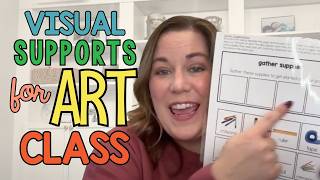
Jen, a former autism teacher, shares how to support special ed students in art, music, and PE. Case managers must share each student's IEP accommodations with specialists. Visual supports like schedules, anchor charts, and task analysis sheets (1 through 8) help students work independently and understand instructions.
Chapters
Let's talk about helping our students be successful outside of the special education classroom. I am Jen, and I am a former K-12 self-contained autism teacher, and my students varied in their level of participation in general education. Oftentimes my students were able to join their neurotypical peers and their gen ed peers and go to specials like art, music, and PE. Sometimes they were not able to, but it was always my goal to help my students participate in general education as much as was appropriate. And so one thing that I did really early on is that I helped my students' teachers. Now this could be their gen ed teachers, and I've talked about that in the past. It could be related service providers, and I've got a video on that. But today I want to talk about specialists, specifically art, music, and PE. Those teachers deserve gold medals and all of the chocolate because they deal with so many students and such a wide variety of needs. And so it's hard when you have that many students to be able to remember and know and put in place all of the supports that are necessary for that large number. So I want you to do some work on the back end to help your students be successful. The first thing I'm going to suggest is share those accommodations. Anyone who interacts with your students, who helps provide any level of service for them, should be given a copy of that child's IEP for accommodations and modifications. If you want those supports implemented, it is your responsibility as a case manager to share those. So that is number one: make sure that they have the information necessary to be able to do things, especially if it's things like preferred seating or extended time. We need to make sure that teachers have the information needed to put those accommodations in place. The second thing that I'm going to do is say give them the supports needed to be able to put those accommodations into place. One of my favorite accommodations to write is that I would give my students visuals to be able to support them in those special environments, or in any environment really. So one of the things that I did is I pulled these art visual schedules. Now the Autism Helper has these in every special, but they just came out with brand new ones for art. I think they're fantastic. So I wanted to share them with you just to share how I would use these when I was looking at using these to help my students with visuals in a special environment. So for art, I'm gonna give anchor charts, right? I wanna make sure that my students have the availability to know, and on an anchor chart, what the teacher is talking about. So oftentimes we talk about things like horizontal and vertical. I want to make sure that my student knows what those mean. I'm going to have checkpoints for numbers and for colors. And then there's a second one as well that has real photos, and these talk about like all the different supplies. It is so well done. There's another one. I love this because this core language board, it, it can kind of act like a fringe language board but it tells— allows the student to tell what they need. So the student can say, I need, and be able to show what the student needs. And then there are matching supply labels for that art teacher to use, if they will, in their classroom. So the student can say, this is what I need, or you can tell the student, hey, you need this, and then they can go gather supplies. And it is the exact same photo. I love that they're real photos. This allows us to scale up and scale down when it comes to age. We know that having appropriate Create visuals for older kids is really, really important. So there's no age stigma when it comes to using these visuals. So I also have a gather supplies, um, so you can have the student plan out and provide some independence. You can say, hey, these are the 4 supplies you need, go find them using these labels. So that's fantastic. But then I also really, really love this. These are art project steps. So you can cut this out and it'll say first all the way through last, and then here we've got 1 through 8. So you can just kind of pick and choose which one works. For younger kids and a smaller, shorter art period, you're probably going to use the first, second, third, last, or the art project steps. You know, you can just put it down as many as you'll get through in that art period. But then there are actions as well that's going to tell the student what to do. And when combined with those visuals of paper, oh, you've got a fantastic step-by-step task analysis for the child. This is very, very simple to implement. This is a total of like 10 sheets of paper to cut, laminate, and get off to your specialist, but it is going to provide such great support for any student that accesses that special. And those specialists now have tools to be able to help seamlessly teach these— our students, and that is really truly what we want. Um, so if you have tips and tricks about how you help your students be successful in specials, I would love to hear it. I'm going to drop a link for this down in the comments because this is just one of those things that it's going to serve you so well no matter what age level you teach, and I know that it will be successful in your classroom.