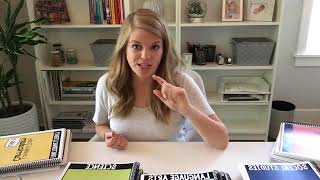
In this live Facebook broadcast, educator Angela Kulcsar announces the Teachers Pay Teachers (TPT) back‑to‑school sale (code BTSFRESH for 25% off) and walks viewers through her expanding curriculum portfolio. She introduces a brand‑new "Functional Literacy" series—three levels of materials that teach students to apply language‑arts skills to everyday texts such as signs, recipes, receipts, and schedules. The series includes a regular writer version and a non‑writer version for Level 1, with plans for non‑writer adaptations for Levels 2‑3. She explains the structure of each level (skill focus, types of texts, increasing writing complexity) and how the series aligns with her existing Language Arts, Math, Science, and Social Studies series (each with multiple levels, with Level 4 for Math and Language Arts already available and Level 4 for Science/Social Studies forthcoming). Kulcsar describes practical details: how to print and bind the books cost‑effectively, the inclusion of anchor charts, rubrics, data sheets, pre‑ and post‑tests, and daily‑work/homework resources (including a Year‑long “Daily Work” station). She shares a skill‑matrix that maps student abilities to each level, emphasizing that the materials are not tied to a specific grade or Common Core standard. The session also features a giveaway (tag a teacher friend to win TPT gift cards), answers to live viewer questions about bundle options, non‑writer versions, assessment tools (VB‑MAPP, ABLES), homeschooling use, and future plans (Level 0.5, early‑intervention adaptations). Kulcsar interweaves a personal anecdote about her first year teaching without resources, underscoring her motivation to create ready‑made curricula that reduce teacher workload. The broadcast ends with reminders about the sale code, links to product pages, and a preview of upcoming PD sessions on behavior and Functional Literacy.
Chapters
Good morning, happy Wednesday. Today and tomorrow are the TPT— today's August 1st— August 1st and August 8th, or August 1st and August 2nd, god I'm losing my mind, are the TPT back-to-school sale to start off. The code is BTSFRESH. I always forget to put the code, so don't forget to put the code. So if you put the code, I have a sale set and then the TPT adds a section off and it's 25% off. So I wanted to jump on here this morning and talk about— morning, Tara— and talk about the curriculum. I get always a lot of questions at this time of year because this is when people are looking at what they're gonna use this year, what resources has their school bought for them, and I get why there's a lot of questions because these, these packs are an investment. They're, they're pricier. They're not $5 to $10, so you want to make sure if you're buying it that it's the right fit for your class, which I totally understand. So I wanted to jump on here and hopefully answer some of those questions. And if you have any more detailed questions, of course, please feel free to message me or email me. I'm happy to kind of go through it with you. Also, in all of the product descriptions of each of these resources, there is a video tour as well, so you can kind of see all the pages. So before I jump into that, I also wanted to note, in case you don't watch the whole thing because I usually ramble on these things for a while, I have a bunch of TPT gift cards to give away. As you're watching this, tag a teacher friend that you think this would be a good fit for, and tonight we will pick people and you and your friend will both get a gift card. Sorry, I think I just saw someone coming to my door. If you fade out at some time, that's cool, but tag someone to win a gift card later and we will give those out tonight. Yesterday I was giving a PD on adapting academics and I shared this story that kind of everyone laughed at. But my first year teaching, I was 22 years old. I had literally no idea what I was doing. And I started a new classroom. So I wasn't taking over another room. I just had a new room. So I had this empty, huge room with just tables, like that's it. And I really think those first few weeks I was like naively like waiting for someone to bring me like the stuff. Like I'm pretty sure I like almost asked my principal like, hey, when does someone like bring the things I need to like teach these kids because I don't have any of the things. And as you and I both know, obviously I'm still waiting for that day. That day never came. And it was really, really hard as a young teacher and as a veteran teacher to make all the stuff and to keep up with that because every year it's different and kids are changing. And I felt like I was pulling myself away from something else, like I wasn't doing a great job with behavior plans or data because I was making curriculum and or had literally zero social life or family time. So this is really where this stems from. And I really— I started doing this, making these a few years ago, and it kind of snowballed into all of these different series and subjects I'll show you in a minute. But I really kind of poured my heart and soul into this because I know how hard it is. Like, our jobs are already so, so, so hard, and then to put on top of it that like we have to be an amateur curriculum developer is just ridiculous. So This is really where this stemmed from, and I've loved, loved, loved hearing about everyone using it in their classrooms. I love seeing pictures. I have a bunch of schools that I've worked with that the whole school is using it, so it's just so exciting. And I really— my hope is that it makes your job easier and your teaching better and keeps you more on top of everything. So without further ado, I want to show you the new series, which I'm super excited about. I shared this on like Insta Stories the other day. I've been working on this for like 6 or 7 months, and I know that because my baby is 6 months old and I started working on it before she was born. So this is, this is older than Amelia. So it took a long time because there was a lot of, as you'll see in a minute, a lot of different types of images and a lot of thought. And I put like purposefully put a lot, a lot of thought into like the content, and I mean the types of text used. So functional literacy is not the same as language arts. It's applying language arts skills to everyday text. So text that we see and use on an everyday basis in our lives, which there's like thousands of times in our day, probably millions, I don't know, um, times that we read and respond to text in a day, whether it's a recipe, whether it's a bathroom sign, whether it's directions on our phone, whether it's a train schedule or movie schedule. There's just so many different times that we're reading and responding to text. So I wanted to kind of, I made these like master lists of like all these signs and things that I was seeing in my life that I was responding to and then pulled all of that in here. So there's tons and tons of variety. My goal was really generalization. My goal was that kids are learning a skill and applying it to a lot of different types of text. So there's 3 levels. It's set up in the same way as all the other series. If you already use the language arts one, it'll work really well with the language arts one. Because it's gonna be applying similar concepts in a different way. So if you had a student that was on Level 2 of Language Arts, they'll be on Level 2 of Functional Literacy. I think they would work really nicely together. And don't let the functional scare you, it's not just for older kids. I think this would work awesome for younger kids as well. So Level 1, I'm gonna show some little just peeks so you get some ideas of what I mean on the different text, but it's gonna be reversed here because I'm in like in selfie mode, but you guys get that. But check out the video previews too. So like I said, tons of different types of text. I really was thinking beyond like community signs, so things like name tags, things like barcodes and ingredients and parking signs. So like just things that we see all the time. It has the same setup with anchor charts and data sheets and curriculum maps and those amazing rubrics that I know you all love. So definitely check out these. This is kind of the level of the Level 1, so I will also be making a non-writer version. Someone already asked me, and way to call me out, good call, I kind of forgot about that, but I will make the non-writer version by the end of this month and it will be within this version. So Level 1 will within a few weeks include the regular version and the non-writer version because there's a little bit of writing, like as you can see this is like a copying task, um, and there's some copying tasks, so it'll be all tracing and matching and circling in the non-writer version. So I love— there's one section that's small, medium, large, like some of my favorite vocabulary. I just like die over some of these activities. So that's Level 1. Level 2 takes it a little bit to the next level. They, um, a lot of the skills are things like WH questions and sequencing and answering questions, uh, sorting by more advanced feature, function, class. So things like the kind of text like this is really what I want to be showing is things like receipts and shampoo bottles and maps and schedules and Post-it notes. Like thinking about like your mom leaves you a Post-it note like, "Don't forget to put the chicken in at 4," or like, "Pick up eggs at the store." So really it's all text that we're seeing in our lives from recipes to ice cream containers to things like that. So this is kind of the level of difficulty here. Again, this is like— you probably can't see much by this, so check out the video for preview. And then Level 3, of course, gets super tricky. A lot of the same skills align from Level 2 to 3. So maybe Level 2 is working on similarities and differences, and then Level 3 is on compare and contrast. So it's similar concepts, but again, that big variety in types of text. This one has a lot more writing, and we're really not repeating the images that much too. So I, uh, I really was focusing on generalization. Um, someone asked, how do you make the book? So this is not very cheap to do, um, to print, but if you have like a really good photocopier at work, I would, um, I would photocopy it at work. Like, that's what I did in the classroom. I photocopied them at work, and then I have a coil binding machine, and I just did that myself. These I did at FedEx, and If you get a coupon code, it can be about $25 a book, which is not cheap. So that's why I'd say try to photocopy it at work because there's no color in here. I just did color for the COVID So photocopy at work and then the coil binding machine. I've shared it a few times, but if you go on Amazon and go just put coil binding machine, I have the first one that's there. It's like $150. It's worth it. Someone just asked about the non-writer version. The non-writer version will be part of Level 1, so you don't need to purchase anything different. I'll just add it on probably realistically in the next like 2 or 3 weeks, but you don't need to purchase anything different. It'll just be part of it. It'll definitely be done by the end of August. So that's Functional Literacy. If you're new to the other series or the other sets, I have language arts, math, science, and social studies. Math and language arts I have 4 levels for, and science and social studies I have 3 levels. A lot of you asked me for level 4 for science and social studies. That is coming. Not my back-to-school time, sorry. So this is math. Yeah, and so math, we have level 1, level 2, level 3 and 4. So I'm not gonna show the insides. Again, there's video previews of everything on the product link, 'cause I get that since these are pricier, you wanna like make sure it's exactly at the right level. Language Arts and Science and Social Studies. Science and Social Studies came out last year. I have loved, loved getting your feedback. Social Studies is actually one of my favorites. There's just so many cool skills to work on and it's still like super literacy-based. I just love, love Social Studies. So definitely check that out if you haven't used it before. Questions I get a lot are what grade is each one for? And I have like an ambiguous, non-answer that I give. Um, I specifically didn't align these to Common Core. I specifically didn't try to make it specific to one grade level or another or name it one grade level or another because I know our kids, our older kids, are sometimes working on more foundational level skills. And I hate when an older kid is working on a worksheet that says like first grade all over it. Like, it doesn't feel very good. So I specifically kind of created these levels, um, on my website, and I'll link it here in the comments. I have kind of this matrix of skills that a kid needs in each level. So a Level 1, we need these skills. Level 2, your student can do these skills. Level 3, your student can do these skills. So I will link that here for you to check that out. I also recommend checking out the video previews as well. Um, but more or less, uh, Level 1 is a student that maybe has— they don't have to have writing skills because there's always a non-writer version included in Level 1. Um, but maybe they have some copying skills, so they can copy a word, they can copy something. That's something that this kid would be able to do. They could match, they can sort, things like that. So that's Level 1. Level 2, students are working on writing sentences. I don't actually have my Level 2 language arts books, I gave them to someone. Level 2 in all of them, they can write some simple sentences, starting to answer some WH questions, a little bit more verbal skills, things like that. But like I said, the matrix gets pretty detailed. Level 3, kids are writing full sentences, working towards writing a paragraph, things like that. And the math will get all specific in that matrix. So, and I will share all of the links as well at the end. I will share the links for each subject. So bundles, bundles are levels 1 through 3 for each subject. So I don't have a bundle of everything, sorry. I don't even— that would be like the biggest download ever, I don't even know. But I've made these things kind of slowly, like throughout years. And, um, sorry, I'm trying to read questions in my head. "Son hates reading and going to be in 7th grade. How do I help him?" Will you message me, Marilyn? I just— the comments are coming too fast, I can't keep up. But message me that one about your son. Um, so bundles levels 1, 2, and 3. Um, for level 4, that's going to be separate. I wasn't originally planning on making a level 4, so that is going to be a kind of a separate thing. So if If you want level 4, if you used math or language arts last year and your kids already finished level 3, congrats, you did awesome, your kids did awesome. So check out the level 4 because that's something separate. If you have kids that are at that level 4 kind of skill set, I also made, which I don't have here on the table with me, but I made Daily Work and Homework in level 4. So those are also 2 year-long resources. They really line up nicely with the whole curriculum. Homework is homework that's ready and prepped for the year. So Level 4 homework is out, and then daily work was my— I call it like my baby, but it's the first time I ever made a year-long set, and I'm obsessed with it. And now there's Level 4, and I'm obsessed with Level 4. It's really good. Jasmine asked, "Do you have plans to include non-writer, low-writer skill options for Levels 2 and 3?" Good question. I've had questions for this. I have students who don't write well but need to work on higher skills. That's a really good question. I am— I'm gonna brainstorm on this. I have a flight today that I will brainstorm on how that would look. And if I do, it will be— I will definitely work on something like that because that's not the first time I've been asked that. So I will work on some non-writer components for 2 and 3, and if I do those, it will be part of Level 2 or the bundle. Those wouldn't be separate resources. So if you're thinking about that, um, since both my boys have autism and are nonverbal "Verbal homeschooling them. I'm needing some info and help please." Okay, so Megan, sorry, like this is like really testing my eyesight. I'm gonna link this matrix here in a few minutes and it shows what skills you need for each level. So if you are a homeschooling parent, if you are a parent that wants extra work for the afternoons or the weekends and you like are like, "I have no idea where to start. This girl's showing all these colored books and I don't know what she's talking about." Check out the matrix 'cause you'll see like, okay, "My kid has these skills, so I know I should buy something in level 2," or, "My kids have these skills, I should buy something in level 1." So those are my main questions, the bundles, the level 4s. If you have anything else, throw it on here. And so we have language arts, I'm gonna put all the links too. I have language arts, math, science, social studies, functional literacy's the new one, super, super excited. "how is the Daily Work curriculum different from—" that's a really good question, thank you for asking that. So the Daily Work, I don't have with me right here, so the Daily Work I made probably like 4 years ago now. So Daily Work is set up kind of as like a bell ringer independent station, a paraprofessional-run station. It includes language arts and math skills, and it is a student has one worksheet that they fill out and they respond based on this work page. And the work page changes every day, but it's in the same structure. So like maybe every day there's a vocabulary word of the day or a sentence of the day they have to write. So it's in the same structure, but the content changes. So there's 4 levels of daily work, and I absolutely love it because it's one and done. You can print those pages, there's one for every day of the year, and then you just switch it out. When I was in the classroom, I posted it every day, we switched switched it out. I had 3 different levels going. I did level 1 with my one morning group, level 2 and 3 kids did it on their own and then we checked it. It was super, super great. The yellow one is Functional Literacy. It's new. And the— so that's Daily Work. I love it. It works well with these. This is like a curriculum. This is something you'd sit and teach or have a paraprofessional work with your students on and is like bigger, more involved. This has rubrics and anchor charts and data sheets. The daily work is something that's like a center or kind of one component. Someone said, "I wish you have a social skills curriculum." You think I'm not already planning that? Because I am. I've got all these plans, guys. I just don't have enough minutes in the day. So that's daily work. So it works well with this. It's not included in this. It's something separate and different. The also thing that I want to add on daily work that a ton of people do is they post the student page on a smartboard or on an iPad, so then it's zero, zero ink. You literally like, you print, you photocopy the student page, and then it's done and it's gone, and you just— it's planned for the whole year. So amazing. So I want to grab this question. Um, someone said, homeschooling parent using Ables or VB-MAPP, or is that not necessarily if you only have one student? Oh no, I use the Ables for like my in-home clients. I think the Ables would be Sorry, I can't read the top of your question. Would you recommend a homeschooling parent consecutively use an assessment like VB-MAPP or ABLES? You would need to use both. You could pick which one, um, but for homeschooling, I think using the VB-MAPP with ABLES would be awesome. It'll tell you what things to work on not only in your homeschooling sessions but throughout the day. Um, the ABLES has a lot of life skill components, so if you're a homeschooling parent, I would maybe veer towards the ABLES because it'll include the toileting, feeding, fine and gross motor skills, things like that. So I would definitely check that out. So if you're just jumping in, I shared a little bit about the new curriculum, the Functional Literacy. I'm so, so, so excited. I feel like, I don't know, like this is like my little— you guys, I feel like I've been lying to you guys. Like, I didn't even know about it for all these months. But I wanted to wait until right before the sale to put it out because I know that's when a lot of you kind of think about getting these things. This is the time of year, you know, we have the whole year now to kind of plan. And so this to me just takes a lot of the pressure off too. Um, I also have plans. This is like plans, guys, haven't started it, so it will definitely not be, um, before the school year. I have plans for level 0.5 for everything. We have level 0.5 only in the homework right now, um, because I had a ton of requests for easier homework, which I totally get. I love how the 0.5 homework turned out. It's 1 page a day, very fine motor focused. But Gina, who's a blogger on my website that started last spring, she's amazing. She is starting an early intervention class, I forget what they're calling it, preschool? And so she and I have kind of been talking about 0.5 and what that would look like in all these subjects. So something that like really had probably no writing, big focus on receptive language, things like that. So that's That's in the works as well. The Matrix, Samantha, I will be linking here right when I jump off, and it's on the website though if you click on curriculum. Someone just asked, I have a 10-year-old son who struggles with writing, needs something at his level that doesn't require a lot of writing, if any. So yeah, check out the video previews on these and see kind of what would be a good fit for him. Depends if he has no writing at all, like I said, everything right now except Functional Literacy it will in the next few weeks include— Level 1 includes a non-writer version, so it's all circling, matching, things like that. Is there a reading program you recommend to go hand in hand with your curriculum for low-level beginner students? Great question. I'm gonna think on that one. I'm not sure. I'll get back to you, Ashley. That's a good one. You stumped me. It's hard. I mean, it's especially for our low-level beginning readers. I would say a ton of adapted books. And really making books reinforcing, giving them access to adapted books. I think literacy is so daunting for some of our kids because they're like, "I don't know what to do with this book. I turn the pages." So I think just getting them engaged and involved is kind of the first step for me always. Okay, so don't forget about the giveaway. Tag a friend at some point tonight, for sure by the end of the day. We will message you and we'll pick 3 people and give away 6 gift cards. So you and your friend will each get a gift card. So we'll message you you to, to message me, and then I can give you the gift card because I can't message you unless you message me first. That's how pages work. So yeah, so if you have any questions about anything, let me know. There is a video preview for everything in the TPT link, so you can click on it and be like, oh, does this make sense? Is this a good fit for my kids? You can see all the pages, you can see what I mean if you're unfamiliar with this setup. This is— the workbook is not the only thing included. This is just what I'm showing here. There's also anchor charts and grading rubrics, and the grading rubrics are like the best, you guys. Like, I'm obsessed with them. And, um, data sheets and pre and post tests. So that's all included as well as this. Um, so hope everyone enjoys the sale. Don't forget the code. It's really frustrating to check it out without the code, so BTSFRESH. Um, Sarah also just posted a few cute new products, little task cards and things like that, and I posted, um, the anchor chart mega pack. I had a lot, a lot of people ask for the anchor charts from here separately, and so I kind of did a little more than that. Of course, um, I made a set. It's a hundred— it's over 100 anchor charts. They're set up into 10 books. I actually think they work really, really well with this curriculum. It's a little— there's a few components that are similar, but there's a lot of different, um, skills included as well. And the way it's organized, I think, will be really helpful when using these as well. So yeah, I hope everyone has a good Wednesday, and I'm gonna share some sneak peeks tomorrow. I'm doing a behavior and a functional literacy session. I forgot about that. I'm doing functional literacy session tomorrow at a PD, and I'm doing a behavior one. So I'll share a little bit of screenshots and stuff from my PDs tomorrow, and hope you all have a great day.










