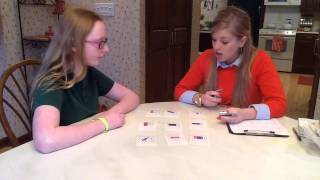
Sasha from theautismhelper.com shows how to set up a fluency station to measure how quickly nonverbal students recognize pictures and concepts. Use four or more picture cards, time trials for 20 seconds, and tally correct responses. The approach works for vocabulary, colors, coins, and functional skills, with data logged and a preferred reward given after each trial.
Chapters
Hi, this is Sasha from theautismhelper.com, and today's video tutorial is how to run a fluency station for students who are nonverbal. So I've had a lot of emails and questions about this lately, so I thought the best way to show this would be through a video. So with students that are nonverbal, you're going to be assessing receptive vocabulary, so that's what they're understanding when you talk. And this is great to work on in fluency because we want to be ensuring that these students are understanding what we're saying quickly so they can identify these objects and with much more speed than we would with just discrete trial. So I'm going to show a few different ways to do this. It's pretty basic, but you can assess a lot of types of skills with this. So the first one I'm starting out with are just common classroom items. So just pictures of desk, garbage can, things like that. So I just want to assess receptive vocabulary. You can do the field size whatever you want. I have 12 cards out. You could do 4, you could do 20, it depends on your student. I wouldn't recommend doing 2, 3, or— 2 or 3 because they're going to have a pretty good shot of getting it right if you only have 2 or 3 options. So I'd say 4 or more, and you can mix it up. You can work with the same ones however you want. So I'm going to show how this goes, and I'm going to show a few different tricks to kind of make it easier on yourself. I have a counter that I got on Amazon for I think $2. They're super cheap, and it just— you can click. This is a really easy way to do this. This is kind of what you see like bouncers outside of bars or restaurants have. So I'll show how to do it with the clicker, but also I'll show how to do it with tallies. So the first one I'll do with the counter. So every time she gets it correct, I'm going to click, and then I'm going to make— I'm going to know how many she got correct during the timing. I'm just going to show a 20-second timing right now, but you can do obviously a minute, 10 seconds, 30 seconds. Play around with what fluency you want to do. So we're going to get started. All right, so we're going to touch the items as I say them, as fast as you can. Ready? Go!
Awesome! Okay, so you just— as she got it correct, I just clicked it. She got 10. So usually I would— this would be a good time to give the reinforcer. Maybe she was working for an iPad, I would give her the iPad so I can take time to write down the data. I'm using the same data sheet I use for my expressive vocabulary, so I'm just gonna put in the date, how many correct, and the timing. So she got 10 in 20 seconds. So a little caveat on this, you could, if a student is maybe beyond, already has mastered the vocabulary, You could also work on function, which is a great ABLE skill from the assessment of basic language and learning. So this would be another thing you could work on. So I'll just— I won't do this in the timing, I'll just do a few ones to show how it goes. So you could say we're gonna work on maybe function of an item. So I'd say, okay, which one is the one you cut with? Which is the one you use to glue? Which is the one you use to talk? Which is the one that holds trash? Which one do you walk through? So the same idea. So you can really work on a lot of different things like this. This is a great way to work on colors, even with objects, with color pictures. So there's a lot of different things you can do. I'm gonna also show coins because that's a great— I love working on money. It's very functional, especially with students that are nonverbal. Maybe you're not ready to work on adding, but coins are a great thing to work on. So I just have different pictures of different coins. So I'm gonna use all of them. I have a few different images, fronts and backs, because of course we have to plan for multiple exemplars. So I'm going to do all the coins out here. So this would be obviously something that was already taught, but we want to be making it fast. So we want to see how quickly she can get the coins in a timing. So I'll do the same 20-second timing, and this time I'm going to use tally. So if you don't have the counter, don't worry, you can just tally correct and incorrect under the column right as she does it. It's really easy. Alright, so we're going to touch the coins as I say them. Ready?
Awesome! So again, I just tallied and how many correct, and then I can count it up as she's having a reinforcer. So if you don't have the counter, don't worry. Just taking simple tallies in the plus or minus column is a great way to do it as well. If you want to make this harder, again, all these things can be individualized to challenge your kids even more. So you could work on values with this. So I'm just gonna do a few just to show how it goes.
So the same thing. So you could really work on a lot of different things. You could add coin combinations and do receptive coin identification. Any skill that you're working on expressively, when the student is saying the answer, you can also work on the opposite, receptively. So putting out the field of options and having the student identify. Again, this was a video tutorial of receptive fluency timings for students who are nonverbal from theautismhelper.com.