Sasha from The Autism Helper previews Functional Literacy Level 1, a curriculum teaching reading and writing through real-world texts like labels, recipes, and nutrition facts. Nine units include anchor charts, grading rubrics, and 20 activities per unit that use minimal writing: mostly circling, matching, and tracing. The program tracks error patterns to guide instruction and works alongside other literacy curricula at the same level.
Chapters
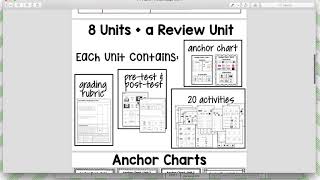
Hi, this is Sasha from The Autism Helper, and this is a product preview of my Functional Literacy Level Daily Curriculum Level 1. So I'm excited to share an in-depth kind of tour of everything that's included. If you've utilized or checked out any of my other Level Daily Curriculum, it's set up in the same setup as those because I just love, love the structure and ease of use. But I'm going to kind of highlight some of the differences between this and the traditional literacy pack and why this is just so important for your kids and they're just gonna love it. So Level 1, the skills that are focused on are included in the curriculum map. There are 2 to 3 focus skills in each unit and then there— here are the details of what's included. So this makes it really easy for your yearly planning. There's 8 units, so if you did one a month, this would last the whole year, but of course you could have this take a little bit longer or quicker depending on the needs of your students. So Level 1 really focuses on basic skills. So this is maybe a student that has some writing skills, tracing, copying, things like that, but it's really that beginning level of literacy. And with this functional literacy series, we're looking at applying language arts-based skills, writing, grammar, language, things like that, to functional text. So text that we see in the community, recipes, labels, maps, ingredients, nutrition facts, things that you and I see and utilize on a daily basis and we probably don't even realize we're reading. We live in such a text-rich environment. So it's applying these reading skills to functional text. The Functional Literacy Series isn't designed for a specific age group. Just because a child is younger doesn't mean they shouldn't be working on functional skills. So it's really just applying these basic literacy skills to those functional community household-based texts. So looking at what skills your student is at and then matching it up with one of the levels within these 3 levels available right here. So level 1 focuses on things like non-identical matching, personal information, calendar, day and month vocabulary, using an anchor chart, text associations, feature, function, class, same and different, prepositions, and then a bunch of different vocabulary sets as well. Each unit includes a grading rubric, a pre and a post-test, an anchor chart, and 20 activities. So that's what each unit includes. So you're getting 8 units plus a review unit, so there's 9 units in total. Here's an example of the anchor charts in Level 1. So you can see some of the skills that we're working on. This is basic. I want these anchor charts utilized all the time because it's really teaching kids how to problem solve when we're teaching them to reference an anchor chart. There's some really cool skills worked on in here. I love the non-identical matching. I love the text associations, so associating that the word date goes with a date, the word size goes with one of these size words. Just some really key kind of associations that will be functional for our kids to learn in the job place, in the household, in the community, etc. And then there's the grading rubrics, rubrics, and these are really the fave— my favorite part of all of the curriculum subjects because this This is where your data-based decision-making is coming. This is where your data is coming that helps you drive your future instructional decisions. I kinda joke that data-based decision-making is a buzzword in education and that it sounds harder than it is, and we all utilize it on a regular basis. And this makes the process even easier. So you're gonna grade the pre-test and the post-test using the same rubric, score how many correct they have out of the total possible. And then this section here below analyzing the errors, tells you specifically what the student needs more work on based on where their errors are. So for example, on Unit 8, if they have a lot of errors on number 1, they still need to work on matching prepositions, and here are some activities for you to do. If they have errors on 2 and 3, they still need to work on money management vocabulary. Here are some activities you can do. So not only are you taking data, but you're taking data that has a purpose to plan future instruction, because if your student hasn't mastered something, that means you need to work on it more. So here's an example of what the pre- and post-test look like. The vocabulary sections in each unit have options for expressive or receptive language practice, so students who are nonverbal are fully capable of utilizing this curriculum as well. And then each unit has 20 different activities. The unit— the activities require, I would say, minimal writing. There is some copying included, some tracing, and some copying from a sample, but it's mostly circling, matching, things like that. So very minimal writing. I'm gonna pop over to the actual resource again. So here's everything included. There's a grading data sheet, unit data sheet, two different lesson plan templates, and then we get into each of the units. So I just want to scroll through some of the activities so you can see everything included and see all of the real-world text. I went through, spent a lot of time taking pictures, making pictures, finding things that I was doing in my own life, what text that I was looking at, and really tried to apply this to these— this series. A lot of research went into this because there's a lot of different ways that we see text in our environment, and I wanted our kids to be exposed to that as well. So things like coupons and caution signs, directions on an ironing board, book covers— there's just such a wide variety that the generalization is really built right in, which can be such a struggle for a lot of our kids. So as you can see, the writing is very minimal. It's some copying activities, a little bit of tracing, but mostly circling, a lot of matching, a lot of that non-identical matching, which is just so, so great for our kids. I love the small, medium, and large section. That's one of my favorites. The vocabulary is very real-world based, fun, functional, things that you'll use a lot, broken, not broken, dates, calendar, etc. I'm going to show a few more pages, the whole thing. So like I said, lasts a whole year, would be— would work really well along with the literacy curriculum if your student was at a Level 1. With the other literacy curriculum, the language arts curriculum, they'll be on Level 1 with this as well, so levels align. Would be a great set to do together. Um, so again, this was a product preview of Functional Literacy Level 1 from theautismhelper.com.