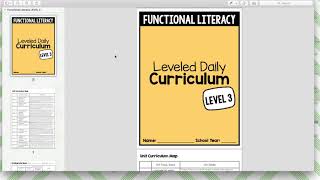
Sasha from theautismhelper.com previews Functional Literacy Level 3, a curriculum with eight thematic units covering WH-questions, inferencing, sequencing, and vocabulary through real-world texts like bus schedules, recipes, and nutrition labels. Each unit includes a rubric, pre- and post-tests, and twenty activities designed for home, school, and community settings.
Chapters
Hi, this is Sasha from theautismhelper.com, and this is a product preview of my Functional Literacy Level Daily Curriculum Level 3. So I'm going to go through the preview as well as the full, um, resource and give you some kind of behind the scenes and show you pictures of everything so you know exactly what skills are included, what level those skills are at, and get all of those questions answered. The Functional Literacy Curriculum looks at applying language arts skills to to functional text. So text that you would see in your house, in your school, in your community, really looks at the generalization piece of all of the language arts skills that we're teaching. Of course, we want our learners and our readers to utilize those skills with books, but we read constantly. We are always reading and responding to texts we see in our environment, and we wanna make sure that our kids can do that as well. These levels are the same levels as the language arts curriculum, so if your learner is at a level 3 in language arts, they'll be at a level 3 here. These resources complement each other really well. A lot of the same skills are worked on but in a different way, and really focusing on that generalization piece, which for our learners really is just so key. So I'm going to jump in and go through the curriculum map, show you the structure. If you use my other curriculum sets, this is structured exactly the same. I love the layout. I love how easy it is for a teacher to follow, to pick up and jump in and have all kind of the bells and whistles ready to go. So Level 3 focuses on more abstract wh- questions and how questions. So looking at those inferencing skills, the when, the why, the how, how to discriminate between those question types, looking at things like sequencing, predicting, compare and contrast, using context clues, and problem solving. The vocabulary is similar to the level 2 vocabulary, but getting more advanced. So it's gonna be a lot of the same overall concepts. Um, in level 2, unit 3 is self-care vocabulary, just as in level 3, but it's different self-care terms. So it'll be nice if you have a multi-level classroom that everyone, when working on unit 3, is working on self-care vocabulary, but the level and complexity of those terms will differ level to level. So it's gonna help keep your class consistent, but really be able to differentiate for kids that need those higher level skills. So the curriculum map outlines the main focus concepts and then details exactly what's included. There's 8 different units. So if you did 1 unit a month, this would last the whole year. And then there's a 9th review unit. Each unit has a grading rubric, a pre and post-test, an anchor chart, and then 20 activities. Here's an example of the anchor charts for this level. Again, there's minimal visuals really in this unit 'cause we're really focusing on a lot of text-based skills. The vocabulary component, we're really applying these definitions to text later. So I want this to be a resource that kids can come to to remind themselves. We're using these anchor charts as problem-solving tools and as, as like a mini Google. If we don't know what this word means, let's go look at our anchor chart to remind ourselves. There's a grading rubric for every unit. You use this when scoring the pre and post-test. This will help you show progress in a numerical way, but the best part of this is it's not just taking data. You're taking data to plan future instruction. After you take that post-test and you still have some errors, the rubric is going to tell you specifically what that student needs to work on based on which questions they get wrong. So it's taking the guesswork out and it's really outlining, okay, if you got level, you know, a lot of errors in number 2, that means that this skill is not mastered and this is what you need to do next. So your data-based instruction is built right in. Here is an example of the pre and post test and then the 20 activities. So let's go through the actual resource to see some of the activities, the skill level, and the different types of texts included. So there's a bunch of lesson plans and data sheets included at the front, and then we're into the units. Um, so I made sure in all of these levels to include a huge variety of text. I spent a long time observing my own behavior, taking pictures, creating images, and making sure that I really have this wide range of types of text that students were utilizing these language arts skills with. So things like bus schedules and hours, um, and recipes and signs and address labels and calendars— there's just such a wide range of different skills. And this level 3 really gets to that inferential more abstract skill level, which is really great for those learners. A lot more writing involved, especially as we get later into the units with some of the different skills that we're working on, and the vocabulary gets a little bit more complex. So here's just some examples of some of the texts included: things like user manuals, things like schedules, nutrition facts, all kinds of things like that, things that students are going to see in their house, in their school, in their community is all included within this. So like I said, it would work really well with the language arts curriculum because it's going to give you that generalization piece really well. Um, so all the examples— we get a lot of writing towards the end of the units because some of those skills that we're working on describing with detail really target that description piece, the sequencing, the context clues. Um, there's just so many great activities that I really love. Some great text excerpts to read and look at comprehension, and it builds in difficulty as we go through. There are some review activities within each unit, so Level 8 will— you know, Unit 8 includes previous tasks, so we're always working on that maintenance piece. So again, this was a product preview of my functional literacy curriculum Level 3 from theautismhelper.com.