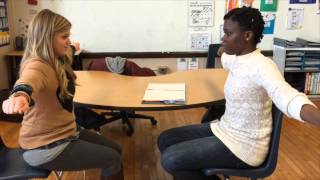
In this tutorial, Sasha from theautismhelper.com and ABA expert Kamisha demonstrate the Gross Motor Fluency Instruction Program, a brief, data‑driven intervention designed for students—especially lower‑functioning learners with autism—who need to develop foundational gross‑motor imitation skills. The video explains why rapid imitation is essential for functional communication, outlines the program’s structure (10‑second timed trials, typically repeated 2‑3 times per session), and shows how to use a simple clicker to record the number of correct responses without manual counting. A data sheet is introduced for scoring the best trial of the day. The presenters discuss handling incorrect responses by remaining silent, providing reinforcement only after the trial, and moving quickly to the next task to maintain attention. Practical tips for aides and teachers, such as keeping sessions short, using multiple opportunities, and focusing on attention to the adult, are highlighted. The tutorial emphasizes that the program is easy to run, efficient, and effective for building attention and imitation speed before moving on to more academic curricula.
Chapters
Hi, this is Sasha from theautismhelper.com, and today I'm here with Kamisha, one of our ABA experts, to show you our Gross Motor Fluency Instruction Program, which is a mouthful, but it's a great program to run. Um, types of students that you'll want to be running this are students that really need to focus on those foundational basic skills. Maybe they're struggling to attend and you're really trying to teach those desk time behaviors so you can start to teach more academic programs. So you want to make sure that your student already can imitate. So what is imitation? Imitation's when you're telling a student, "Do this," and they do it back. So that's something you wanna teach first. You wanna give great reinforcers every time they do it and really teach that skill in a structured way. So once your kid can imitate, the next thing you wanna teach is them to imitate quickly because imitation is only functional if it's done right away. We don't want our child to say to a child, "Hey, do this," everyone's sitting and they sit 10 seconds later. That's not really functional. Think about a fire drill. When everyone leaves the room, you can't wait a minute, you gotta leave right away. So it's really, really important to make sure this skill is quick. So today we're gonna show how to do it in effluency timing. This is a great, great program for an aide to run, for a teacher to run. It runs really quickly. This is also great for some of our lower functioning learners to really build those foundational skills, like I said. So Kamisha's gonna show it, I'm gonna be the student, she's gonna be the teacher, and we're gonna go over a few tricks on how to make this run really efficiently. Good job! Thanks! Um, so I don't know if you noticed what was in Kamisha's hands, but she had this really great clicker. You can buy these on Amazon for a few bucks. They're used a lot of times by bouncers outside of bars or runners, things like that. I've talked about these a few times on my website, but they're really easy because she can quickly count how many I did. So she counted that I did 6 in 10 seconds, and it didn't distract her from having to write down data, having to count in her head. There's a lot going on for this program. You have to think about what movement you're doing next. You have to make sure the student's doing it. So an easy way to keep track is using that clicker. So I really, really recommend that. So we only did a 10-second timing. Typically with kids, I like to do 15 or 20, but just to show you runs really straightforward. Let's take a quick, uh, view at our data sheet. So I really like to run this program multiple times because you're going to give kids multiple opportunities. If they have one bad session, they can try again, and then you can just score the best one of the day. And it only takes 15 seconds, so even running it 3 times is only going to take you a minute, so it'll go pretty quickly. Um, like I said, I think this is great for kids that are teaching that attention behavior because now they have all of their attention on another adult for 15 seconds, which for some kids Kids with autism can be really hard to focus their attention on an adult. Let's show a few kind of tricks on what to do when they don't do the task because you're gonna have those kids where you're gonna be— do this and they just sit there. So we're gonna not want to slow them down and want to jump to the next one. So we'll do another trial and I'll get one wrong so you can see what that looks like. I do that all the time, Joey. So you can see she gave me a few seconds to respond, to respond, and then she moved on to the next one. So you really— it's hard for us teachers to keep our mouths shut, not be like, "Do it! Come on!" But this is not the time to do that. You're only giving reinforcement at the end of the session. You're totally silent during this and just give them a few seconds to respond and move on to the next one. And we'll count that one as an incorrect. You typically aren't going to be seeing a lot of incorrects because we know they can do this skill. It's just as much— we're just looking at how fast they're doing it. So you can just keep track of the incorrects in your head. So this is a video tutorial of gross motor imitation, a great task to work on with some of your lower learners, and that can be easily run by an aide. Check out more info on theautismhelper.com.