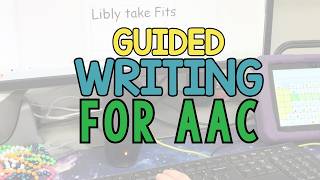
Special education teacher Winnie White demonstrates guided writing with non-speaking students who use AAC devices. She works through a real example with her daughter, building a short story while teaching phonics, capitalization, and typing. Guided writing reduces overwhelm, builds confidence, and gives these learners a voice.
Chapters
Have you ever taught a student who is non-speaking and who has fine motor impairment how to write their own stories? Well, it could be quite a challenge for the student and the teacher. My name is Winnie White, and I am a special education teacher in a self-contained classroom in elementary school, and I want to talk to you a little bit about guided writing. Guided writing is especially important for individuals with intellectual and developmental disabilities because writing is not just an academic skill. It's a voice. Many individuals with IDD have strong thoughts, experiences, and ideas, but they need structured support to express them. So guided writing provides that support through modeling, prompts, visuals, that one-on-one scaffolding that reduces overwhelm and it builds this confidence. So when, when we guide writing, we break the process into manageable steps, we honor different communication styles, we allow students to succeed at their own pace, This approach strengthens that language development, executive functioning, and self-advocacy skills. But most importantly, guided writing communicates to individuals with disabilities that their words matter. With the right guidance, writing becomes a tool for independence, connection, and dignity, not frustration. So, you want to write about the library today? Okay, so which picture here? I can click on Creative Commons, take that off, and that opens up more pictures. What picture would you like to use to write about the library? All right, so I went in and typed in children's library, and now she gets to choose which picture she wants. So click the picture that you want. That's the one. All right, we'll click it and then we'll insert it. Okay, click the insert button. Let's move your hand right this way on top of the green. Insert. Excellent. All right, so you chose a picture of the library. What would you like to say about the library? Mm-hmm. It's important to give wait time. Dog. Oh, you want to take a dog to the library? Is that what you want to talk about? Yes or no? Is that what you wanted to write about? Dog. Okay, well, let's add a dog to our library story. We have online. We can go to dog, and I'll click that so you get more options. Which dog do you want to take to the library? You're going to take them to the library? All right, we'll click on them and we'll add them to our library. Click that insert button. You got it. Awesome. Library. Okay, so what's going to happen in the library? What do you do? Who are you taking? Take. Uh-huh. So you're going to take who to the library? It looks like you got some cute little dogs. Uh-huh. Who are you going to take to the library? Are you going to take a dog or you going to take Fitz? Fitz. Library take Fitz. Okay, well let's write it, girl. Library take Fitz. Fitz. I love that. Her dog is actually Fitz, so she wanted to write about her dog. You said, "Library, take Fitz." So now you're going to type your story. Library. What do you hear in that word? Library. There's 3 syllables. Li— Library. Brrr. Remember what says brrr? Do you hear another sound in library? Library. Library. Now at the end of the word, a Y, the letter Y, can say that E sound. Library. All right, so you're going to use a space. When you use a space with the computer at the beginning, it will turn your first letter into a capital. I love that. Now you said library. Take. Take. What are you hearing in that word take? What does it start with? Oh, a T. Very good. Now let's listen to that vowel. /t/ /a/ /k/. Take. Very good. Now remember, we talked about how you have to add a magic letter at the end end of the word take in order to make this a long A? What is that magic letter that you have to add at the end of a word? Yes, that E, that magic E. So library, take. Now what do we put at the end after each word? You have to do a space. Excellent. Library, take, Fitz. Now what does Fitz's name start with? We need us a capital letter because we always use capitals in somebody's name. So you hold the Shift button down and then you type with the other hand. That's right. So get your other hand and type F, F, Fitz. That's right, F, F, Fitz. Now you know that word, it. How do you spell it? It Fitz. And what's at the end of his name? "fits." What do you think it is? "Fits." You think it's an S? Ah, sometimes it does sound like an S. You're right. Now what do you put at the end of your sentence when you're done? Oh, that looks like a comma. Can you backspace? I think you made a mistake. That's all right if you make mistakes. What do you put at the end of your sentence when you're finished? A period. So let's go back and read it one more time. You touch those words and I'll read it. Library Take Fitz. Oh, I love that story. So I think it's important to mention that Sandy Kay is not only in my classroom, but she's also my own personal daughter. So being able to write is very, um, serious to me, and I really want to see her be able to write her thoughts, to use her AAC device to communicate those thoughts. If it's not in her device, I want her to be able to write freely. So this is something that we spend time on daily, and it has taken us this long to get to this spot. She is now in the 4th grade. This is a very slow process. So if you have a student who is in kindergarten, start with that independent writing. Allow them to express their writing, whether it's through using letters or magnetic letters or scribbling or typing, whatever it may be. Allow them that time for independent writing, and then also include this guided writing piece as well so that they can see how all the things that you are teaching, phonics and language arts, how it all fits together to get their thoughts across. I encourage you to check out more videos right here in the Autism Helper channel and learn more about helping meet the needs of our AAC users.