In this instructional video, the presenter outlines a practical approach for special‑education teachers—particularly those working with students on the autism spectrum—to help learners move their focus from a digital display (board, iPad, Smartboard) to a corresponding physical item. The core method relies on using paired digital and printable resources, such as spring‑file‑folder worksheets from The Autism Helper. The teacher first models the task (I‑do) by asking whether the digital and printed images are the same or different, narrates observations, and then guides students through guided practice (we‑do) before allowing independent work (you‑do). The presenter demonstrates flexible grouping options (one‑on‑one, small‑group of three, whole‑class) and emphasizes scaffolding, repeated practice, and checking for understanding. The overall message is that printable, tactile materials can effectively translate board‑based skills into hands‑on learning for autistic learners.
Chapters
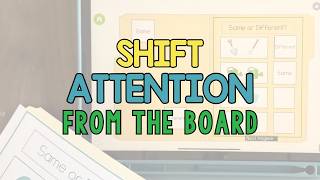
Let's talk about helping students move their attention from the board to an actual physical item. Now, this can be tricky, right? This is one of those skills that students in general education use all the time. We have students look at the board, pay attention to something their teacher is doing, then they look down at their own work and they complete a piece of their own work. Well, we can model that in the special education classroom and teach that And one of my favorite ways to do that is by pulling a resource that offers digital versions and printable versions. I make the printable version for the student. Now, this is a file folder. You wouldn't have to use a file folder. You could use anything that had both opportunities, right? Then I would pull up the digital version on my whiteboard or an iPad, a Smartboard, anything you need. And then I would have this physical item with the student. Now you could have one for each student if you had a small group. Let's say you had a group of 3, you could print this 3 times. You could do it in black and white, totally fine. You could make this worksheet. File folders don't have to be in a file folder, or you could do it one-on-one with a student. You could do it whole group if you needed to, to practice. But we're going to practice moving from the board to the physical item. So the first thing I would do is find the name of it, same or different, and then I would pull that up. Um, these are our spring file folders and they are so cute. I love them. So we have opportunities here for the learner to identify, is it the same or is it different? And the physical item matches exactly. So the first thing I would do would be model, right? Like, I would do the I do piece of gradual release of responsibility. So I would provide a model. Is this the same? Hmm, let's think about it. What do we notice? Talk through it, right? Then we can identify it's different. Now I would have the learners, you look at your page, you find different, and you put it down. Great. Model, practice, do it again. Let's model and practice. Then I would have the learner come back and do it. On theirs. Now I can support the learner however they need within this opportunity. Then I am going to allow them to do it, right? Then we're going to do the we do piece, right? Because I modeled, now they're going to do it. All right, let's have you try. Hmm, are these the same or are they different? Allow students to look, allow students to practice. Then after I've identified what they wrote down Maybe a student said same. Ooh, what do we think? Do we think it's same or different? Well, this one is yellow and this one is blue. They look the same, but they're actually different, right? So now I've provided that scaffolding for students. Let's do it again. Let's give the learners another opportunity. So here it's going to be, hmm, you tell me, what do you think it is? They identify, I wait for the learner to be done, then we come back and talk about it. Ooh, I notice a red flower and a red flower. They have the same number of leaves. They look like they're the same. Great. Now I'm gonna choose that next page. Now I'm going to give learners the opportunity to do more than one on their own. And then as a group, we're gonna go back and we're gonna check our answers. This is one way you can really build learners moving between the board and a physical item, but do it and meet them exactly where they are. This can be done in a variety of skills using anything that has a digital and a physical component. It's one of the reasons that we love printed materials so much here at the Autism Helper, because it really does help translate those skills.