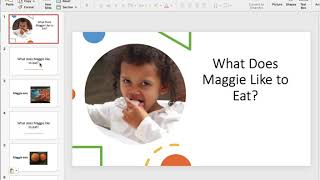
In this instructional video, Gina from The Autism Helper demonstrates how to create a simple, low‑resource homemade repetitive book to support expressive language and everyday skill development for young children, especially those on the autism spectrum. She explains the concept of a repetitive question‑answer book (e.g., “What does Maggie like to eat?”) and walks through building one using PowerPoint, stock images, or household items such as food packaging labels. Gina shows step‑by‑step copying, pasting, and resizing of pictures, and offers alternatives for families without printing capabilities, like cutting out labels and pasting them into a notebook. The tutorial also covers how to use the book during reading sessions: pausing for the child to attempt the word, providing phonemic prompts, and delivering positive reinforcement. She emphasizes that the approach can be adapted to any content area—foods, clothing, family members, toys—allowing families and educators to personalize the material. The overall goal is to give families a practical, affordable tool to increase language exposure and encourage verbal attempts in a supportive, repeatable format.
Chapters
Hi everyone, this is Gina from The Autism Helper. I wanted to show you a really cool way to make a homemade book with your families or for your families or even when you get back into school. I'm all about using what parents and families have at home right now to increase language and work on everyday skills. I got this idea from the Activity Kit for Babies and Toddlers at Risk and of course you can use it for children that are you know, age-appropriate as well, or working on foods or clothing. The book suggested making one of these easy books. I just thought it would be a neat way to see in PowerPoint. You can make it for the family, or you could have them make one at home, and you can coach them through how they can make one at home with just their supplies. So really, you're using the repetitive language approach to inspire some expressive language and to help children start learning the names of maybe their favorite foods. So I made this with the things that I have in my house. I found this adorable little girl on Google Images, and the title of the book is "What Does Maggie Like to Eat?" And of course you would replace Maggie with your student's name or the child's name, and you would take pictures of, you know, they could be stock images online. You could have the parent tell you some of the things that the child likes to eat Or maybe they could send you photos. It doesn't have to be difficult. You just have a repeating style book. So "What does Maggie like to eat?" is your cover, and then the question repeats inside so that when the parent reads the story to the child, on one side of the page it'll have the question and on the other page it'll have the answer. So "What does Maggie like to eat?" "Maggie eats carrots." And then you keep going. "What does Maggie like to eat?" "Maggie eats oranges." Then you keep repeating. This is very easy to make. I just copied and pasted the pages. So copy, go down here, I'll paste. I'll take out the oranges and you just insert a picture. So I have some right on my desktop. File. And you can just drag them over. Let's see, oh, Pop-Tarts! Maggie eats Pop-Tarts. Okay, resize. And say you're making this at home with a parent. Maybe you can't print it out or the child won't attend to like a screen reading of it. You can have them actually, you know, take off parts of the box that the food comes in that the child knows, you know, where the food comes in. So maybe they could cut out the Pop-Tart label and, and paste it on a construction paper or piece of paper or whatever they have. Or maybe they have an old notebook that they could paste things into. So it doesn't have to be picture and print it and all that because I know not all of our families have that. And I don't either right now, so that's why I'm using PowerPoint. I would read it off of here. And then, so once your child gets familiar with this book, you would try pausing at various points to see if they fill in some of the words. So you could prompt with like the first sound of the word while you point to the picture, and even if they don't try, you can fill it in for them, but if they do, then you can give them that positive reinforcement feedback about it. So for example, if you say, "What does Maggie eat?" Maggie eats— say you're on this one— Maggie eats, and you pause and you wait. Maybe you're pointing to the picture. —and you say "C-C-K! Maggie eats C-C-K!" And maybe the child says "car" or "carrots," or something like it, or they attempted to attempt it, or they say carrots and you say, "Yes! That's right! Maggie eats carrots." So you're demonstrating the way to say the word but more importantly you're going to reinforce that enthusiasm for attempting to say the word. You can do this book with all different kinds of things if your child is interested in books. You could do it with clothing, family members... Toys, all kinds of things. So, very simple way to create your own book with your families and send home, or teach them how to do it in their home.