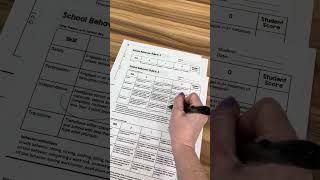
A teacher uses behavior rubrics to track four dimensions—safety, participation, independence, and transition—by circling estimated levels for each student throughout the day. The ratings feed into a data sheet with built-in graphs so you can watch progress over time, especially useful when you're stretched thin.
Chapters
Let's talk about what a game changer rubrics can be for taking data on negative behaviors. So these are great if you have a big class, if you are understaffed, if you don't have a ton of time to take data. Rubrics are a great way to really summarize what's happening throughout the school day. So you can use this as a way to really track progress over time. Each one of these kind of gets a little bit more in-depth and detailed. This one looks at safety, participation, independence, and transition. Throughout the day, you'll basically kind of circle where we think the student is at with each of these. Again, it's an estimation, but it has— we have defined kind of what unsafe behavior means, on and off task. We're looking at getting as detailed as we can with the prompt level, but this is something you can easily do within the school day. Look at roughly how much help students need, and then what's really cool is you want to transfer this all to a data sheet. I absolutely love this data sheet because there's this little graphing component on the bottom, so we're able to kind of track the scores over time and then see that progress being made.