How the VB-MAPP Helps Teachers Plan Instruction
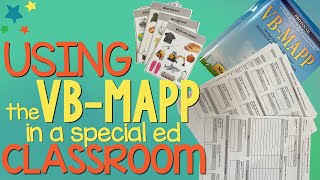
Sasha Long, a behavior analyst and former special education teacher, walks through using the VB-MAPP assessment to plan instruction for students with communication delays. She covers the two core books, how to score and identify missing skills, practical prep steps like gathering parent questionnaires, and how to turn assessment results into individualized goals using task analysis.
Chapters
Let's talk about the VB-MAPP. The VB-MAPP is an amazing tool that is used as an assessment and curriculum planning guide. This is going to help you plan your goals and your programs. This is perfect for students with significant communication delays or that are really struggling to communicate in your classroom. If you are an early childhood, preschool, any type of teacher that is working with kids with special needs, or if you are an SLP or BCBA, you definitely need this in your life. So the VB-MAPP stands for the Verbal Behavior Milestones Assessment and Placement Program. What I love about the VB-MAPP is it is so in-depth. It's going to teach you all about the different types of communication skills that your learner needs, and it's going to help you assess whether they have those skills or not. Once you do the assessment, then it's going to show you what to do. What skills do you need to work on in your classroom? I am Sasha Long. I'm a former special education teacher and board-certified behavior analyst, and I love sharing tools like this that can really make an actionable difference in your classroom and help you streamline your planning and your instruction. In this video, I'm going to give you an overview of what's in the VB-MAPP as well as some tips on how to use it. So let's take a peek into the VB-MAPP books. There are two books: the main guide and then the protocol. The protocol is going to have the detailed description of the skills you're working on as well as the task analysis, skills tracking chart, and the milestone skills tracking chart. I'll go over those in a minute. First, let's talk about the guide. What I love about the VB-MAPP is that it thoroughly explains how to give this assessment. Some of the language in here is ABA-based and a little bit technical, but it defines everything, so you're really going to know exactly what you're doing. It is going to teach you how to fill out the Milestone Master Scoring Form. This is going to be in the protocol book, and this is going to show you exactly what skills your student has. So this sample form that's filled in, everything yellow is a skill that they have. There are 3 levels within the VB-MAPP, and as you'll see, there's additional skills that go on to each level. So level 1, we have MANS, TACS, listener responding, verbal, visual perception, play, social skills, imitation, echoic, and vocal. So there's some additional skills and some different skill areas that we remove or add in based on the levels. So as we can see, this student has a lot of level 1 skills and they're starting to get some great level 2 skills. Everything yellow is a skill that they have, and now we know where to work. That's what I love about this. It's gonna show exactly what skills we have to work on. I would probably want to work on mand 3, and I'd want to work on these social skills right in here. I know exactly where to focus my instruction. So within this first book, we have detailed instruction of the different skills. There's the objectives, the materials, everything you need to do to know how you— that all the information that you need to know how to give this skill. So here, for example, for listener responding, follows the 3-step direction for 10 directions. Here's why this skill is important. Here's the materials you need. Here's some examples. And here's how you score 1 point or a half point. Super clear-cut. And as you go through these, for me, when I started using tools like the VP Map, It gave me some great ideas of skills to work on. I hadn't maybe worked on 3-step directions before. Oh, that's a great thing, I should try that. It's going to give you a lot of skills that maybe you hadn't thought about testing. Now let's peek into the protocol book. You can have one protocol book for each student or copy the main assessment page. So here's that Milestone Master Scoring Form that we just showed before with that sample, and then in here we have all of the skills included for each level. So this makes it a lot easier to give the assessment. Yes, we have all those great details in the guidebook, but here's quick and easy. Does the child engage in independent play? And then here's our skills right under there. So it's all of the 5 skills for each level, um, for each area of the VB-MAPP. A hidden gem in this protocol book is the task analysis section in the back. This is going to really help you with your instructional planning. So it takes each big skill and then breaks it down into all of the sub-skills. So for example, 6M is matches identical objects or pictures in a messy array of 6. And then look at all of these subskills. So if that's something you're working on with your learner, your learner needs to work on matching identical objects, you have all these subskills you can work on. Can they work on turning pages in a book? Can they work on puzzles? Can they work on stacking blocks? All of these skills will build to this big skill. If you're like, how do I teach this? Guess what? It's right here. Now that we had a peek inside the VB-MAPP, let's talk about some tips for giving this assessment because that might feel overwhelming. The first thing you should do is prepare. If you sit down unfamiliar with the VB-MAPP with a learner across from you and you're like, okay, let's get started, that's not gonna go well, right? So read through the protocol, read through the guide, get familiar with this. Then I want you to start to fill in some of the assessment before you sit down with your learner. So on our milestone tracking form that we showed a few minutes ago, go through these skills and read them. Go in here and be like, all right, let's think about Johnny. Can Johnny imitate the actions of other people? Read that objective thoroughly in the guide. And if there are skills that you know he can already do, fill it in. If you saw him do that yesterday, you're like, oh my gosh, yeah, yesterday we were in gym and we were doing jumping jacks and he copied that action. Go ahead and fill that in. You don't have to test that. If you test every single little thing, this will take forever and then will not be super useful to you. I want you to get this going and get your valuable information for instructional planning. So go ahead and fill in ahead of time what things that you know he can do. Another tool you can do to prepare and get this kind of really efficient and get it going as quickly as possible is with the skills that you're not sure about that you haven't reliably seen, make a list and make a list of things that maybe you want to talk with a parent or caregiver about. Or if they have a one-on-one paraprofessional or paraprofessional who works really closely with them, ask them. Be like, hey, you know what, I'm pretty sure that Johnny verbally responds to the content of words and words of other people. I'm pretty sure he does that, and he can complete fill-in-the-blank phrases. I think he can do that. What about you? What do you think? Get other people's opinion. That's a really great tool that I love to do. I actually set up a whole parent questionnaire because I like doing that so much. That's just like a simple yes/no. Can your child independently play with 5 or more different toys? Does your child independently engage in movement play like running, climbing, dancing? Yes or no. And then I wrote in all of the BB Map skills. So if I had a parent or caregiver fill this out, then I could be like, okay, they said that they definitely use 5 or more toys. That's play, 2M. So I'm gonna go into my book and I'm gonna fill in play to M because mom and dad said he reliably does that. So that's a great way to get your assessment up and rolling is filling in those things ahead of time. Now for the things that you don't know yet, you're like, oh, actually, can he follow 3-step commands? I'm not sure. Make a list of what you're gonna test. Get prepared. I have different data sheets that I've made to have myself be really prepared so I know exactly what things I need to look for. And I've also separated them out into observation versus testing data sheets. Because when you peek into the VB-MAPP, and you might have noticed this when we were looking at it, there is this little code in the top that says direct testing, observation, and either. There are some things that you're going to have to sit down at a table and practice, especially things for feature-function class. You might need some contrived resources or flashcards where there's other things that you're going to want to just observe. Especially this one, classroom routines and group skills. Can they sit at a group or lunch table without negative behaviors for 3 minutes? That's something you have to observe, right? You can't just sit down and just be like, okay, sit here for 3 minutes with no, you know, negative behaviors. You want to get a real score on this and really know if this is an issue. So that's why I like pulling everything that's like an observation skill and having it on one page. You could easily make your own of this, even on a dry erase board or a Post-it note. Write down the skills you're looking for, and that next morning at go down and write down which one, which of those skills are ready and which ones are not. That'll be a great way for you to focus up what you need to know and then fill that into the milestone assessment form later. Now for the skills that you have to test, if you want to really level up, I like to get everything organized according to the VB-MAPP skills. So you sit down, you know exactly what you have to work on and what skills. So having it all ready to go so when the learner's sitting across from you, you are there, is key. So So here we have visual perceptual skills and matching a sample, um, task 6. And right here, this is a matching skill. So I have already all of the, the pieces ready to go. We can work on matching. If we get to something more advanced here, we're at sort by color. I can sit down, pull this. Let's— hey, let's sort by color and test those skills right away. Because sometimes it's very particular in the VB-MAPP about what the field size is. For example, this field size is bigger than that one we just how many pieces there should be. There's things like non-identical matching that you have to really— might have to create some resources from or find some resources for, but having these ready to go so you can sit down and hand the student the pieces and be like, okay, let's find the match, and go through and find the matching pieces for each one. So, okay, we're gonna match the non-identical car to the non-identical car. We're gonna match the non-identical truck to to the non-identical truck. These pieces were mixed up because we were doing them all as one big activity before. So that non-identical match, we want those, those pieces all ready to go, those activities ready to go, so when the learner is ready to work, we are ready to assess. All right, now that you've done the VB-MAPP assessment and you have all this great assessment information, what do you do next? So you filled out your milestone form and you have a clear idea of what skills they have, and now you know what skills you need to work on. When I'm now planning goals— and there's a lot of details in here on how to plan goals, definitely check that out— when I'm planning the goals, I go to this book and I also go to the protocol because, as I said before, this task analysis section is just a gold mine— I mean, or a gold mine, right? So many things that we can work on. Oh my gosh, it takes that big skill and it breaks it down into all of these little skills. So if I knew that my student needed to work on 2-component noun-verb instructions. It gives me all of the sub-skills that they need to work on. Super key. I now know exactly what I have to work on to build up this skill for him. I love doing this through task cards. I think task cards are pretty low prep. You laminate, you cut them out, and they're easy to use. You can use them for group instruction, you can use them for independent work, you can use them for all kinds of things. So I love task cards, and we created a ton of task cards for these sub-skills. So for all of the little skills related to, let's say, 6M—this is listener responding with feature function class—the big skill of 6M, we also need them for all the sub-skills so we can really hone in on those skills we have to work on. And there are so many cool skills included, like this one for listener responding feature function class 6B is select an item given a sound it makes. I would have never thought to work on that, especially with students with limited language that you've had for many years in your classroom. Sometimes it's hard to figure out what to do next. So having these all ready to go, like drip drip goes the, snip snip goes the, click click goes the— having all the exemplars ready, this is a great way to build that receptive language, builds that feature function class skill, and we know now we're building up to that bigger skill. I love storing task cards in these photo bins. These photo bins are great for so many different skills, but types of activities, but having it all ready to go and labeled again. Now you can put this in their IP bin their independent work, give it to a para. I'll show you one more. This one is selecting from an array of 5 to complete associations. So, and we're gonna work on it in both ways. Paint and, and you have to find the paintbrush, and then paintbrush and paint. So we're finding those associations in reverse orders. And again, all those exemplars, they're ready to go. I hope you enjoyed this overview and intro of the VB-MAPP. If you are looking for VB-MAPP-aligned resources like some of the things I showed today, head over to our shop. The link's in the caption. And if you are looking for more ideas for instruction for your classroom and curriculum planning, follow us on YouTube for more videos.










