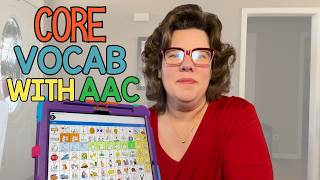
Special education teacher Winnie White shows how to build a hygiene unit around core vocabulary for non-speaking AAC users. Core words like go, stop, help, and want are high-frequency and flexible, supporting real communication and language growth. Adults must model these words on the device consistently, even before students use them, to build muscle memory and longer sentences.
Chapters
Whatever you may be getting ready to teach, I want to challenge you to develop that unit around core vocabulary. My name is Winnie White, and I teach in an elementary self-contained classroom for students ages 8 to 10. So come with me as I get my hygiene unit ready and how I include core vocabulary in those lessons, especially for students who are non-speaking and use AAC devices. So when we think about communication, it's It's easy to focus on naming things, food, toys, colors, places. Those are called fringe words. They're helpful, but they're limited. Core vocabulary is different. Core words are the small set of words that we all use every day across all situations. Words like go, stop, help, want, more, like, finished. And here's why that matters. Our AAC users don't just need a way to label objects. They need a way to express their thoughts, their feelings, their needs, their opinions, and their boundaries. Core words give them that power. With just a few core words, a student can say, "I want more," or "Not that," or "Help me," "Let's go outside," "My turn," or "I'm finished." That's real communication, not just requesting snacks. Another reason core vocabulary is so important is motor planning. On most AA systems, core words stay in the same place on the screen, and that consistency allows students to build muscle memory. Just like we don't have to look at the keyboard when we start to type common words, AAC users learn where their words live, and that reduces frustration and increases independence. Core vocabulary also supports language development, not just communication. These words are flexible. One word like go can mean go outside, go fast, go home, go again, or even go away. That flexibility helps students combine words, grow sentence lengths, and even move past single message communication. But here's the part that really matters. Core words only work if we model them. AAC is not intuitive. Students learn AAC the same way Speaking students learn spoken language by hearing it used around them. That means we as adults must use the AAC device while we talk. We don't need to model every single word, just a few core words like go or stop or help. And it's okay if the student doesn't use the word right away. Modeling is still teaching. Exposure is still learning. And when we prioritize core vocabulary, we're doing more than teaching words. We're giving students a voice that works everywhere in the classroom, at home, in the community, and across their lifetime. Core words don't limit communication, they actually unlock it, and every student deserves that access.
Okay, let's match the laundry room activities. We're going to sequence this first. As you can see, I have some dirty clothes. You always start with those dirty clothes. They happen every single day. Then you put the dirty clothes into the washing machine. That's the second thing that we do. The third thing you have to do is to put in the detergent. The fourth thing that you do is you close the door. You set the washing machine to wash for a certain amount of time. You can say whether it's a light load or a heavy load, or you might even need a gentle option. Then when it's finished, you can take the clothes out. That's the fifth thing in our sequence. And then the last thing you're going to do is you are going to— you— some people will dry their clothes in a dryer, and some people will hang their clothes up. On a clothesline, and that would be the last thing to do. You're going to dry it. All right, you ready to sequence it? All right, are you ready? We're going to match the laundry room activities. The first thing we're looking for is we are looking for dirty clothes.
Can you find the dirty clothes and match the dirty clothes?
Excellent.
Excellent.
The next thing, the next thing we want to do is we want to put, put in. That's right. Good job. The next thing, next, we want to do is we want to put, put in, in the detergent. Can you find that picture? Put, in the detergent. Excellent. Now we are going to turn, turn on, on, turn on, turn on the washing machine. Can you find it? Ooh, yes, that was fast. The next thing we want to do is to take, take out Out. Can you find take out the laundry? Put it in the square. No thanks. Excellent. Now the last thing is we want to— yes, go ahead. We want to dry the laundry. Now I don't know where dry is, so can—
let's look for the word dry.
We're going to do our word finder. Dry. Oh, there it is. Can you find it? Can you find the word dry? This is Mexico. Keep going. Let's try again. Try again. Try again. Try. Awesome!
Check out the links below to access the hygiene kit, either to print it or to use it digitally. There are so many more training videos right here on the Autism Helper channel about how to meet the needs of our AAC students.