In this instructional video, a special‑education teacher explains how to teach the WH question “why” to K‑12 self‑contained learners with autism, a skill she finds especially abstract. She showcases a suite of resources from The Autism Helper, including adaptive books (e.g., “Why Do You Use…”, “Why Did They Go?”, “Why Are They Similar?”) and two sets of task cards (real‑photo and age‑appropriate clip‑art). For each resource she provides concrete examples (e.g., “Why do you use a duster?”) and discusses how the materials can be used for life‑skill instruction and across primary to elementary ages. The teacher also outlines practical scaffolding strategies for adjusting difficulty: reducing field‑choice options, removing visual stimuli, and employing errorless learning. She emphasizes that focusing on the adaptive books and task cards is sufficient to solidify why‑question answering for her students.
Chapters
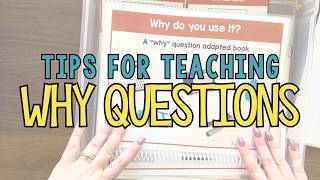
Teaching WH questions, specifically why questions, doesn't have to be tricky. Let me show you this why question set from The Autism Helper. When I was in the classroom, I taught K-12 self-contained autism. I often inherited goals for students based on answering WH questions, and the hardest WH question in my opinion is why. It's just not super concrete. It's really tricky. And so the Autism Helper has made some resources that I think really help solidify why questions and make it more concrete for learners who are starting to understand why. So the first one comes with this adaptive book, um, so I'm just going to answer why I use items, you know, why do you use a duster, or Why do I use a toilet brush? These are very simple. I love the real photos. These can be used for life skills kiddos. They can be used for primary or elementary because they're real photos. They really transcend age groups. The next one is Why Did They Go? This one is trickier, so you've got to have some reading comprehension or listening comprehension depending on how you use the book, but we are going to read or listen to a statement or a sentence and then we are going to answer a why question. We can very simply use these pictures from A Field of Three. If I want to make it harder, I wouldn't give any pictures as an option. If I wanted to make it easier, I would reduce the field choice. I could even make it errorless if I needed to. So just some ideas, um, for scaling this up, scaling this down. You know, really, these are so Great, and again, perfect for real-world scenarios. Next, I have Why Are They Similar? This one does have some clip art, but it's really age-appropriate clip art. You know, why are these items similar? What do they have that makes them similar? Because they all, you know, have wheels. All right, great. You know, why are a suitcase, a jackpack, and a backpack similar? You know, what do they do? Oh wait, they all have zippers. You know, these really make you think, and so this one is going to be definitely tricky. Again, I could reduce the stimuli. I could give no stimuli and have students come up with their own, whatever that looks like for your students. Now, I love some task cards, so there are 2 sets of task cards that come with this set. The first one is going to be real photo So, you know, why do you use a key? And then it's going to give you 3 choices, and there are so many, so many. And so that's kind of the real photo option. Again, you know, just really simple, beautiful photos, 3 options, easy to be able to put in a center or just do with students and get some quick data. The next one is going to use clipart, but Again, very, very age-appropriate. You know, why do you go to the grocery store? Why do you wear a winter hat? You know, why do you use a toothbrush? So I'm giving a prompt here. Again, look how many there are. Additionally, there are work tasks. I don't have those prepped yet, but there are a bunch of work tasks. And so some great pieces here. But for right now, for my learners What I'm really going to focus on are the task cards and the adaptive books, and I'm telling you, this is going to be enough to really help solidify those why questions.