Learn how to teach Level 0.5 of The Autism Helper Curriculum using anchor charts with six vocabulary terms in different orders, plus receptive and expressive language activities. Track data on prompt levels, matching accuracy, and correct responses across 12 trials per day to monitor student progress.
Chapters
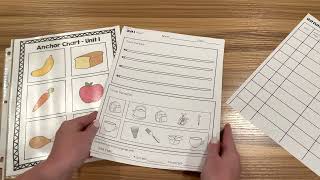
Okay, let's go over how to utilize the anchor charts in Level 0.5. Level 0.5 is set up a little different. There are anchor charts that look like this, and there are actually 5 for each unit. And I recommend storing them in a page protector like this for a reason. So we have 5 of these anchor charts and they have the same 6 vocabulary concepts, but they are mixed up because if we have the same order, then we're going to memorize the order. So they're in a different order. So I recommend putting them in a page protector so you can switch up which one you are using each day. So these are gonna be the 6 vocabulary words that you are working on within each unit. You can work on receptive language building with students who have limited verbal language or no verbal language. You can also work on receptive language with students that have verbal language 'cause they may need to work on this skill as well. And you can also work on expressive language building. So I'm gonna show both examples. So for receptive language building, I'll put like this to the student. Let's say the student's over there. I'm gonna say, "Show me the banana." "Banana!" And he's gonna point to the banana. "Where's the carrot?" "Show me the pizza." "Which one is an apple?" And he's gonna point to each one as I say it. If we're working on expressive language building, I'm going to point to each one and say, "What is it?" "What's that?" "What's that one?" And point to each one and have him name it. So how this is set up is to really be embedded into your daily routine. So at the bottom of each worksheet, there is a little data collection section. So the student will do the worksheet, and what I really like that this data sheet goes like according to the skills on here. So let's say today is September 1st, and our activity page is page 2 in Unit 1. This is Unit 1 I'm doing for Johnny, and first we're gonna go through the tracing section. So here he's gonna trace the lines, and I can put the level of prompt. Let's say he does it with some gestural prompts. I have to kind of like point to the end, so we're gonna put gestural. Matching, how many correct out of how many total? So there are 2 matching activities, so it's out of 2, and let's say he got both correct, so 2 out of 2. And then we're gonna go to the vocabulary, and that's where we'll use this section here. So on the bottom, we're going to circle if we are doing receptive or expressive. Let's say we're doing receptive and how many trials we're doing. We want to keep the trials consistent every day. You can practice as much as you want, but take data on the same amount every day. So because there's 6, I'm going to do 12 total trials. So I have the chance to maybe get to each twice. I'm not going to really worry if I get to one 3 times and one of them once. So I'm going to ask him, where's the apple? Show me the carrot. Show me the apple. Touch the bread. And I'm going to do tallies as he's doing it. So I'm gonna tally each one if it's correct or incorrect, and then I can come over here later and add this to my data sheet. So vocabulary, we are doing receptive language, and he had a 6 out of 12 correct. So that's how you can track that. With the math, with the math 0.5, you'll do the same concept. This math, the math one will involve counting, so you'll say, where's 2? Where's, which one has 4? The same idea, but this can be utilized with students with no verbal language, limited verbal language, We're building this vocabulary throughout the unit. Each unit has 6 new vocabulary terms, so we don't have a lot we're working on. You can print an extra one, make these as flashcards if you want, however you want to set it up. I wanted to give you a lot of flexibility and then be able to consistently see that growth.