Learn how to give, score, and use pre- and post-tests from The Autism Helper Curriculum. The presenter shows how to tally answers, calculate scores, and compare results to measure student growth. Use error analysis to find which skills need more practice and pick targeted activities to fill the gaps.
Chapters
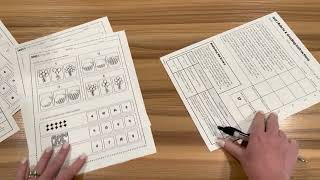
All right, let's go over how to utilize and grade the pre- and post-test. For every unit, there is a pre-test and an identical post-test. I would recommend giving the pre-test before you do any of the introduction of the content, any of the worksheets. You give this first, you give the pre-test and then score it. You do all of the worksheets, the entire unit, and then you give the post-test and score it. And then we're going to have our grading sheet to track progress. So let's go through and do this. So let's say The student completed the pretest before they did any of the activities yet. We're gonna now score their work. So based on how they did, I would say, okay, for number 1, it tells you exactly how to score number 1. Let's say they had 3 correct, 1 incorrect. For the section of 2, there's a total score of 3. There's, as you can see, there's 3 different options. They got 1 correct, 2 incorrect. And then on the next page, for number 3, they had 2 correct, 2 incorrect. And then for this section, there are possible 6. They had 3 correct, 3 incorrect. So now we're going to add it all up. So we're going to have 9 over here, and we are going to have— let's see how quick I can do this— 8 over here. So now we have, out of total possible of 17, they had 9 correct. So then you'd go ahead and figure out that percentage. So we don't need to utilize this part quite yet. We already— we can use this to kind of know what to really focus on, like We are— we obviously had quite a bit of errors in all areas, so I would see that we'd be really— we got to work on everything, right? So that was a pretest. We're gonna put that on our data sheet. We're gonna say, okay, I did this on September 1st and the score was a 9 out of 17. I'd probably also put my percentage there. Okay, so I did that on September 1st. Any notes, anything else I would need. So now I'm gonna go ahead and do the post-test. So So the student completed the post-test and now we are going to— you can also circle this up here, circle the post-test. So this was Johnny again, I didn't write his name on the last one, and let's say now it's October 1st, okay? We did exactly a month later. So I'm gonna score his work. So he, let's say on number 1, got 4 correct, 0 incorrect. On number 2, he had 3 correct, 0 incorrect. On number 3, he had, let's say, 3 correct, 1 incorrect. And on number 4, he had 5 correct, 1 incorrect. So now I'm going to score him. He had 2 incorrect, 15 correct. And now this is where the analyzing the errors part is really, really essential, because now you're going to be able to look and see, based on his errors, what do you still need to do? So he didn't have any errors on 1, 1 or 2, so okay, we're good there. He did have errors on 3 and 4. So we know that he still needs to work on identifying the number word for a number or quantity. And now there's a list of suggested activities. You wanna put this into your lesson plans, into your Curriculum Map, of what you are working on next. You can repeat those sections or utilize some of these suggested activities here. So that part is really important. And now you're gonna come over here to your grading sheet again. I'm gonna put, I did this on 10/1, and his score is 15 out of 17. So we're able to see that growth right there. You could have the percentage again and see the growth over time. So exciting to see this happen for each unit over the course of the year and see that growth happen time and time again.