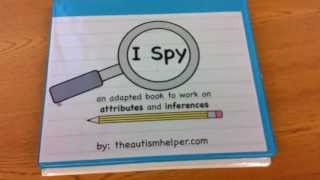
Sasha from theautismhelper.com shows how to make an adapted I Spy book using a binder and page protectors. Each page teaches a different attribute like color, size, or temperature, with mixed response options to prevent kids from just memorizing answers. It works for both teaching and assessing how children recognize and infer attributes.
Chapters
Hi, this is Sasha from theautismhelper.com, and this is a video tutorial of I Spy, an adapted book to work on attributes and inferences. So this is a pretty standard adapted book, but I did want to give a quick tutorial just to show how to set up the pictures that will— that are the response options. I actually did not laminate these pages, I just threw them in a binder and then put them in page protectors because I'm a little low on laminating. So this is a great way to save a little bit of laminating, and it's a lot quicker than to set up. So I love the repetition of this book. My little guys were kind of saying that along with me the other day. It was so cute. So each page starts with the same repetition. I spy with my little eye, and then something that is orange. So then there's 4 response options so they can match which is the orange. And they're not all colors. I wanted to make it a little bit trickier. And when I set up the book, I purposefully mixed it up. So I did different attributes kind of scattered around. So I spy with my little eye something that is cold. And so they were kind of mimicking the I Spy with My Little Eyes. We were reading, it was really cute. I spy with my little eye something that is yellow. So there's 4 options for each, and I like this because you can switch it up. They're not going to memorize that the yellow one is always on the right. Like, you'd be surprised how fast some of my kids have memorized file folders because they know where each spot goes and they aren't really learning the skill. So this is nice to really assess the skill. The size ones are tricky because I didn't make the bug any smaller, but obviously Bug's going to be smaller than truck and volcano. So something that is small, something that is square, something that is hat, something that is red, big, green, and circle. So some of these are a little bit easier, but like I said, some of them do require some of that higher-level inferencing, which is sometimes really hard to tell with our kids that have less verbal skills. So this is a nice way to assess that and work on this. This is a video tutorial of I Spy, an adapted book to work on attributes and inferences, by theautismhelper.com.