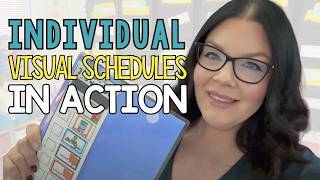
Michelle, a TK-2nd grade autism teacher, shows how individualized visual schedules help her 15 students work independently. She uses a wireless doorbell cue to prompt students to check their schedules instead of asking for help, and demonstrates one student moving through seven center rotations with no verbal prompts needed.
Chapters
These individual visual schedules are how I set my students up for independent success in my self-contained autism classroom. I'm Michelle with The Autism Helper. I'm a TK through 2nd grade self-contained teacher, and this is my classroom. Let me show you how my students use their individual visual schedules during a regular school day. My paraprofessionals and I do not have the time throughout the school day to prompt every student to to check their schedules. So how do we combat that? With this. This is a wireless doorbell, and when my students hear this sound, they know it's time to check their schedule. This year I have 15 students in my classroom, and all 15 of my students are different. Their, their autism is different, so that means their schedules need to be different. Some of my students have simple schedules where they're just moving down an arrow piece when they check their schedule. Other students have icons that they're physically removing from their schedule and matching at each center. Let's take a look at how one of my more impacted students uses his visual schedule throughout our center rotations. We have 7 center rotations in the classroom, and I want you to pay close attention to how we are prompting this student. If you look at the prompt hierarchy, we're using a lot of visual prompting, no verbal prompting for this student. Thank you.
Hands up. Good job.
Go over there. It's in a green bucket.
Yellow. Thank you. Purple tea. Why is he so happy?
Ah, you go. Now this is a new student to my classroom. We've been in school for about 16 days and this is how independent he already is. Just imagine what it's going to look like towards the end of the school year. For more self-contained and autism tips and tricks, like and subscribe to The Autism Helper on YouTube and check out our resources at theautismhelper.com.