Language Arts Leveled Daily Curriculum LEVEL 2 Product Preview
Sasha from theautismhelper.com walks through the Level 2 Language Arts Leveled Daily Curriculum, a structured program for students with autism and emerging language skills. Eight units cover wh-questions, vowels, nouns, synonyms, verbs, blends, and prepositions, each with pre-tests, twenty daily activities, anchor charts, and data-tracking tools. Units take roughly one month each but can be adjusted to individual pace.
Chapters
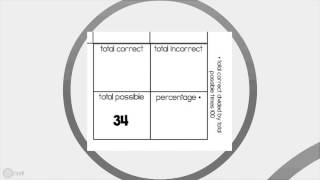
Hi, this is Sasha from theautismhelper.com, and I'm really excited to share with you my Language Arts Levelled Daily Curriculum Level 2. So the Levelled Daily Curriculum is an individualized curriculum created specifically for students with autism and special needs. It can be used with any types of learners and would be great for any types of learners, but it's really specifically designed to meet those visual, visual and structure needs that a lot of our more challenging learners really benefit from. So there's 3 different levels. Level 1 is the most basic foundational levels for those kids that really need the, the emerging skills mastered. Level 2, which we're talking about today, is for your learners that have some language. They're starting to work on academics, but they need to do so in a slow and meaningful way. Level 3 is for our more complex learners that really takes a lot of those cognitive skills to the next level. You can buy the levels separately, or you can buy them as a bundle. Many of us have multi-level classrooms, so having the option of having the 3 levels levels can be really helpful and is money-saving. So today we're gonna focus on Level 2. So again, this is for our students who have emerging academic skills, who have some expressive and receptive language, and just need to work on those skills in a very structured, slow, and meaningful way. This curriculum is perfect for them because it's really structured. It's gonna break down each skill into manageable parts. Instead of trying to tackle parts of speech, it's going to look at each parts of speech in a slow way and make sure each component skill is mastered before moving on to the next one. Students in this level still need some visuals. Receptive language skills might not be so strong, so visuals is going to help them learn these skills more quickly and more concretely. With all levels, assessments are embedded into this curriculum, and this curriculum utilizes data-based decision-making. And I'm going to show you a grading rubric later that's going to knock your socks off. It's going to impress your parents. Your principal and your administrators to see how great you are using their data to plan your future instruction. So Level 2 has 8 units plus a review unit. So ideally this unit can be utilized for one whole year, which means your language arts curriculum is planned for the entire year, which is amazing. So here's the curriculum map. You can print this right out, hand this to your administrators in the start of the year, and they will know exactly what you and your students are working on all year. So some topics that this curriculum focuses on are some communication skills and some academic skills. So in Level 1, we start out with answering who, what, and where questions and the basic sentence formation. Unit 2 looks at vowels, consonants, and increases those sentence skills by adding capital letters and punctuation. Unit 3 and 4 work on short and long vowels. We begin some noun work. 5 and 6 work on synonyms and antonyms, and we add in verbs and adjectives. By Unit 7, we're working on discriminating between nouns, verbs, and adjectives, which is when things can get tricky for our kids. Units 7 and 8 works on reading and spelling words with blends and digraphs, and Unit 8 works— looks at the concepts of different prepositions. So what's included in a unit? Each unit has a pretest and a posttest, which is going to give you that awesome baseline assessment of where your student is prior to beginning any instruction. The posttest is the exciting part that's going to show you exactly how much your student has learned over your time I'm working on this activity. It has the grading rubric that's gonna show all of your data-based decision-making process. It has a visual anchor chart, 20 activities. So ideally, one activity could be done each day of the week, and this unit could take up one month. Again, some of our students need more time or less time, so obviously can be accommodated as needed, but more or less, this unit could take up one month. So with 8 units plus a review unit, again, you're, your language arts planning is done for the whole year. So the pretest and the posttest is gonna target those concepts for each unit. It's gonna be very straightforward and you're gonna be able to see exactly where your student is prior to beginning any instruction. And the posttest is gonna show you all that they learned. So this is the exciting part. I'm such a data nerd and I love, love, love this grading rubric. You're gonna be so impressed. It's gonna really ease all of your planning and your data process. And most importantly, you're gonna be using your data for something instead of it just sitting in a file somewhere. Somewhere. So it has detailed instructions on how you're gonna grade the pretest and the posttest. So you're gonna score the pretest and the posttest and get a final number of total correct and total incorrect. There's also the option to get a percentage. Many of us have IEP goals written as percent, so this will really help you track your IEP goals. Now this is the cool part. On your posttest, you're gonna be able to see exactly what the errors mean, uh, for your students. So the errors will coordinate with certain skills that your students still need to practice, and this will provide suggested activities for your future instruction. There's no need to practice skills that your students have mastered, but your students might still have things that they have weaknesses on. You'll know exactly where to target future instruction by these suggested activities. So you're analyzing your errors, you're using your data to make future curricular planning decisions, which is huge. So there's 8 different anchor charts included. The anchor charts are in color and all of the activities are in black and white, so your printers can thank me. The anchor charts are going to show the 2 to 3 target skills for each unit. I highly recommend having these in your students' binder, posting these in the front of the room. You could project them on a Smartboard each day or pull them up on the iPad. There's a lot of cool things you can do. For some of the skills that might be harder for your kids, like maybe synonyms or antonyms, this is gonna really aid as— this is gonna really function as a matching tool. So your students won't need to necessarily memorize all these synonyms and antonyms, but they'll know where to go reference them to find out the answer. And soon independence will emerge, which is what we want to see. So here's some of our anchor charts. So Unit 1 focuses on those tricky wh- questions. And they look at the basic components of a sentence. And then Unit 5 jumps up to synonyms and shows a bunch of different examples. So again, your students will be able to use this as a matching tool when completing the activities. Unit 8 looks at words that have digraphs. These can be tricky for spelling and reading for some of our kids, and also looks at the concepts of prepositions. So the 20 different activities, like I said, are all black and white, which is gonna make printing this and setting this up a lot easier. So 20 different activities, one for each day of the week, can take up one whole month, which is awesome. Each unit has a bunch of different activities from the focus topics, but it also pulls in activities from previous units. So maybe in Unit 5 you'll see some activities from Unit 2 and 3. So to make sure our students still have those previously mastered skills fully mastered and get some extra practice on those. These activities are still visual because our students still need some visual cues, and the activities are interactive. And they change, so it'll keep your students on their toes and make sure you're assessing these skills in a multitude of ways. So here's some examples of some of the activities. So who is this unit for? Again, we've talked about this, but this is for students beginning to work on basic academics. It's those— it's perfect for students with emerging verbal and writing skills. So students that need to work on those basics of creating a sentence and answering questions. This unit is great for early childhood because it focuses on those foundational academic tasks. So you might be thinking, see, reading, seeing some of these things and thinking this could be good for some of my kids, but maybe it's a little too tricky. So really you can adapt this unit for lots of types of learners. You can add in some writing prompts by getting them started on some of these options or writing in response options. The anchor chart is key for adapting this unit because you can use this as a matching task. Instead of your students always figuring out their own verbs, they can reference the anchor chart and copy verbs from there. And again, this will lead to independence, and soon they will be doing it on their own. Again, you can work on these skills more slowly. You don't need a unit to take a month. You can have it take 2 or 3 months and really take the time to ensure that your students are mastering the skills. So let's check out what else is included in this unit. So there's also a grading data sheet. This will guide your instruction for the entire curriculum. It'll— you— here's where you'll keep track of those pretest and posttest scores, which is going to be really exciting to see how much your students have grown and make you feel really proud of yourself as a teacher. Then we have our unit data sheet. So this is gonna be your daily data sheet where you'll put what activity you're working on, how many they got correct, incorrect, and maybe how many prompts they needed. So this will guide your data for the entire length of each unit. And then there's different lesson plan templates: a whole class weekly lesson plan and a whole class daily lesson plan. Many administrators in schools require lesson plans, so this is gonna help align this curriculum exactly with the needs of your school. So thank you so much for checking out our Language Arts Level Daily Curriculum Level 2. Be sure to check out Level 1 and 3 and consider buying the bundle if you have a multi-level classroom because this will be so helpful to have curriculum for all of your learners. I am beyond excited for this. I've been working on this for months. I didn't teach summer school or do anything else this summer because I've been only working on this. And I can't wait to have my entire year planned and ready to go. Math curriculum is on the way. It's almost finished, so please be on the lookout for that. Thanks so much!










