Language Arts Leveled Daily Curriculum Level 0.5 Video Preview
Sasha from theautismhelper.com previews a language arts curriculum for emerging writers with limited fine-motor or language skills. Eight units pair tracing, matching, and vocabulary work with daily data tracking. Each concept repeats across two units to build mastery.
Chapters
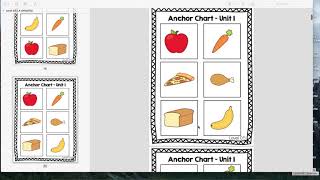
Hi, this is Sasha from theautismhelper.com, and this is a product preview of my language arts level daily curriculum, Level 0.5. So I want to explain in depth the reason I set things up a certain way, because I kind of— I spent a lot of time brainstorming exactly the structure of this resource. I had a lot of requests for something that was easier than Level 1 for kids that really had no writing skills, were emerging writers that needed to build vocabulary and just build up these basic skills. So the structure is the same as the other units with some important tweaks. So in the unit data sheet, we have spots for the date, spot for the page, and then there's 3 things we're gonna look at with each day that you're working on this. There's tracing activities on every page. It increases in level difficulty from tracing lines and shapes to letters. So there are some directions to track the prompting level. There's a matching activity on every page. You can track how many correct out of how many. Some pages have maybe 3 or maybe 2. So you want to know how many they're getting correct out of how many. And then vocabulary. So the vocabulary isn't included on the worksheet, but it is on the anchor charts, and there's a spot for the data on the worksheet. So you can still stay really streamlined, work on one page a day, and then when the student is done with the page, you'll be able to take that data and then transfer it onto here. So be able to get a total view of how you're progressing throughout the unit. Um, so I'm going to explain that vocabulary system in a minute. So here is the curriculum map. There's 8 units, but instead, a little bit different from the other levels, we're going to work on each concept for 2 units. Um, kids that are at this level are just going to need a little bit extra practice and a little bit longer than maybe just 20 activities, so I wanted to give, um, purposefully those extra worksheets and extra opportunities to build these skills. So as far as tracing, the order progression here is first working on tracing lines and shapes, then uppercase letters, then lowercase letters, and then upper and lower together. For matching, we're working matching out of a field of 4, then matching out of a field of 6, and then we go to non-identical matching out of a field of 4, and then out of a field of 6. Um, so the vocabulary pages, a little bit different than the other, um, levels as well. So these are going to be our vocabulary. This is where we're going to work on identifying or saying the words. I purposefully included 5 versions of each one because I don't want students to memorize the order. So if we only worked with this page, a student might just memorize that whenever I say apple, they point to the upper right-hand corner, not pointing to the red circle. So my recommendation would be to put all of these into one page protector. So I explain this in detail here, but it's put all in one page protector so you can be constantly switching it up. I also give some details on how to mix up your teaching clue cues and really build generalization in your instruction. So you have these different 5 pages that you will use for either expressive or receptive vocabulary building. So that means your students who are nonverbal can easily use this unit, and they should. They should be learning receptive language, learning to identify the words as you say them, and building here. So our pretest and our posttest, just like the other units, and our grading rubric. So here's an example of what a worksheet would look like. There's a matching activity, a tracing activity, and then down here— this isn't for the student, this is for you— So you're gonna put how many trials you're doing of vocabulary building, how many correct, how many incorrect. I give really thorough instructions on how to use this. So each day the student will do this part. You'll likely be working with the student. If maybe if they're doing it independently, then they can come to you and you'll do this together. And then you can transfer this to that data sheet to see that overall growth, or if a paraprofessional is doing it, you can kind of check in that way. So Unit 1 and Unit 2 are tracing lines and shapes. So I'm gonna kind of slowly go through this so you can see. Everything's a lot bigger. There's there's a lot more room. So this is for students who are building those fine motor skills and just need a bigger area to work with. And it increases in difficulty. So we had more basic lines and shapes and things get a little more complicated and smaller shapes in this unit. So even though it's the same concept for 2 units, it is building in difficulty throughout the 2. And then matching is out of a field of 4, sometimes smaller than that, building in difficulty in there as well. So that's Units 1 and 2. So the vocabulary changes every unit. I tried to pick vocabulary that was really functional, really important to learn, and kind of the 6 top vocabulary items in each one. So pre-test, post-test, then we get to uppercase letters. So we have a variety of types of ways to practice tracing uppercase letters and then matching out of a field of 6. And matching is used with a lot of different items because we really want to build in that generalization as well. The next vocabulary set here is like, I call Rec Leisure. So we have some technology items and some toys, and we're still working on that uppercase and matching out of a field of 6. And again, looking at here, it looks pretty small, but when you print, these letters are actually pretty sizable, which is nice again for our kids that need that bigger tracing option. Unit 5 looks at household vocabulary, and then we get on to lowercase letters. So same structure. It's really important not to have a ton of variety because we want to be consistent and we want to just switch out that content, not the structure of the activities. Then we have some community vocabulary, some more lowercase, and then non-identical matching. So in this section, we're matching a banana to a banana, a backpack to a backpack, but the pictures aren't identical. This is really important. I think sometimes we focus too much on identical matching and we don't build up that non-identical matching. There's a lot of examples of that right here. And then we have some school supply vocabulary. We're— then we're working on upper and lowercase together, so intermixed, and that non-identical matching out of a field of 6. So it really gradually builds in complexity, but it does. And you'll notice even within from Unit 7 to Unit 8, the letters get a little bit smaller, they get a little bit close together, but it's going to happen really gradually to really allow to build on those skills. So there's Unit 8 and then the 9th review unit with a little bit from all the other units, and that's it. So if you have been loving the other curriculum sets but needed something more specific for your kids that needed extra practice, needed more space, are struggling with language, are struggling with fine motor skills, I really hope you enjoy this. It's really detailed instructions, and again, on how to utilize these vocabulary anchor charts, and I hope that this is successful for you and your kids. Thanks!










